
For an initial Aiphone budget, Swiftlane’s general video-intercom guide uses $1,000 to $7,000 or more per entry door and $5,000 to $50,000 or more for multifamily projects. These are market planning benchmarks from another intercom provider, not a measured Aiphone installed-price range or our quote. The exact price depends on how many entrances you cover, how many stations you need, and whether you choose an IP or analog system. Aiphone does not publish prices and sells only through dealers, so a buyer cannot get a real number from the manufacturer’s own site. At Safe and Sound Security, we design and install Aiphone intercoms for commercial and government facilities nationwide, and we have installed Aiphone systems for more than 20 organizations since 2018. This guide breaks down the price by Aiphone series, what drives your total, and the installed and integration costs that hardware list prices leave out.
Key Takeaways
- Use a scoped benchmark before a firm quote. Swiftlane’s general video-intercom guide uses $1,000 to $7,000 or more per entry door; its full-project range is $5,000 to $50,000 or more for multifamily properties. Aiphone station count and wiring determine whether those benchmarks fit.
- Equipment prices are not installed prices. Aiphone publishes no installation cost, and labor is quoted separately for each site.
- Price scales with entrances and stations. You pay per door station and per tenant or master station, so a 4-unit building and a 200-unit building are very different jobs.
- IP series cost more per station than analog but scale to thousands of units and integrate with access control and cameras. Analog is cheaper for small or retrofit jobs.
- Aiphone hardware is a one-time purchase with no mandatory per-user fee, which is the real cost advantage over cloud intercoms that charge monthly. The one exception is Aiphone’s optional cloud service.
- Integration is a separate cost line. Tying the intercom into access control and video is where a commercial budget grows, and it is the part generic pricing pages skip.
What an Aiphone Intercom Costs (Installed)
Swiftlane’s general video-intercom guide gives $1,000 to $7,000 or more per entry door as a preliminary market benchmark. It does not establish an Aiphone-specific price. That figure includes the hardware and the labor to mount, wire, program, and test it. The wide range exists because a single audio door station at a small office and a video entrance station tied into access control at a hospital are not the same job.
The following general intercom benchmarks are reported by Swiftlane, as retrieved November 14, 2026. They are not Aiphone quotes:
| Project scope | Typical installed cost | What it covers |
|---|---|---|
| Single entrance, small property | $1,000 to $5,000 | One door station, one or two answering stations, basic wiring |
| Mid-size multifamily | $5,000 to $30,000 | One or two entrances, in-unit or in-office stations, mobile answering |
| Mid-size multifamily retrofit | $8,500 to $34,000 | One to two entrances, video, mobile, door release, admin setup |
| Large, mixed-use, or multi-site | $30,000 to $50,000 or more | Multiple entrances, access control, visitor management, integration |
Sources: Swiftlane’s video-intercom guide and apartment installation guide, retrieved November 14, 2026. Scope: general multifamily/video-intercom planning, not Aiphone-specific installed pricing. Hardware and installation are included; recurring subscriptions are separate unless the quoted scope states otherwise.
Cost per door is the cleanest way to budget an intercom project. Multiply your total entrances by the installed per-door range and you have a working estimate before any quote. A building with four controlled entrances at $3,000 per door is roughly a $12,000 hardware-and-labor project, before any access control or camera integration. For general, brand-agnostic install detail, see our guide to intercom installation cost.

The reason you cannot shortcut this with a list price is simple: Aiphone sells through dealers and distributors, not direct, and it does not publish installation costs anywhere. Hardware is only part of the number, and the labor half is always site-specific.
Aiphone Price by Series
Aiphone prices its intercoms per station, and the right series depends on your building type and whether you need IP or analog. Representative equipment-only prices for each current series are listed here, as street and catalog prices rather than installed prices, and they change with dealer discounts.
| Series | Best for | IP or analog | Representative equipment price (2026) |
|---|---|---|---|
| GT | Multi-tenant residential and mixed-use entrances | Analog (IP options) | Entry kits about $1,000 to $5,600 |
| JO | Small office or single-entry with a mobile app | Analog | Stations about $400 to $800 |
| JV | Basic residential video entry | Analog | Video kits about $540 |
| JP | Larger wired video properties | Analog | Master and sub-stations about $900 to $2,100 |
| IX | Commercial and campus IP video | IP | Master stations $1,100 to $1,870; video door stations $850 to $1,520 |
| IXG | Multi-tenant IP video at scale | IP | Tenant stations $440 to $740; guard and entrance stations cost more |
Equipment-only reference ranges reported in ButterflyMX’s Aiphone review and Swiftlane’s Aiphone review, retrieved November 14, 2026. These competitor-authored guides are indicative rather than Aiphone tariffs or purchase offers. Confirm the exact SKU and current dealer price; installation is excluded.
The GT series fits multi-tenant residential and mixed-use buildings that want a wired or hybrid system with a station in each unit. It scales from a single-family kit to a 16-apartment entrance panel, which is why entry kits start near $1,000 and climb toward $5,600 for multi-unit configurations.
The JO series suits a small office or a single entrance that wants a mobile app without moving to full IP. It is one of Aiphone’s more affordable lines, with stations running about $400 to $800.
The JP series handles larger wired video properties that need more answering stations than a JO system supports, with master and sub-master stations running roughly $900 to $2,100 each.
The IX series is Aiphone’s commercial and campus IP line. It runs over your network, integrates with access control and cameras, and has model-specific station and network limits that should be checked in Aiphone’s current system design documentation, so it fits offices, schools, and campuses. Expect $1,100 to $1,870 for a master station and $850 to $1,520 for a video door station at street prices. Confirm the current mobile-answering route and gateway for the selected IX or IXG configuration; a legacy app’s status does not establish current capability.
The IXG series is the multi-tenant IP option for apartment and mixed-use buildings that want thousands of tenant stations plus full mobile answering. Tenant stations run $440 to $740, with guard stations and IP entrance panels costing more, especially when an entrance station includes a card reader.
For the full product lineup and capability detail, Aiphone’s own IX and IXG series product page is the manufacturer reference. To match a series to your building and get real pricing, our team works through it as an Aiphone dealer and installer.
What Drives Your Aiphone Intercom Cost
Six factors move an Aiphone quote more than anything else, and none of them show up on a hardware price list. Understanding them tells you why two buildings of the same size can get very different numbers.
Number of entrances and stations. Aiphone prices per station, so your cost tracks the count directly. Every controlled entrance needs a door station, and each answering unit, office or guard post needs a supported endpoint. Depending on the system and configuration, that can be a compatible app or a physical answering station. A two-entrance office with ten answering stations is a bigger order than a single-entrance shop with one.
IP versus analog. IP series like IX and IXG cost more per station than analog GT or JO systems. You pay that premium for scale, network management, and the ability to integrate with access control and video. For a small building with a few doors, analog is often the better value. For a campus or a multi-site operation, IP earns its cost.
Wiring condition. Aiphone stations need several wired connections for audio, video, and power, while IP stations run on PoE over Cat5e or Cat6 cable. New construction lets us wire cleanly from the start. A retrofit depends on whether the existing low-voltage or network cabling is usable. Reusing viable wiring cuts labor significantly, while a full rewire adds to it. We handle this cabling in-house, which keeps the structured cabling and the intercom under one contractor.
Integration scope. Connecting the intercom to access control, cameras, or a phone system adds engineering and licensing cost. This is the single most overlooked line in a commercial intercom budget, and it often adds thousands of dollars to a project.
Labor. Aiphone publishes no installation price. Labor is quoted per site and depends on access, cable runs, mounting surfaces, and system size. According to industry pricing guides, install time ranges from one to two hours for a basic unit to multiple days or weeks for a large GT or IXG multi-tenant system.
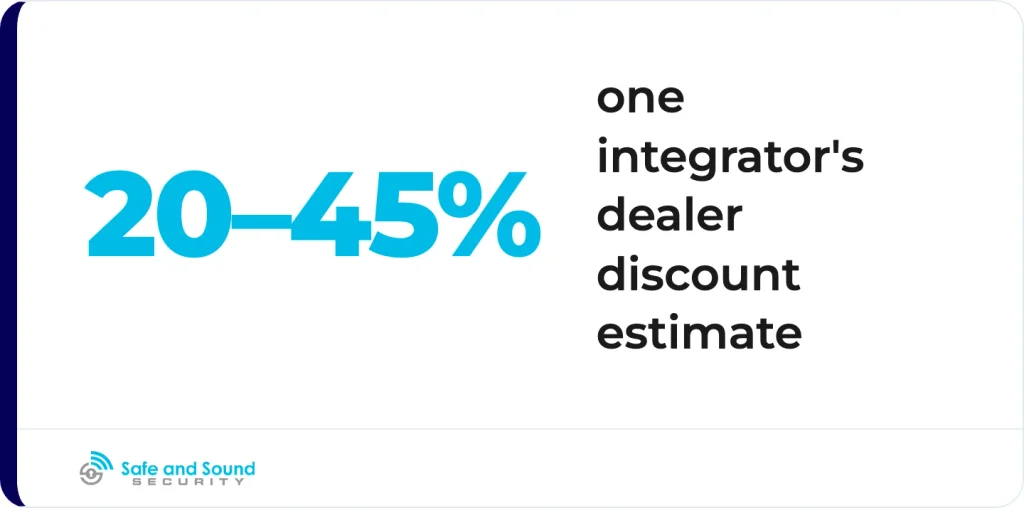
Dealer pricing. Aiphone sells only through dealers and distributors, and Forbel’s published intercom comparison reports dealer discounts of 20 to 45 percent off MSRP. That is one integrator’s estimate, not a guaranteed discount schedule. That is why the same model shows different prices across catalogs, and why a quote from a certified installer reflects real project pricing rather than retail.
Installation Cost: Why Hardware Is Only Part of the Price
Installation is a separate cost that Aiphone never publishes, and it often matches or exceeds the hardware on a commercial job. When you read a street price for an IX master station, that number does not include mounting, cabling, programming, or testing.
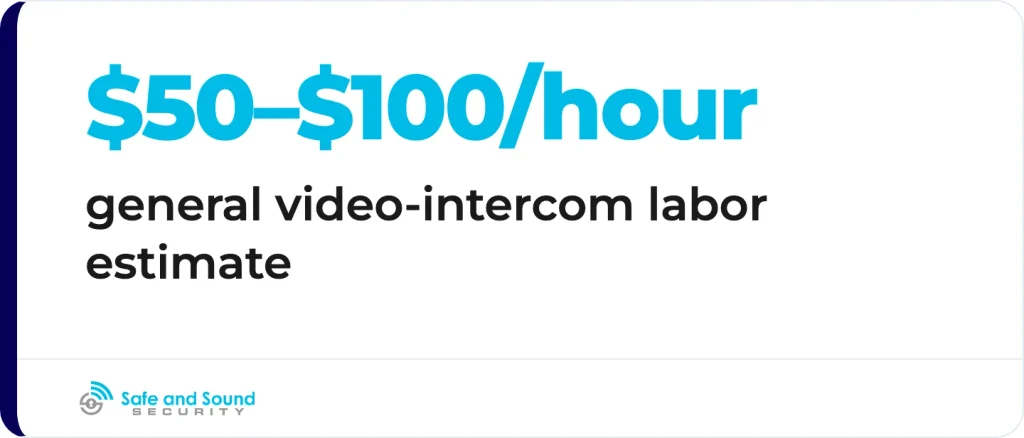
Swiftlane’s general video-intercom guide gives a labor planning rate of $50 to $100 per hour, with a full job taking anywhere from a single day to several days depending on scope. A basic single-door unit can go in within a couple of hours. A multi-tenant IXG system with dozens of stations, a guard post, and door release can take days or weeks, because every station needs its wired connections pulled, terminated, mounted, and programmed.
This is also why self-installation rarely works for a commercial system. Each station requires several wired connections, the programming is not casual, and a mistake on an entrance station is a security gap, not just an inconvenience. A certified installer prices the labor into a single quote so you see the full cost before any work starts.
One-Time vs Recurring Cost
Aiphone’s core systems are a one-time hardware purchase with no mandatory per-user or per-call fee. This can reduce recurring software spending, but compare complete hardware, installation, service and support quotes over the same term before deciding which system costs less. Once the hardware is bought and installed, the base system keeps working without a subscription.
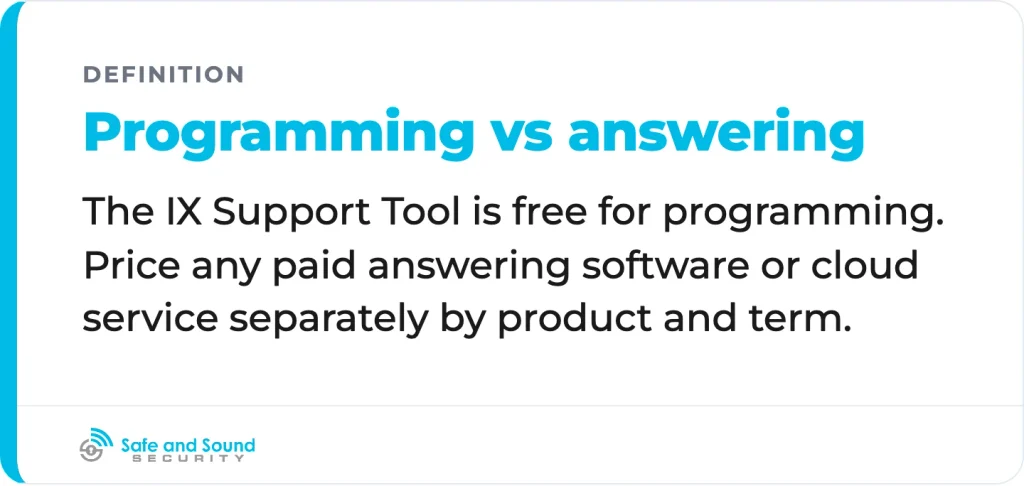
The IX Support Tool used to program the system is available free from Aiphone. Do not confuse it with paid PC answering-station software or a licensed cloud service. If the design includes mobile answering, a cloud gateway, cellular connectivity or another paid feature, list the exact service, term and charge separately in the quote.
Recurring fees are one part of total cost. Compare the complete hardware, installation, connectivity, paid answering or cloud features and support over the same five- or ten-year term. Lower recurring software spending alone does not establish a lower project total. Aiphone’s current US policy lists a five-year limited bench warranty for IX/IXG, JO, JP and JV Series. Other products and purchase conditions differ, and bench coverage is not a promise of free on-site labor. If a recurring-fee model fits your operation better, we also install cloud intercoms like ButterflyMX and 2N, so the choice stays about fit, not lock-in.
Integration Costs: Aiphone With Access Control and Cameras
Integration is where a commercial intercom budget grows, and it is the cost line generic pricing pages ignore. Aiphone’s IP intercoms support SIP and ONVIF, which lets them connect with access control, IP cameras, and phone systems rather than running as an island. ONVIF Profile C specifically covers door access control and event management, which is the standard that lets an intercom and a card-access system talk to each other.
That capability has a price. Most video and access systems do not integrate out of the box. When an integration is supported, it typically costs thousands of dollars; when it requires custom development, it can run into tens of thousands, according to industry integration research from IPVM. Budget for it as a real line item, not an afterthought.
What integration buys is a single system instead of three separate ones. A visitor presses the entrance station, the call routes to a phone or mobile app, the staff member sees live video, and one tap releases the door and logs the event in the access control system. We design the intercom alongside the access control and security cameras so the integration is planned from the start, including platforms like Brivo that pair with Aiphone entrances. That is cheaper and cleaner than bolting systems together after the fact.

Replacing or Upgrading an Existing Intercom
Replacing an old intercom costs less than a brand-new installation when the existing wiring is reusable. The biggest variable in a replacement is whether we can keep the cable already in the walls. If the existing low-voltage or network wiring is in good condition and routed correctly, we reuse it and the job becomes mostly hardware plus a shorter labor window. If the wiring is failing or wrong for the new system, the rewire drives the cost back up toward a new-construction number.
Buildings running a legacy intercom line should plan ahead. When a manufacturer stops making parts for an older platform, a facility on that hardware should budget for a migration to a current IP system rather than a like-for-like swap. Moving from an old analog system to Aiphone’s IX or IXG line also adds capability, from mobile answering to access control integration, so the upgrade often pays back in function.
A straight head-unit swap, where only the answering station or entrance panel changes and the wiring and infrastructure stay, is the lowest-cost scenario. A full system replacement with new wiring and new stations approaches the cost of a first-time install.
Aiphone Intercom Cost by Property Type
Your building type changes both the series you need and the total you pay. The same per-door range applies, but the station count and integration needs differ sharply across property types.
Apartments and multi-tenant buildings scale with the required answering endpoints. A unit may use a compatible app or an in-unit station, depending on the selected system and configuration. A small building might use a GT system for a few thousand dollars installed, while a large complex on an IXG system with mobile answering and multiple entrances reaches the upper project ranges. Separate mobile-answering requirements from any in-unit hardware and cabling before multiplying a per-unit allowance.
Offices and commercial buildings usually center on an IX system at one or two main entrances, tied into access control so staff can see and admit visitors from their desks or phones. Here the cost is less about station count and more about integration depth.
Schools and campuses are a core use case for Aiphone, and in our experience it is a common specification in school security projects for its lockdown and emergency features and its ability to support thousands of stations across a campus. A school intercom budget should account for multiple buildings, classroom and office stations, and integration with mass notification and access control. We handle this work regularly for both commercial and school security and government clients, which carry different procurement and compliance needs than a private commercial buyer.
Large and mixed-use properties combine several of the above, with multiple entrances, visitor management, and integration into a full security system. These land at the top of the project range and benefit most from a single contractor coordinating the intercom, access control, cabling, and cameras together.
How Safe and Sound Security Prices and Installs Aiphone
We provide a fixed quote after a site assessment, so you see the full cost before any work starts. The assessment is where the real number comes from, because it measures the things that move an Aiphone quote: entrance count, station count, wiring condition, and integration scope. We have installed Aiphone equipment for more than 20 commercial and institutional customers across 30-plus signed projects since 2018, from single-entrance offices to multi-building sites.
A clear Aiphone quote separates four things, and you should expect to see each one itemized:
- Hardware. The door stations, answering stations, and accessories by model and quantity.
- Labor. The installation and programming, priced for your site rather than a flat rate.
- Software or cloud. Any one-time license or optional cloud subscription, stated up front.
- Integration hardware. Any controllers, modules, or wiring needed to tie the intercom into access control or cameras.
Because we handle the intercom, the access control, the cameras, and the cabling in-house under one contractor, the integration is designed in from the start instead of coordinated across vendors after the fact. That is the part of an Aiphone project where costs usually hide, and planning it early is what keeps a commercial or government budget predictable. A site assessment turns these variables into a firm number for your building.
Frequently Asked Questions
How much does an Aiphone intercom cost?
For preliminary planning, Swiftlane’s general video-intercom benchmark is $1,000 to $7,000 or more per entry door and $5,000 to $50,000 or more for multifamily projects. These are not Aiphone-specific installed prices. Aiphone station counts, wiring and integration determine the actual scope. Equipment alone is cheaper, but Aiphone publishes no installation price, so labor is always quoted separately per site.
How much does an Aiphone intercom system cost for a school?
A campus must be budgeted from its building, entrance and answering-station counts plus integration and cabling. The $8,500 to $34,000 benchmark above describes a mid-size multifamily retrofit; it is not a school price range. Aiphone’s IX and IXG lines are common in school projects because one system can support thousands of stations and includes lockdown and emergency features. The exact cost depends on building count, entrances, and how much integration the district or school requires.
Does Aiphone charge monthly or subscription fees?
Aiphone’s core systems are a one-time hardware purchase with no mandatory per-user or per-call fee, which is a key cost advantage over cloud intercoms that bill monthly. The IX Support Tool programming download is free. Paid PC answering software, cloud connectivity or licensed features are separate products; identify each by SKU, term and charge in the quote.
How much does it cost to replace an intercom system?
Replacing an intercom costs less than a new installation when the existing wiring can be reused, often dropping the job to mostly hardware plus a shorter labor window. If the wiring is failing or wrong for the new system, a rewire pushes the cost back toward a new-install number. A simple answering-station or entrance-panel swap is the cheapest case, while a full system and wiring replacement is the most expensive.
Which Aiphone series is right for my building?
Match the series to your building type and whether you need IP. GT suits multi-tenant residential, JO fits a small office or single entrance, JP handles larger wired video properties, and the IP-based IX and IXG lines fit commercial buildings, campuses, and large multi-tenant properties that need integration and scale. A site assessment is the reliable way to confirm the fit and the station count before you budget.
The Bottom Line
Use the general video-intercom benchmark of $1,000 to $7,000 or more per entry door as an initial planning lens, then build the Aiphone quote from actual stations, cabling, software and labor. The $5,000 to $50,000 or more full-project range above comes from multifamily guidance, rather than a measured commercial or school Aiphone range. The hardware price by series is only half the picture: labor, wiring condition, and integration with access control and cameras are what decide the real total, and none of them appear on a manufacturer price list. Aiphone’s local-operation model avoids a mandatory per-user fee, but compare the complete hardware, service and support costs before concluding which system costs less over time.
At Safe and Sound Security, we have installed Aiphone intercom systems for more than 20 commercial and government organizations across 30-plus signed projects since 2018, and we price every project with a fixed quote after a site assessment so the full cost is clear before any work begins. To scope your building and get real numbers by series, talk to our team.

