
The four main types of electronic door locks used on commercial doors are magnetic locks, electric strikes, electric cylindrical and mortise locks, and electric push bar locks. Each one locks or releases a door with electricity instead of a mechanical key, and each connects to an access control system that decides who gets in and when.
Electronic locks are grouped two ways: by the hardware that secures the door (the four types above) and by the credential that unlocks it, such as a PIN code, a card or mobile phone, a fingerprint, or a wireless app. Choosing the right lock for a business comes down to the door itself, the security level of the opening, and one decision that outranks any feature: whether the lock should unlock or stay locked when it loses power.
Key Takeaways
- Four hardware types cover most commercial doors: magnetic locks, electric strikes, electric cylindrical and mortise locks, and electric push bar locks.
- Fail-safe versus fail-secure is the decision that drives everything else. Fail-safe unlocks on power loss and belongs on exit paths. Fail-secure stays locked on power loss and protects security-sensitive rooms.
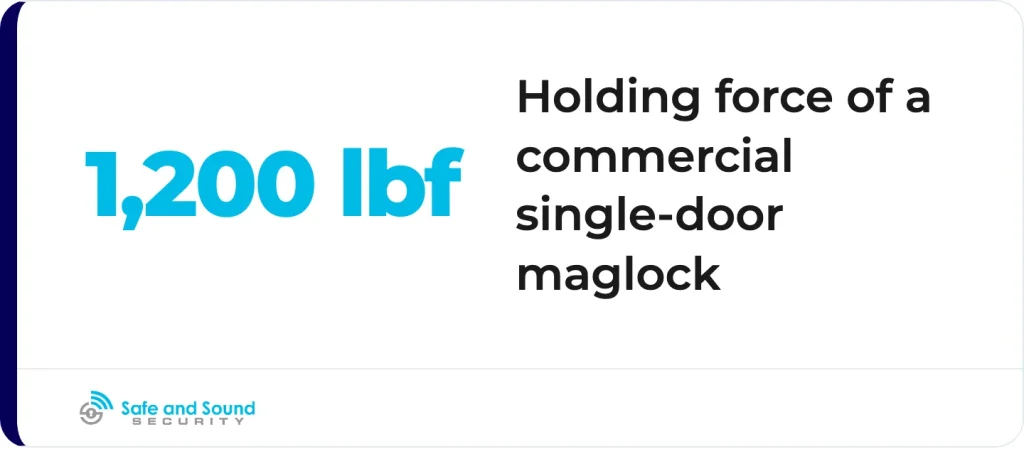
- Magnetic locks hold the hardest. A commercial single-door maglock holds around 1,200 pounds of force, with higher-holding-force models available for high-security openings.
- Egress code governs any electric lock on an exit door. The International Building Code and NFPA 101 require electrically locked egress doors to release on power loss and on fire alarm activation.
- Credentials are separate from hardware. The same door can be unlocked by keypad, card, fob, mobile phone, or fingerprint, depending on the reader paired with the lock.
The 4 Main Types of Electronic Door Locks
Electronic door locks fall into four main hardware types. Each secures the door differently and suits different openings, door materials, and security levels. Here is how magnetic locks, electric strikes, electric cylindrical and mortise locks, and electric push bar locks compare.
| Lock type | How it secures the door | Holding force or fit | Fail-safe or fail-secure | Best suited for |
|---|---|---|---|---|
| Magnetic lock (maglock) | Electromagnet on the frame bonds to an armature plate on the door | Around 1,200 lbf | Fail-safe only | Glass doors, high-traffic entries, perimeter doors |
| Electric strike | Replaces the frame strike plate and releases the existing latch when powered | Matches the existing lockset | Fail-safe or fail-secure | Retrofits, interior offices, server rooms |
| Electric cylindrical or mortise lock | Motorized lockset built into the door, wired to access control | ANSI/BHMA Grade 1 rated | Fail-safe or fail-secure | Wood or metal doors that need a traditional look |
| Electric push bar (exit device) | Surface-mounted bar releases the latch for free exit | Full-width egress hardware | Fail-safe or fail-secure | Emergency exits, stairwells, side and rear doors |
1. Magnetic Locks (Maglocks)
Magnetic locks secure a door with an electromagnet mounted on the frame and a steel armature plate mounted on the door. When the magnet is powered, it bonds to the plate and holds the door shut. A commercial single-door maglock holds around 1,200 pounds of static force, with higher-holding-force models built for high-security openings, according to the Securitron M680E Magnalock datasheet.
Maglocks have no moving parts, so they wear slowly and suit glass storefronts and busy entries where a clean look matters. Every maglock is fail-safe by design: cut the power and the door unlocks. That makes maglocks a natural fit for exit paths, but it also means a maglock on an egress door must tie into the fire alarm and a backup power source so it behaves correctly during an outage or emergency. The maglock installation guide covers wiring and mounting in detail.
2. Electric Strikes
Electric strikes replace the fixed strike plate in the door frame with a powered version that releases the latch when access is granted. The existing lockset and handle stay in place, which makes strikes one of the easiest electronic locks to retrofit onto a door that already has a mechanical lock.
Electric strikes come in both fail-safe and fail-secure versions, so the same hardware can protect a server room that must stay locked on power loss or sit on an exit path that must open. Their low hardware and labor cost makes them a common first step for a business adding access control to interior doors. The electric strike installation guide covers frame prep and power requirements.
3. Electric Cylindrical and Mortise Locks
Electric cylindrical and mortise locks are motorized locksets built into the door itself and wired to the access control system. A mortise lock sits inside a pocket cut into the door edge, while a cylindrical lock mounts through the door face. Both keep the look and feel of a traditional commercial lockset while adding electronic control.
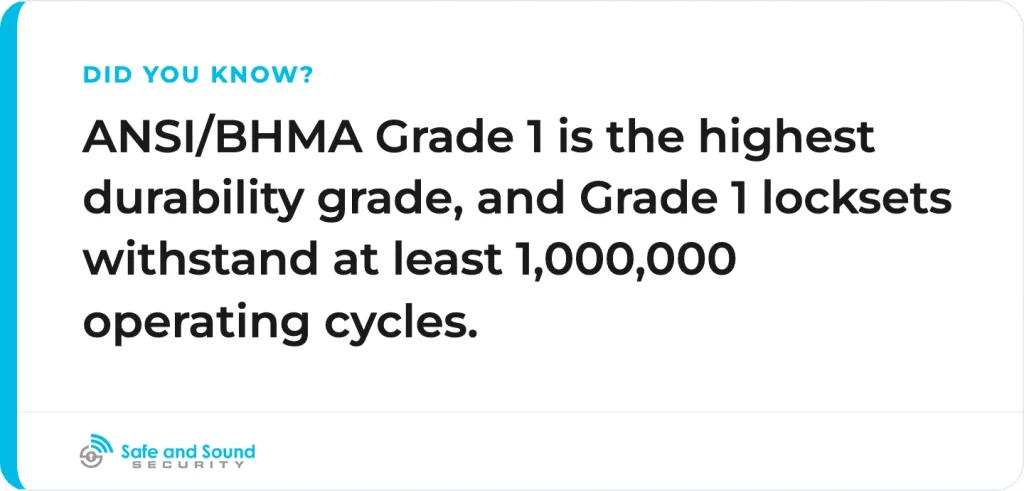
Commercial-grade cylindrical and mortise locks carry an ANSI/BHMA Grade 1 rating, the highest durability grade. Trade-standard testing guidance from The Construction Specifier reports that Grade 1 locksets withstand at least 1,000,000 operating cycles. Both types are available fail-safe or fail-secure. Wiring runs through the door and frame, so these locks are easier to plan into a new door or a full access control installation than to retrofit onto an existing one.
4. Electric Push Bar Locks (Exit Devices)
Electric push bar locks, also called panic bars, crash bars, or exit devices, are surface-mounted bars that let anyone exit by pushing while controlling entry from the outside. They satisfy fire and life-safety codes for emergency egress, which is why they belong on stairwell doors, side exits, and rear doors rather than main entrances.
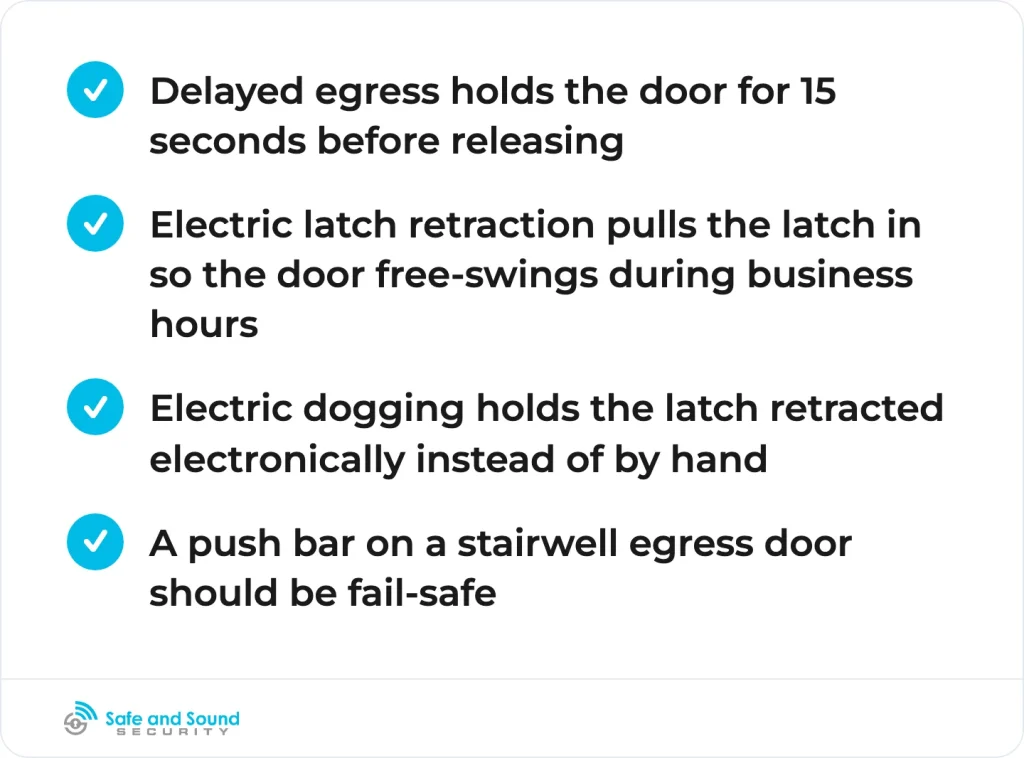
Powered exit devices add features a standard bar cannot. Delayed egress holds the door for 15 seconds before releasing, which slows a theft or a wander-off while still allowing exit. Electric latch retraction pulls the latch in so the door free-swings during business hours. Electric dogging holds the latch retracted electronically instead of by hand. A push bar on a stairwell egress door should be fail-safe. The panic bar installation guide walks through these options.
Electronic Locks by Credential Type
The lock secures the door; the credential decides who opens it. The same electronic lock can pair with several reader types, so a business can standardize on one access control platform and still offer more than one way in.
- Keypad and PIN locks: Users enter a numeric code on a pad. Codes can be scheduled or made single-use for contractors and visitors, and many pads support anti-peek entry that accepts extra decoy digits around the real code.
- Card, fob, and mobile credentials: Proximity cards, key fobs, and phone-based credentials in Apple Wallet or Google Wallet unlock the door with a tap or on approach. These scale best for multi-site businesses because credentials are issued and revoked centrally. The HID access control page covers reader and credential options.
- Biometric locks: Fingerprint, facial, and palm-vein readers verify the person rather than a card they carry, which suits data centers, labs, and other high-security rooms.
- Smart and connected locks: Wi-Fi and Bluetooth locks add remote lock and unlock, activity logs, and app control. Wireless battery locks, such as Salto systems, retrofit doors that are hard to wire, which extends access control across a building door by door without pulling cable to every frame. Consumer ecosystems like Matter and Apple Home Key live in this category too, but commercial buildings run these locks through a managed access control platform, not a home app.
Fail-Safe vs Fail-Secure Locks
Fail-safe and fail-secure describe what an electronic lock does when it loses power. It is the single most important choice when specifying a lock, because it decides whether a door protects people or protects property during an outage.
- Fail-safe: The lock needs power to stay locked, so it unlocks when power is lost. Fail-safe locks belong on exit paths and any door people must get through during an emergency. Magnetic locks are always fail-safe.
- Fail-secure: The lock needs power to unlock, so it stays locked when power is lost. Fail-secure locks protect server rooms, storage, and other doors where security outranks free entry. People inside can still exit by the mechanical lever.
Electric strikes and electric mortise, cylindrical, and push bar locks can be ordered either way. Maglocks cannot, because they are fail-safe only. Match the behavior to the door’s job, then confirm any lock on an exit door meets the egress code requirements for that opening.
Life Safety and Egress Code Requirements
Any electric lock on a door people use to exit is regulated as a special locking arrangement and cannot block egress. Two codes govern this: the International Building Code (IBC) and NFPA 101, the Life Safety Code. Both are enforced by the local authority having jurisdiction.
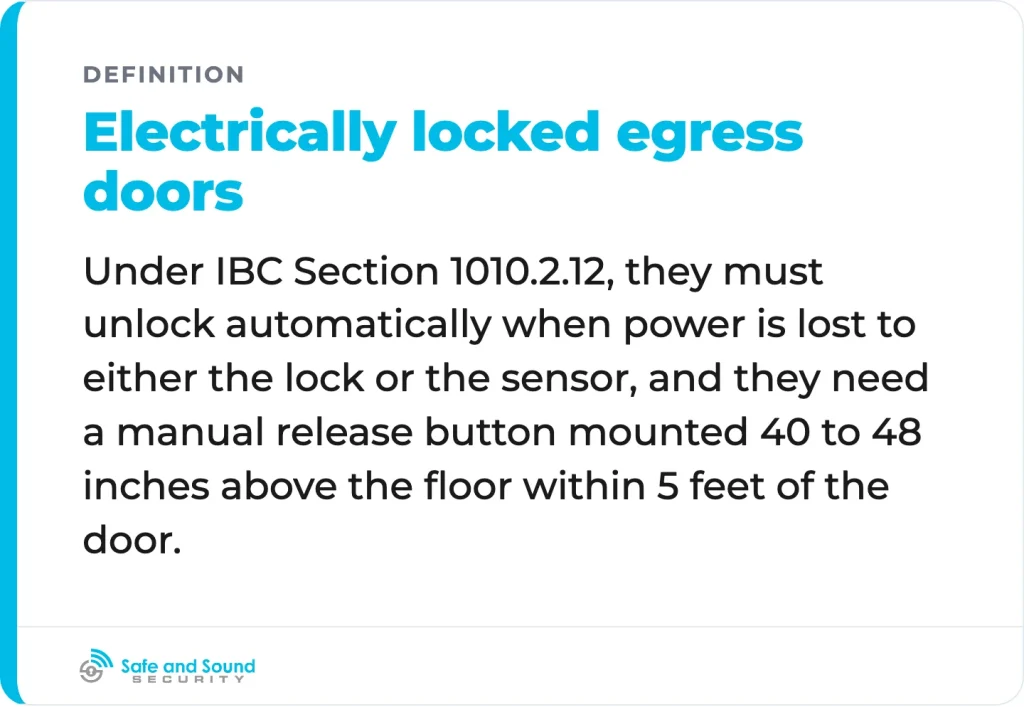
Under IBC Section 1010.2.12, electrically locked egress doors that release on approach must unlock automatically when power is lost to either the lock or the sensor, and they need a manual release button mounted 40 to 48 inches above the floor within 5 feet of the door (International Building Code, Chapter 10). Where a door uses delayed egress, the same code caps the hold at 15 seconds, or 30 seconds where the authority having jurisdiction approves, and the door must release on power loss and on activation of the fire alarm or sprinkler system.
Whichever lock you choose, build in the safeguards code and common sense both require:
- Fire alarm integration: Egress locks release the moment the fire alarm sounds.
- Backup power: Battery backup keeps locks in their intended state through an outage, which matters most at unmanned or remote sites.
- Manual override: A physical key or mechanical lever lets someone out if the electronics fail.
- ADA access: Hardware type and mounting heights meet accessibility requirements for every user.
How to Choose the Right Electronic Lock
Start with the door and the opening, not the feature list. The right electronic lock is the one that matches the door material, the traffic, the security level, and the lock’s required behavior during a power loss. Match the lock to the door type first:
| Door type | Recommended lock types | Why |
|---|---|---|
| Glass doors | Magnetic locks | Clean look, no drilling into the door |
| Wood or metal doors | Electric strikes, mortise, cylindrical | Strong security, traditional appearance |
| Emergency exits | Electric push bars | Code-compliant egress, easy exit |
| High-security rooms | Mortise or fail-secure strikes | Maximum protection, stays locked on power loss |
After the door type, weigh three things: budget, since strikes cost the least to install while mortise locks and biometrics cost more; the credential your team will actually use day to day; and the fail-safe or fail-secure behavior each specific opening needs. For a full walkthrough, see the access control system buyer’s guide.
When to Bring in a Commercial Installer
Electronic locks are only as strong as the access control system and wiring behind them, which is where a commercial integrator earns its keep. A single lock is straightforward, but tying dozens of doors to controllers, readers, credentials, fire alarm release, and backup power across one or many sites is systems work, not hardware swapping.
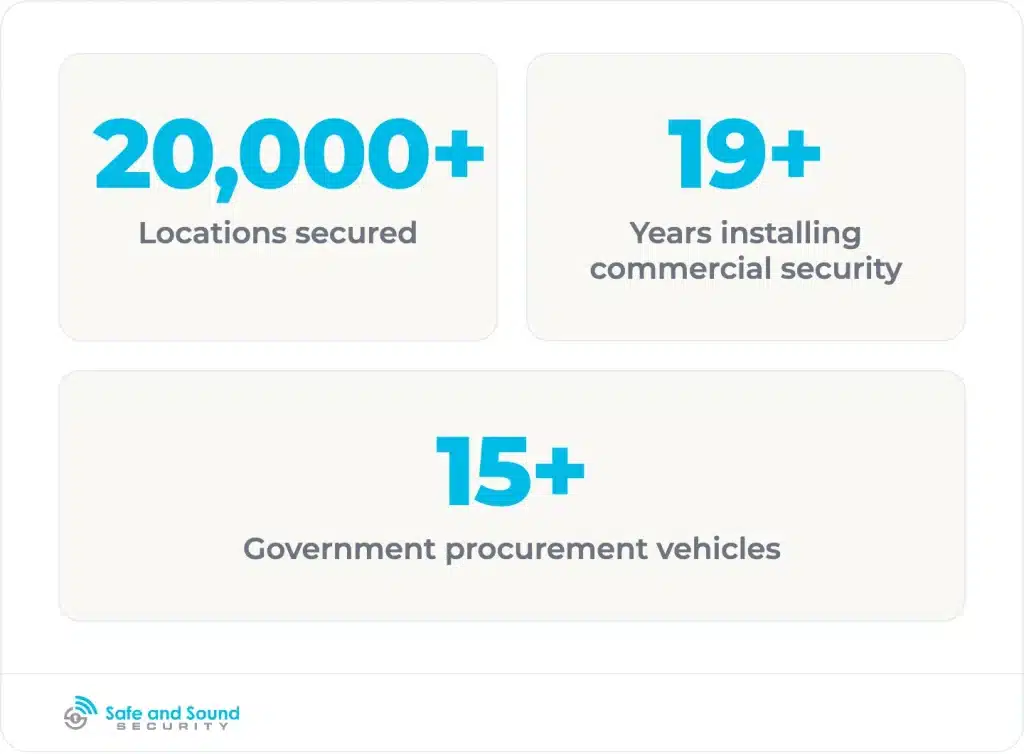
At Safe and Sound Security, we design and install commercial access control systems for businesses and government agencies, from the lock hardware to the readers, controllers, and software that manage them. We work across the platforms our clients specify, including Verkada, Brivo, HID, ASSA ABLOY, and Salto, and we provide NDAA-compliant options for facilities that require them. With 20,000+ locations secured over more than 19 years and approval on 15+ government procurement vehicles, we handle single doors and multi-site rollouts under one contractor. See our access control installation service or our NDAA-compliant options for how we scope a system.
Frequently Asked Questions
What is the most reliable type of electronic door lock?
Magnetic locks and electric strikes are the most reliable electronic locks for commercial use because of their simple, durable designs. Maglocks have no moving parts, and electric strikes reuse the door’s existing latch. For long service life, choose commercial-grade hardware with an ANSI/BHMA Grade 1 rating, which certifies locksets for at least 1,000,000 operating cycles.
What is the difference between a smart lock and an electronic lock?
An electronic lock is any lock that uses electricity to lock or release a door, including commercial magnetic locks, electric strikes, and mortise locks wired to an access control system. A smart lock is a consumer-facing subset that adds Wi-Fi or Bluetooth and a phone app. In a commercial building, electronic locks are managed through a central access control platform rather than a home app, which gives administrators audit logs and remote control across every door.
What happens to electronic door locks during a power outage?
What happens during a power outage depends on whether the lock is fail-safe or fail-secure. A fail-safe lock unlocks when power is lost, keeping exit paths open. A fail-secure lock stays locked, protecting the room until power returns. Commercial systems add battery backup so locks hold their intended state through short outages, and egress doors are required to unlock on power loss under building egress codes.
Are electronic door locks secure?
Electronic door locks are secure when they use encrypted credentials, tamper detection, and a properly designed access control system. Card and mobile credentials can be revoked instantly if lost, unlike a physical key, and every entry is logged. Security depends on the hardware grade, credential type, and installation quality, so commercial-grade components and professional setup matter.
Can electronic door locks be hacked?
Like any connected device, electronic locks can be attacked, but commercial-grade systems reduce the risk with encrypted communication, regular firmware updates, and tamper detection. Cloning-resistant credentials and multi-factor entry protect sensitive areas. Keeping firmware current and following access control best practices closes the most common gaps.
The Bottom Line
The four main types of electronic door locks (magnetic locks, electric strikes, electric cylindrical and mortise locks, and electric push bar locks) each fit a different door and security need. Maglocks hold hardest and suit glass and high-traffic doors. Electric strikes retrofit easily. Mortise and cylindrical locks keep a traditional look. Push bars keep exits code-compliant.
Before the hardware, settle the fail-safe versus fail-secure question for each opening, then confirm every egress door meets the IBC and NFPA 101 release requirements. Get those two decisions right and the rest is fitting the credential to how your team works.
Safe and Sound Security installs commercial electronic door locks and access control systems for businesses, schools, and government facilities nationwide, with NDAA-compliant options and integration across the major access control platforms. If you are planning or upgrading access control, contact our team for a system scoped to your doors.


