
Dated US retailer listings from November 2026 put Hikvision camera hardware from around $60 for an entry model to $900 or more for an advanced PTZ, with many listed commercial 4MP and 8MP models between $150 and $400. These are hardware budget references, not assurances that every listed model is lawfully available for the intended use. A complete multi-camera system with a recorder and storage usually costs $650 to $5,000 or more before installation. For a commercial project, exact-model compliance screening comes before ordering. This guide gives you dated hardware references, installation scope and the federal rules that affect the buying decision.
Key Takeaways
- Individual Hikvision cameras cost about $60 to $900 or more, with most commercial 4MP and 8MP models priced between $150 and $400 as of November 2026.
- A full system costs more than the cameras. Budget cameras, recorder/storage, cabling, mounting, network configuration and installation together. An itemized commercial quote needs your camera count and site conditions.
- Older price lists read low. Hikvision’s US model lineup changes often and current prices sit higher than older guides show, so check current listings before you budget.
- Private-company status is not purchase clearance. Effective July 16, 2026, FCC restrictions reached certain previously authorized covered equipment. Screen the exact model, intended use, authorization and current rules before ordering.
- Hikvision is not NDAA compliant. If your business holds or may pursue government contracts or grants, we recommend a compliant brand instead, and we can help you weigh the trade-off.
Hikvision Camera Prices by Type (2026)
Hikvision camera prices depend mostly on resolution, camera type, and smart features. Entry-level cameras run roughly $60 to $160, mid-range 4MP cameras run $170 to $280, high-resolution 8MP (4K) cameras sit around $220 to $260, PTZ cameras start near $380 and climb past $900, and genuine thermal models need a model-specific quote. Dated US retailer-listed hardware references from November 2026 break down this way:
| Camera type / tier | Example model | Resolution and key feature | Dated retailer-listed hardware reference (Nov 2026) |
|---|---|---|---|
| Entry ColorVu bullet | DS-2CE10HFT-F28 | 5MP, 24/7 full color | $60 to $80 |
| Entry 4MP IP bullet | DS-2CD1043G2-LIUF | 4MP, IR and white light, IP67 | $130 to $160 |
| 2MP AcuSense dome | DS-2CD2123G2-IS | 2MP, AI person and vehicle detection | $80 to $100 |
| 4MP AcuSense dome | DS-2CD2143G2-IU | 4MP, AI, built-in mic, IP67 | $170 to $200 |
| 4MP ColorVu turret | DS-2CD2347G2-LU | 4MP, 24/7 color, AI | $240 to $280 |
| 8MP (4K) AcuSense dome | DS-2CD2183G2-IU | 8MP, WDR, IP67 | $220 to $260 |
| 4MP AI PTZ | DS-2DE4425IW-DE | 4MP, AcuSense, motorized zoom | $380 to $450 |
| AcuSense IR fixed mini bullet | PCI-B15F2S | 5MP visible-light / IR | $227.99 retailer listing |
| 8-channel 4K NVR with storage | DS-7608NI-Q2/8P-2TB | 4K, PoE, 2TB included | $450 to $500 |
| 4-camera kit with recorder | EKI-K41T44 | 4MP turrets plus 4-channel NVR | $650 to $750 |
| Video intercom station | DS-KH6320-WTE1 | 7-inch touchscreen | $350 to $400 |
These are dated retailer-listed hardware references, not assurances of lawful availability for a proposed use. The manufacturer’s AcuSense flyer classifies PCI-B15F2S as a 5MP visible-light/IR fixed mini bullet; a retailer’s thermal label does not change that identity. Confirm the exact SKU, intended use and current authorization before ordering.
Here is how the tiers break down:
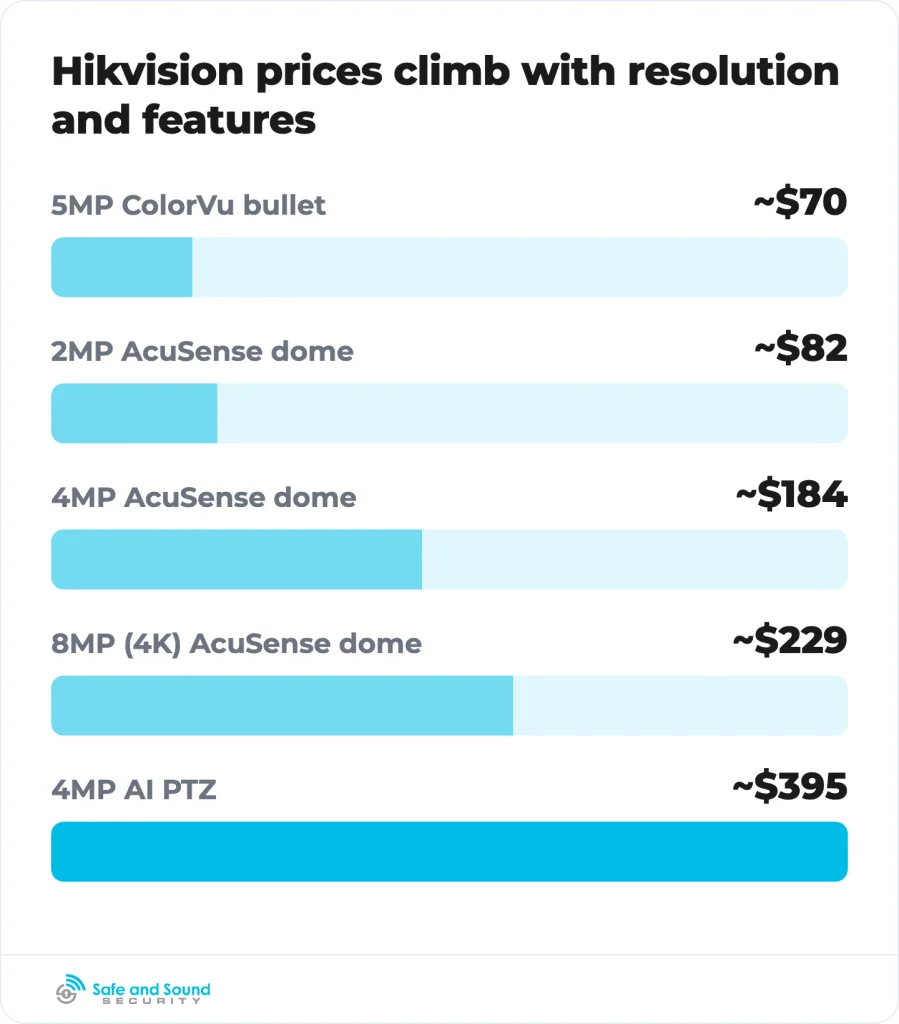
- Entry-level cameras ($60 to $160): Basic bullet and dome cameras, including ColorVu models that capture 24/7 color and the cheapest 2MP AcuSense domes. Good for small retail, offices, and low-risk indoor areas. Examples: the 5MP ColorVu DS-2CE10HFT-F28 around $70 and the 2MP AcuSense dome DS-2CD2123G2-IS around $82.
- Mid-range 4MP cameras ($170 to $280): 4MP domes and turrets with AcuSense AI that separates people and vehicles from false triggers like shadows and animals, plus ColorVu color-at-night models. Most commercial buyers land here. Example: the 4MP AcuSense dome DS-2CD2143G2-IU around $184.
- High-resolution 4K cameras ($220 to $260): 8MP domes and turrets for areas that need detail, such as entrances, parking lots, and points of sale. Example: the 8MP DS-2CD2183G2-IU dome around $229.
- PTZ cameras ($380 and up): Motorized cameras that pan, tilt, and zoom to cover large open areas with one unit. The 4MP AI DS-2DE4425IW-DE runs around $395, and higher-zoom models pass $900.
- Thermal cameras: These read heat signatures. Obtain a quote for a verified thermal model, its required features and the permitted intended use. The PCI-B15F2S listing above is a visible-light/IR AcuSense camera and does not establish a thermal price floor.
- Recorders and complete kits ($450 to $5,000 and up): An 8-channel 4K NVR with 2TB of storage runs about $455. A 4-camera kit with a recorder runs about $650 to $750. Larger multi-camera systems and 16- or 32-channel setups reach several thousand dollars before installation.
What Determines a Hikvision Camera’s Price
Four things move a Hikvision camera’s price the most: resolution, smart features, camera type, and build quality.
- Resolution. Higher megapixels capture more detail but cost more. A 2MP camera is the cheapest, 4MP is the commercial sweet spot, and 8MP (4K) carries a clear premium for the sharper image and the larger storage it needs.
- Smart features. AcuSense AI, which cuts false alarms by telling people and vehicles apart from other motion, and ColorVu, which captures full color at night, both raise the price over a basic model with the same resolution.
- Camera type. Fixed dome and bullet cameras are the most affordable. Turret cameras cost a little more. PTZ and thermal cameras are the most expensive because of their motors and specialized sensors.
- Build quality. Weatherproof and vandal-resistant ratings, such as IP67 and IK10, add cost but are necessary outdoors and in exposed areas.
One more factor is timing. Hikvision’s US model lineup changes often, and current street prices run higher than older price lists show. If you are working from a guide published a year or two ago, expect to pay more than it quotes.
Installation and Total System Cost
The camera is only part of the commercial project budget. Add the recorder and retention storage, mounting, cable runs, PoE switches where needed, configuration, installation and testing. Price those against a defined camera count and site survey. Residential national averages do not establish what a business installation will cost.
Compare a complete commercial scope: cameras, recorder/storage, cabling, mounting, network configuration, installation and testing.
Beyond the cameras and labor, a working system needs a recorder, storage, cabling, and network configuration. The recorder choice alone affects your budget and your footage retention, which is why it pays to understand the difference between an NVR and a DVR before you buy.
Hardware is only one line. A commercial security installer also prices mounting, cabling, the recorder, storage, and network setup, which make up most of a project’s cost. Our commercial security camera installation cost calculator gives a working estimate for your site and camera count.
Buying Hikvision: Authorized Dealer vs Gray Market
Hikvision cameras sold through gray-market channels, such as overseas marketplaces, often look cheaper but carry real risk for a business. Security integrators who work with the hardware consistently report three problems:
- Gray-market units may ship with region-locked firmware that cannot be updated to the US interface or integrated with standard management software.
- Hikvision generally will not service or warranty hardware bought outside its authorized distribution network.
- There is no guaranteed path for security patches, and components can vary from batch to batch.
For these reasons, integrators widely advise against gray-market Hikvision for commercial use. The modest upfront saving rarely covers the support, warranty, and firmware updates you give up. Buying through an authorized channel, or through an installer who sources that way, protects the investment.
Can You Still Buy Hikvision Cameras in the US? (NDAA and FCC Rules)
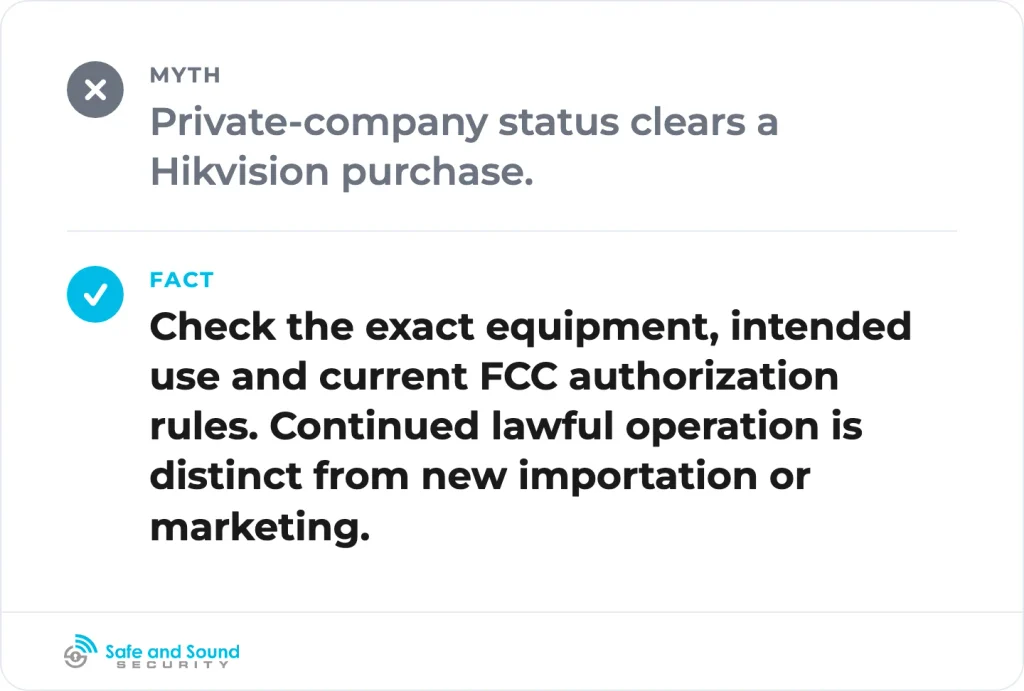
Do not treat private-company status as purchase clearance. Effective July 16, 2026, FCC restrictions reached certain previously authorized covered equipment. Applicability depends on the exact equipment, intended use, authorization and current rules. Continued operation of legally purchased equipment with an existing authorization is distinct from new importation or marketing. Have the supplier or integrator document that the proposed model and use are permitted before ordering.
- Federal procurement, contractor-use and award funds. FAR 52.204-25 addresses covered-equipment procurement and contractor-use restrictions where the clause applies. Separately, 2 CFR 200.216 restricts specified award spending on covered equipment and services. Review the actual contract or award and the proposed equipment. Hikvision is on the federal covered list, alongside Dahua, Huawei, Hytera and ZTE.
- FCC equipment rules. Since November 2022, covered equipment has faced restrictions on new authorizations. The July 6, 2026 Federal Register notice extended importation and marketing restrictions to certain previously authorized covered equipment, effective July 16, 2026. Applicability is equipment- and use-specific; screen the exact model, intended use, authorization and current rules. A retailer listing does not establish permission for a new transaction. The notice distinguishes continued operation of legally purchased equipment that maintains an existing authorization.
- What it means for you. Before ordering, have the supplier or integrator document that the exact equipment and intended use are permitted under current rules. Separately check any federal procurement, contractor-use or award conditions. Continued lawful operation of existing equipment is a different question from new importation or marketing.
If compliance matters now or could matter over the life of the system, an NDAA-compliant brand such as Axis, Avigilon, or Verkada is the safer choice. Compliant hardware generally costs more upfront. For the full compliance picture, see our guide on Hikvision and NDAA compliance.
How to Choose the Right Hikvision Camera for Your Budget
The cheapest camera that covers the risk is the right camera. A few decisions keep the budget honest:
- Match the camera to the risk. High-risk areas like entrances, cash handling, and parking need higher resolution and AI. Low-risk interior spaces can use entry-level models without hurting overall coverage.
- Count coverage, not cameras. One well-placed wide-angle or PTZ camera can replace several fixed cameras. Plan the field of view before you buy on quantity.
- Leave room to grow. Choose a recorder and network that can add cameras later without a rebuild. Paying a little more upfront beats retrofitting in a year.
- Weigh warranty and support. Authorized-channel hardware keeps your warranty and firmware updates intact, which lowers the long-term cost even when the sticker price is higher.
Hikvision Camera Price FAQs
Can you still buy Hikvision cameras in the US?
Private-company status alone does not clear a purchase. Effective July 16, 2026, FCC restrictions reached certain previously authorized covered equipment. Confirm the exact model, intended use, authorization and current rules with the supplier or integrator before ordering. Continued operation of legally purchased equipment with an existing authorization is distinct from new importation or marketing; federal contract and award restrictions are separate checks.
How much does a Hikvision camera cost?
Most individual Hikvision cameras cost between $60 and $900 or more. Entry-level models run $60 to $160, mid-range 4MP cameras run $170 to $280, and 8MP (4K) cameras sit around $220 to $260. PTZ and thermal cameras cost more. A complete system with a recorder and several cameras runs $650 to $5,000 or more before installation.
Are Hikvision cameras any good?
Hikvision cameras are generally well-built and feature-rich for the price. Security integrators rate them a strong value and a step up from consumer brands, though below premium names like Axis. The main cautions are compliance status and a narrowing long-term support path in the US, not image quality.
Why are Hikvision cameras cheaper than Axis or Verkada?
Hikvision manufactures at very large scale with a value-focused lineup, which lets it price below premium brands. The trade-off is NDAA and FCC compliance, since Hikvision is on the federal covered list, plus a US supply and support path that is winding down.
Does the price include installation?
No. The product prices above are hardware-only reference points. A commercial installed quote should itemize the cameras, recorder/storage, cable runs, mounting, PoE/network work, configuration, installation and testing. Compare the same camera count and site conditions, and check that labor is counted once.
Is Hikvision NDAA compliant?
Hikvision is on the federal covered list. Check the applicable federal procurement, contractor-use and award-spending restrictions for the exact project. Private-company status is not an exemption from the separate FCC equipment rules, and continued lawful use of existing equipment must be distinguished from a new purchase.
The Bottom Line
Hikvision remains a lower-cost option in business surveillance, with most commercial cameras priced between $150 and $400 and full systems from about $650 to several thousand dollars before installation. The real budget is the installed system, not the camera sticker price, and the real decision is whether Hikvision fits your compliance situation now and over the life of the system.
At Safe and Sound Security, we are a commercial security installer that works with both Hikvision and NDAA-compliant brands. Since 2018, we have taken on Hikvision camera projects for more than 100 customers. We help organizations price the right system and avoid a compliance mistake they would have to rip out later.
If you are planning a Hikvision install or weighing it against a compliant alternative, contact us for a free consultation, or see our Hikvision installation services to get started.
Sources
- FCC: Covered List
- Acquisition.gov: FAR 52.204-25
- Broadband Breakfast: FCC Moves to Expand Covered-List Equipment Import Restrictions
- HomeAdvisor: Cost to Install Security Cameras
- IP Security Depot: Hikvision DS-2CD1043G2-LIUF
- IP Security Depot: Hikvision DS-2CD2143G2-IU
- IP Security Depot: Hikvision DS-2CD2347G2-LU
- IP Security Depot: Hikvision DS-2CD2183G2-IU
- IP Security Depot: Hikvision DS-2DE4425IW-DE
- IP Security Depot: dated PCI-B15F2S hardware listing
- IP Security Depot: Hikvision DS-7608NI-Q2/8P-2TB
- IP Security Depot: Hikvision EKI-K41T44 Kit
- IP Security Depot: Hikvision DS-KH6320-WTE1
- Planet Security USA: Hikvision DS-2CE10HFT-F28
- Planet Security USA: Hikvision DS-2CD2123G2-IS


