
Correctional facility security systems are integrated networks of electronic door control, video surveillance, perimeter intrusion detection, duress alarms, and contraband defense, all run from a central command center. They exist to protect three groups at the same time: staff inside the walls, inmates in custody, and the public beyond the fence.
The stakes are unlike any other commercial building. Prisoners assault federal prison staff hundreds of times a year, and a single unlocked door can end in an escape. A correctional system has to control every door, survive physical attack, meet federal monitoring rules, and keep custody intact even while it is being upgraded. Safe and Sound Security is a nationwide commercial and government security integrator, with more than 19 years in business and a client base spanning public agencies and multi-site commercial operations. This guide covers the seven subsystems that make up a modern correctional build, the compliance rules that shape it, and how a jail, detention center, or state corrections agency actually buys one.
Key Takeaways
- A correctional security build is seven subsystems working as one: door control, access control, video surveillance, perimeter intrusion detection, duress and officer tracking, contraband defense, and a unified command center. Buying them piecemeal is what leaves the gaps.
- PREA ties your cameras to your staffing plan. Under the federal standard, a blind spot is not just a design flaw. It is a compliance exposure that facilities must document and review every year.
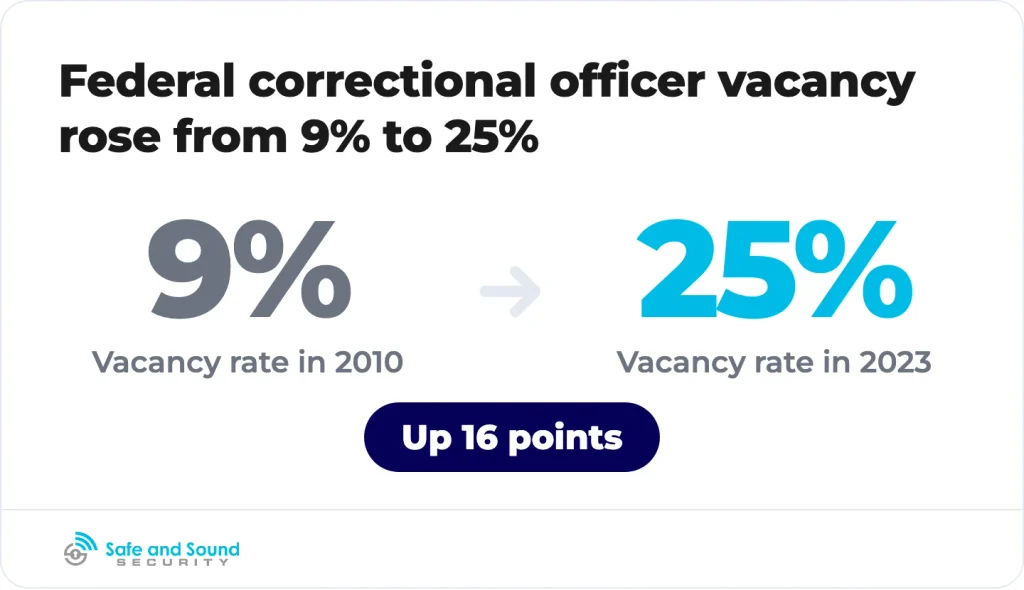
- Officer safety drives the design, not the other way around. Federal correctional officer vacancy climbed from 9% in 2010 to 25% in 2023, per Congressional Research Service data, so automation now covers what thin staffing cannot watch.
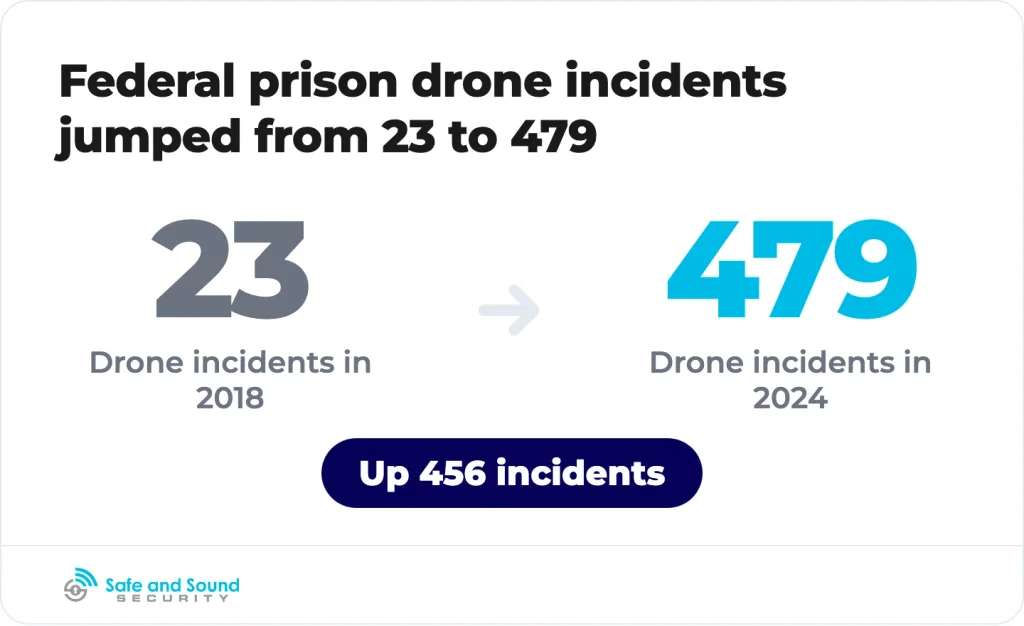
- Drones are the fastest-rising threat. Federal prisons logged 479 drone incidents in 2024, up from 23 in 2018, according to federal testimony reported by Facilities Dive.
- These are custom-bid public projects. Who can legally hold the contract, and whether their equipment is NDAA compliant, matters as much as the hardware itself.
What Are Correctional Facility Security Systems?
Correctional facility security systems are purpose-built networks that control inmate movement, watch every space, defend the perimeter, and protect staff, all coordinated through one command platform. Unlike a standard commercial system, they are engineered for a hostile-use environment where the hardware itself is a target and a single unlocked door can end in an escape or an assault.
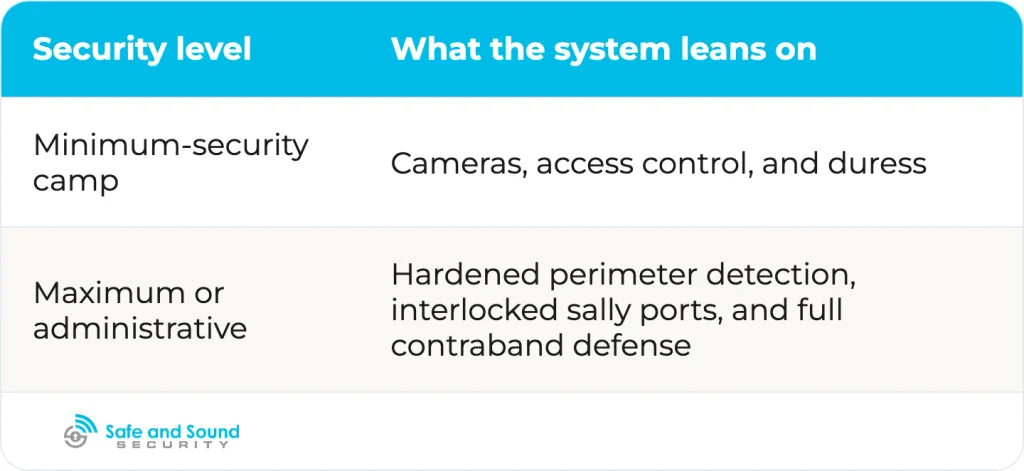
The design scales with the facility’s security level. State prisons are commonly sorted into three levels, minimum, medium, and maximum, while the federal system runs five: minimum, low, medium, high, and administrative. A minimum-security camp leans on cameras, access control, and duress. A maximum-security or administrative facility layers on hardened perimeter detection, interlocked sally ports, and full contraband defense. The higher the level, the more the system has to assume that someone inside will actively try to defeat it.
The people buying these systems are sheriffs and county jail administrators, state department of corrections facility directors and procurement officers, and federal facility managers. Their triggers are consistent: a new build, an upgrade of an aging system, a compliance deadline, a serious incident, or a funding award. Because a corrections project sits inside government procurement, the buyer is judging both the technology and the contractor’s ability to deliver it under public rules. For the public-sector side of that work, our government security integration practice is built around exactly those constraints.
The Seven Core Systems in a Correctional Facility Security Setup
A modern correctional facility runs on seven connected subsystems. Each solves a distinct problem, and the value comes from tying them together so one event, an opened door, a perimeter breach, a duress press, triggers a coordinated response.
| System | What it does | Key technologies |
|---|---|---|
| Electronic door control | Controls and interlocks every door, gate, and sally port | Fail-safe PLCs, touchscreen control, group lockdown |
| Access control | Governs who moves where, and when, with an audit trail | Credentials, zone and time rules, electronic locks |
| Video surveillance | Watches every space and removes blind spots | HD, thermal, anti-ligature cameras, AI analytics |
| Perimeter intrusion detection | Flags approaches and airspace threats early | Buried sensors, microwave, radar, LiDAR, virtual fence |
| Duress and officer tracking | Summons backup the instant an officer needs it | Wearable panic devices, real-time location systems |
| Contraband defense | Blocks phones and intercepts drone drops | Managed access, drone detection, counter-drone |
| Unified command center | Turns all six into one operating picture | Integrated platform, automated lockdown workflows |
Electronic Door Control and PLC Interlocks
Electronic door control is the backbone of a correctional system, managing every door, gate, sally port, and isolation zone from a secure control station. These systems run on rugged programmable logic controllers, or PLCs, built to fail safe and stay operating when a network drops. Officers control doors from a touchscreen, and interlocks make sure a sally port never has both doors open at once. A single command can put a housing unit or the whole facility into lockdown.
Door control is where custody is won or lost, so redundancy is not optional. We integrate the electronic access control and locking hardware behind these doors and tie it into the wider system, so the control station, the cameras, and the alarms all share one view of every opening.
Access Control and Electronic Locking
Access control governs who moves through the facility, where, and when, and it logs every event. Credentials and rules replace the old ring of keys: an officer badge opens the doors that officer is cleared for, a contractor gets time-boxed access to one wing, and every grant or denial is recorded. That audit trail is also evidence when an incident is investigated.
We install and integrate access control built on credentialed, zone-based, and time-based rules, with electronic locking that holds up to daily institutional use. In a correctional setting the same platform manages staff, contractors, visitors, and program providers under separate rules, so the system enforces policy instead of relying on memory.
Video Surveillance: HD, Thermal, and Anti-Ligature Cameras
Video surveillance in a correctional facility has one job that ordinary CCTV does not: eliminate the blind spot. High-definition cameras cover housing units, dayrooms, corridors, and yards, thermal cameras extend that coverage into darkness and along the fence line, and anti-ligature housings keep the hardware from being turned into a self-harm risk. AI analytics add a layer of attention no control room can sustain, flagging unusual motion, a crowd forming, or a person down.
We install and integrate the video surveillance layer and connect it to the rest of the system, so a flagged event can slew a camera, trigger an alarm, and appear at the control station at once. Where a project calls for thermal coverage on the perimeter, that same camera plan can incorporate thermal imaging lines such as FLIR without changing the platform underneath. In a correctional facility, that camera coverage is also a federal compliance obligation, not just an operational choice.
Perimeter Intrusion Detection
Perimeter intrusion detection defends the line between the facility and the outside world, and it now has to watch the sky as well as the ground. The technology combines several sensing methods so a single failure does not open a gap: buried cable sensors feel footsteps, fence-mounted sensors catch climbing or cutting, and microwave, radar, and LiDAR build a virtual fence that flags an approach before anyone reaches the wall. Layering these methods cuts false alarms, because a real intrusion trips more than one sensor at once.
Airspace is the newer front. The same detection layer increasingly includes drone and airspace awareness, because the perimeter threat no longer arrives only on foot. A correctional integrator’s role is to bring these specialized sensors into the same command picture as the cameras and alarms, so a perimeter hit shows up where officers can act on it in seconds rather than sitting on a separate screen.
Staff Duress Alarms and Officer Tracking
Duress systems get help to an officer the instant they need it, and in an understaffed facility that speed is the difference between a contained incident and a serious injury. A wearable panic device lets an officer call for backup without reaching for a radio, and a real-time location system tells responders exactly where that officer is. This matters because radio dead zones and outdated equipment are a documented problem in corrections, and a duress device that also reports location closes that gap.
We install and integrate the duress and intrusion alarm layer and tie it into the command center, so a duress press instantly cues the nearest camera and pushes the officer’s location to responders. Where a facility standardizes on wearable staff-alert badges, we can integrate that mass-notification layer into the same command center rather than running it as an island. Officer safety is not a feature bolted on at the end. It is the reason many of these systems get funded.
Contraband Mitigation: Managed Access and Counter-Drone
Contraband defense keeps phones, drugs, and weapons out, and the threat has shifted from the visitor room to the airspace. Managed access systems create a controlled cellular zone inside the facility, allowing approved devices to connect while blocking the smuggled phones inmates use to run operations from inside. Against drones, counter-drone and drone-detection systems watch for and flag aircraft attempting to drop packages over the fence.
The scale of the drone problem is why this layer has moved from optional to expected. Federal prisons recorded 479 drone incidents in 2024, up from just 23 in 2018, according to Facilities Dive, which reported the figures from Justice Department and FBI testimony to the Senate Judiciary Committee. South Carolina alone reported 254 drone drops in a single year. These are specialized systems, and the integrator’s job is to fold their alerts into the same command picture the officers already watch.
Unified Command Center and Systems Integration
The command center is what turns the other six subsystems into one. It unifies door control, access, cameras, perimeter detection, duress, and alarms on a single platform, so an operator sees one picture instead of six screens. The real value is automated response: a perimeter breach can call up the nearest cameras, log the event, and arm a lockdown workflow without an operator hunting for the right control.
Pulling separate systems into one operating picture is the core of what we do. We handle full integration, with the structured cabling and network backbone under the same contractor and the same C7 license, so there is no seam between the security systems and the network that carries them. For facilities that also monitor remotely, that unified feed supports live video monitoring of the sites that need eyes when local staffing runs thin.
PREA and Compliance: What the Standards Require
The Prison Rape Elimination Act makes camera coverage a legal obligation, not just a design choice. Under the federal standard at 28 CFR 115.13, each facility must maintain staffing levels and, where applicable, video monitoring adequate to protect inmates against sexual abuse. Setting those levels, the standard requires the agency to account for “all components of the facility’s physical plant (including blind-spots).” A gap in camera coverage becomes a documented compliance problem.
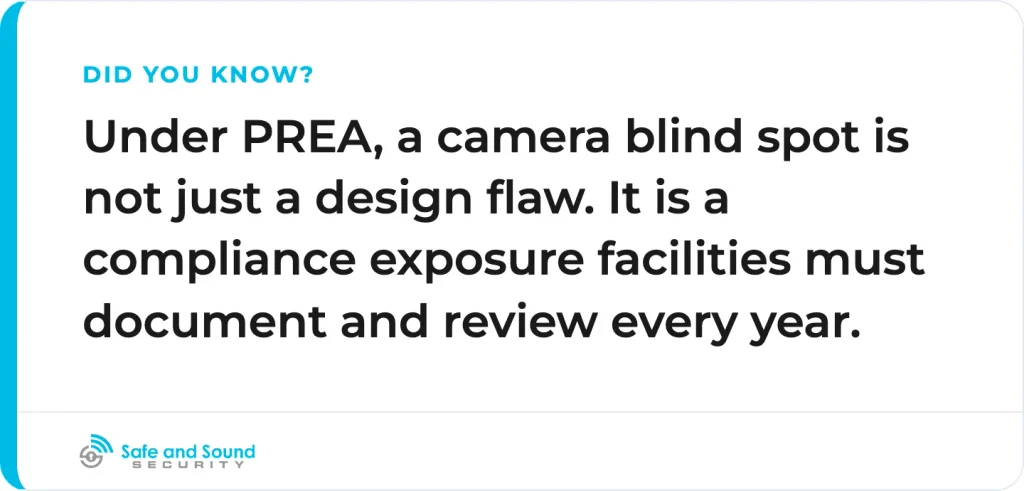
PREA also forces a regular review. The standard requires each facility to assess, at least once a year, whether adjustments are needed to its staffing plan and its deployment of video monitoring and other monitoring technologies. A camera plan is therefore never finished; it is tied to a staffing plan, and both get re-examined every year. A well-integrated video system makes that review easier, because coverage gaps and their fixes are simpler to show when the whole facility runs on one platform.
Federal funding adds a second layer. Cameras and other equipment on a federally funded project generally have to be NDAA compliant, which rules out certain manufacturers regardless of price or features. We provide NDAA-compliant equipment options so a project can meet that bar without a redesign late in the process. Getting the compliance frame right early keeps a build from failing review after the hardware is already on the wall.
Designing Around the Corrections Staffing Crisis
Staffing shortages now shape correctional system design as much as the threats do, because technology has to cover what officers cannot. The Congressional Research Service reports that the federal correctional officer vacancy rate rose from 9% in 2010 to 25% in 2023, and the prisoner-to-officer ratio reached 10.2 to 1 in fiscal 2024. Corrections work already carried the highest rate of nonfatal workplace violence of any occupation, at 149 incidents per 1,000 workers, and the same report records a peak of 718,174 augmentation hours in fiscal 2025, when non-custody staff are pulled to cover custody posts.
The violence behind those numbers is what the system has to answer for. The Bureau of Justice Statistics recorded 872 physical assaults on federal Bureau of Prisons staff by prisoners in 2023. When there are fewer officers on the floor, each of those events has to be caught by a camera, a sensor, or a duress alarm rather than by a person who happens to be watching.
Thin staffing changes what a system has to do on its own. AI video analytics watch feeds no control room has the people to monitor live and raise a flag instead of relying on someone to catch it. Duress devices with real-time location shorten response times when fewer officers are on the floor, and automated door control cuts the manual, contact-heavy tasks that put officers at risk. None of this replaces staff, but designing to the roster a facility actually has, rather than the one it wishes it had, is the difference between a system that helps and one that just adds alarms nobody can answer.
New Build vs. Retrofit: Upgrading a Live Facility Without Shutting It Down
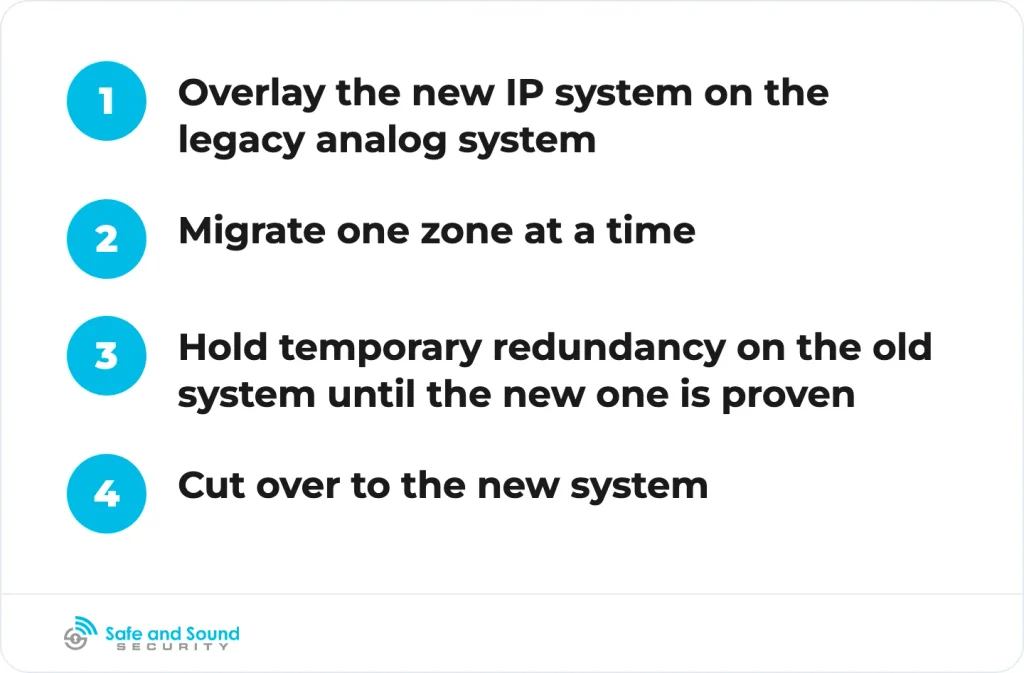
Most correctional security work is a retrofit, and the hard rule is that custody never stops. A facility cannot go dark while its cameras and locks are replaced, so the upgrade has to happen in phases around a running operation. The common path is an IP overlay on the legacy analog system, migrating one zone at a time, holding temporary redundancy on the old system until the new one is proven, then cutting over. Done right, control staff never lose their picture of the facility.
The risk in a phased cutover is the seam between old and new, which is why single-contractor integration matters more here than almost anywhere else. When the cameras, the locks, the alarms, and the network cabling behind them all come from one contractor, there is no gap where two vendors point at each other while a housing unit sits half-covered. Aging analog cameras, radio dead zones, and systems that were never designed to talk to each other are the exact problems a retrofit exists to solve, and solving them without a shutdown is the test of whether an integrator understands corrections.
How Correctional Facilities Buy Security Systems
Correctional security is a custom-bid public project, so who can legally hold the contract matters as much as the technology inside it. These systems are engineered to the specific building, priced against public procurement rules that often include prevailing wage, and bound by equipment-sourcing requirements like NDAA compliance. A contractor who understands the security still has to deliver it through the buyer’s purchasing process, or the project stalls.
That contracting side is where Safe and Sound Security fits a correctional project. We are approved on more than 15 government procurement vehicles, including CMAS, GSA Schedule 84, BuyBoard, PEPPM, Sourcewell, and OMNIA Partners, which gives public buyers established routes onto our work through their existing systems. We hold California Small Business certification, offer NDAA-compliant equipment options, and have protected more than 20,000 locations, with the multi-site rollout capability a statewide corrections agency needs when one standard has to reach many facilities. The same integration discipline we bring to government and multi-site clients, documented across our public-sector projects, is what applies to a jail, a detention center, or a state corrections build. We use procurement vehicles as a route onto the shortlist, not a shortcut around a bid, because on a public installation the work still gets competed.
Frequently Asked Questions
What are the three security levels in correctional facilities?
State prisons are commonly classified into three security levels: minimum, medium, and maximum. Minimum-security facilities house low-risk inmates with limited perimeter controls, while maximum-security facilities use hardened perimeters, tightly controlled movement, and full electronic door control. The federal Bureau of Prisons uses five levels instead of three: minimum, low, medium, high, and administrative. System design scales with the level, so a higher-security facility carries more layers of detection and interlocking.
What is managed access in a prison?
Managed access is a system that controls cellular signals inside a correctional facility, letting approved phones connect while blocking unauthorized ones. It creates a controlled wireless zone so that a smuggled cell phone, one of the most common and dangerous forms of contraband, cannot get a signal to place calls or coordinate activity outside the walls. Managed access is one part of a broader contraband defense that also includes drone detection and physical screening.
Can a correctional facility upgrade its security system without shutting down?
Yes. A correctional facility can upgrade its security system without interrupting custody by phasing the work zone by zone. An integrator overlays the new system on the existing one, keeps the old system running as backup until the new equipment is verified, then cuts over. This approach lets a live facility modernize aging cameras, locks, and controls while officers keep an unbroken view of the building.
What does PREA require for video monitoring?
The Prison Rape Elimination Act, at 28 CFR 115.13, requires facilities to maintain staffing and, where applicable, video monitoring adequate to protect inmates from sexual abuse, and to account for physical-plant blind spots when setting those levels. Facilities must review the plan at least once a year and document whether their staffing or video monitoring needs to change. In effect, PREA makes camera coverage and staffing a single, auditable compliance question.
What is NDAA-compliant camera equipment, and why does it matter for prisons?
NDAA-compliant equipment is video and security hardware that meets the sourcing restrictions of the National Defense Authorization Act, which bars certain foreign-made components from federally funded projects. It matters for corrections because a facility using federal grant money generally must install compliant equipment, and choosing a non-compliant camera can disqualify the purchase. Selecting compliant hardware early keeps a build from failing review after installation.
The Bottom Line
Correctional facility security systems are only as strong as the integration behind them. Seven subsystems, door control, access control, video, perimeter detection, duress, contraband defense, and the command center, have to act as one, and the compliance layer of PREA and NDAA has to be built in from the start rather than patched on at the end. The pressures shaping these systems in 2026, a staffing crisis and a surge in drone-delivered contraband, both reward facilities that plan for integration instead of buying pieces.
Safe and Sound Security is a nationwide commercial and government security integrator, and correctional facility security systems draw on the same work we do for public agencies and multi-site operations: surveillance, access control, duress alarms, intercom, fire, and structured cabling pulled into one command center under a single C7 license. Approval on more than 15 government procurement vehicles, NDAA-compliant equipment options, and statewide rollout experience are what a jail, detention center, or corrections agency needs on the contracting side of a project, not just the technical one. If you are planning or upgrading a correctional facility, contact our team to scope a system around your building, your security level, and your funding.
Sources
- Bureau of Justice Statistics: Federal Prisoners and Correctional Facility Statistics
- Congressional Research Service: Correctional Officer Staffing in Federal Prisons
- Electronic Code of Federal Regulations: 28 CFR 115.13, Supervision and Monitoring
- Facilities Dive: Prisons Battle Nightly Drone Drops of Drugs, Other Contraband
- Federal Bureau of Prisons: About Our Facilities


