
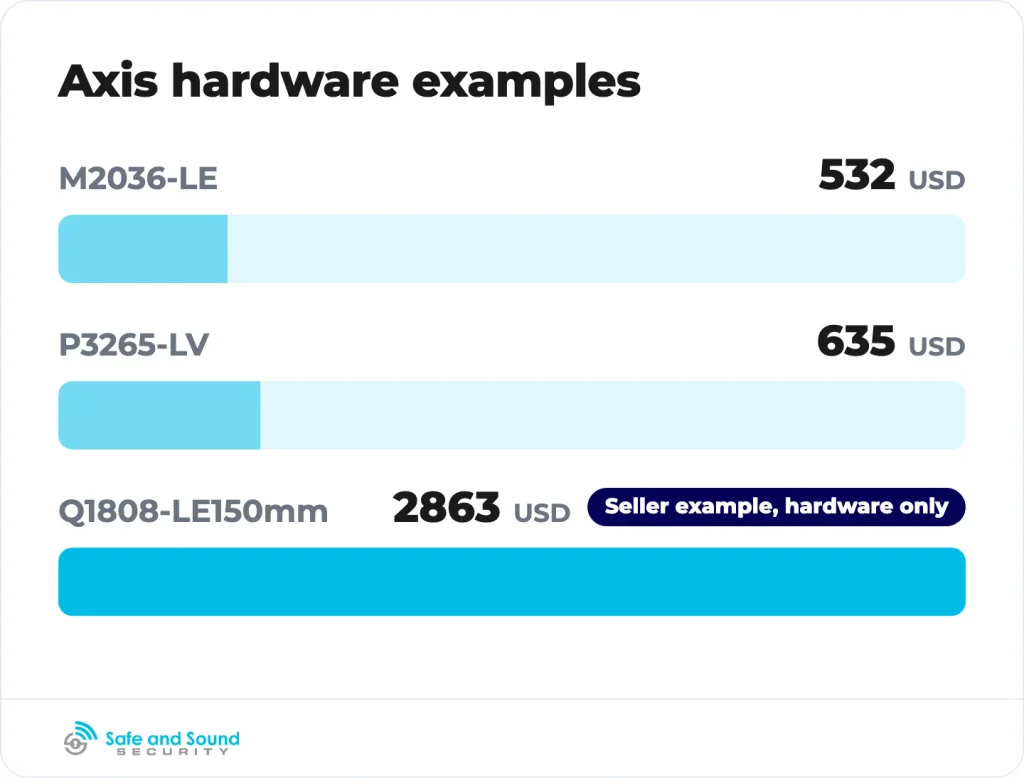
Current seller examples include the AXIS M2036-LE at $532, the P3265-LV at $635, and the Q1808-LE150 mm at $2,863 for hardware only, as checked November 14, 2026. Camera hardware is one line in the complete project budget. Once you add cabling, licensing, network switches, and labor, Tec-Tel’s broad planning guide puts an installed commercial camera at $500 to $4,500, with higher-end PTZ installations above that. It is a planning estimate, rather than a guaranteed Axis project range. At Safe and Sound Security, we design and install Axis systems for commercial and government clients, and we handle the security wiring and the cameras under one low-voltage license, so we see where the real money goes. This guide breaks down what Axis cameras cost by series and by type, what you pay to put one on the wall, and the ownership costs that most price lists leave out.
Key Takeaways
- Current hardware examples span hundreds to thousands of dollars. Tec-Tel’s planning guide uses $500 to $4,500 per installed commercial camera; treat that as a scoped planning benchmark, not a national Axis average.
- Series is a useful first filter, but model and features set price. The table below compares three dated seller examples rather than unsupported series-wide ranges.
- The camera is often not the biggest cost. Cabling, network switches, labor, and software licensing are. Do not apply a residential labor percentage to a commercial Axis quote. Price cabling, mounting, switching and commissioning separately; Camera Station licensing depends on device type, server and term.
- Axis costs more than budget brands for defensible reasons: a free 5-year warranty, strong low-light imaging, and full NDAA Section 889 compliance for government and federally funded work.
- Axis does not publish a complete public price list. Firm numbers come through an authorized distributor or integrator, priced to your model mix and site.
How Much Does an Axis Camera Cost?
The current seller examples below span $532 for an M2036-LE bullet to $2,863 for a Q1808-LE150 mm long-range bullet. Those are three specified models, not the minimum or maximum of the entire Axis catalog. Specialty optics, PTZ, thermal imaging and environmental requirements can move the hardware price considerably.
That hardware number is where most price research stops, and it is the wrong place to stop for a commercial project. The camera is one line on a much larger quote. The real budget question is what it costs to get a working, recorded, compliant camera on the wall, which the installed-cost and ownership sections cover. For how camera costs compare across brands and form factors in general, see our guide to the cost of security cameras.
Axis Camera Prices by Series: M, P, and Q
The M line covers compact and value applications, the P line mainstream professional uses, and the Q line premium or specialty requirements. These are exact seller examples rather than a price range for every camera in each series.
| Series | Example model / SKU | Hardware price | Scope |
|---|---|---|---|
| M | M2036-LE02125-001 | $532 | Bullet camera |
| P | P3265-LV02327-001 | $635 | Indoor dome camera |
| Q | Q1808-LE150 mm 02508-001 | $2,863 | Long-range bullet camera |
Source: Network Devices Inc. Axis catalog, checked November 14, 2026. USD hardware-only seller prices; tax, shipping, mounts, licenses and installation excluded. Examples differ in features and are not a matched-performance comparison.
Higher prices may buy different sensors, lenses, low-light capability, mechanics, analytics or housings. Choose those capabilities for the actual scene before comparing quotes.
Axis Camera Prices by Type: Dome, Bullet, PTZ, Thermal
Form factor alone does not set price. A current seller lists the P3265-LV indoor dome at $635 and M2036-LE bullet at $532, but a long-range Q1808-LE150 mm bullet at $2,863. PTZ units add motors, optical zoom and tracking; thermal cameras use different sensors for heat detection.
Compare resolution, lens, low-light requirements, environmental rating and required analytics alongside type. A low-cost PTZ and a specialty fixed bullet do different jobs; neither proves one form factor is always more expensive.
What Drives an Axis Camera’s Price
Within the same brand, prices can differ sharply because of the features and intended scene. Knowing which features drive the price lets you spend where it matters and skip where it does not.
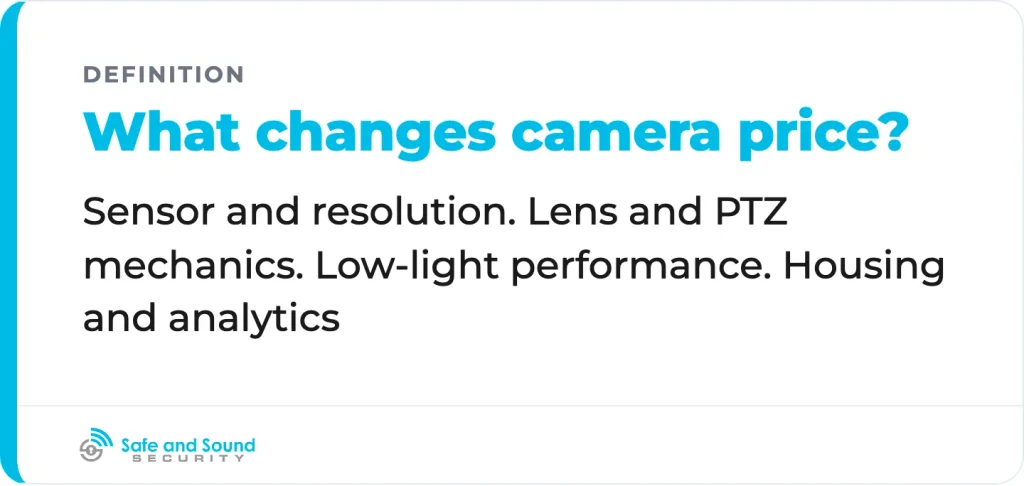
- Resolution and sensor size. Higher megapixel counts and larger sensors cost more and also raise storage and bandwidth needs downstream.
- PTZ versus fixed. Pan-tilt-zoom mechanics, motors, and optical zoom add cost and ongoing moving-part maintenance. A fixed camera covers one scene for far less.
- Low-light and wide dynamic range. Features that keep a clear image at night or against bright backlight, such as Axis Lightfinder and WDR, raise the price and are worth it where lighting is poor.
- Weatherproofing and vandal resistance. Outdoor-rated and impact-rated housings cost more than indoor units built for a controlled space.
- Onboard analytics. Cameras that run analytics on the device using the Axis ACAP platform, such as object classification or line-crossing, carry a premium but can reduce server and labor cost elsewhere.
What an Axis Camera Costs Fully Installed
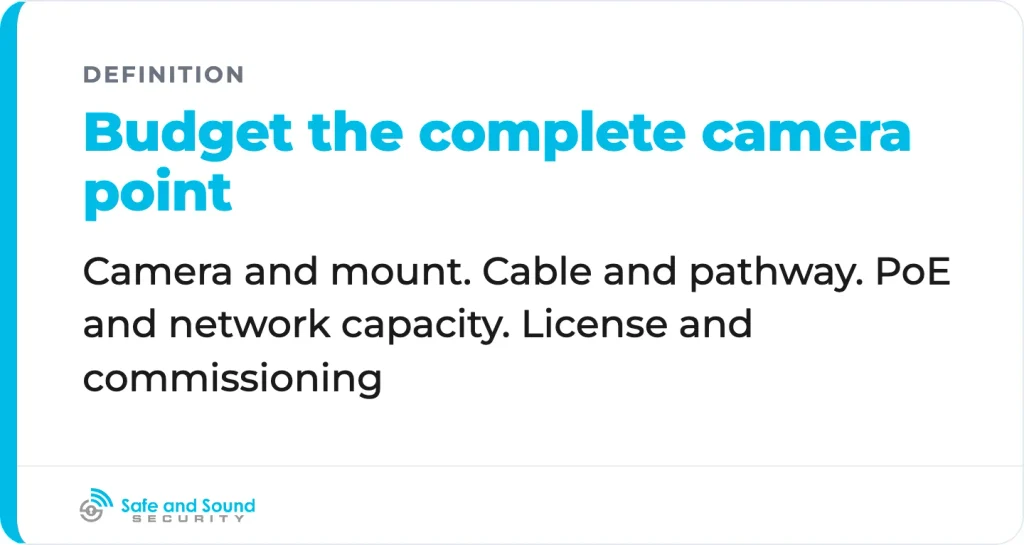
A fully installed commercial Axis camera typically costs $500 to $4,500 per camera all-in, and Q-series PTZ cameras can run $5,000 to $15,000 or more each installed, according to Tec-Tel’s published Axis planning guide, retrieved November 14, 2026. These are another integrator’s broad planning ranges, not measured national Axis averages or a quote for your site. “All-in” means far more than the camera. It includes the mount, the cable run, the network switch capacity, the software license, the labor to install and aim the camera, and the commissioning to get it recording correctly.
| Cost component | What it covers |
|---|---|
| Camera hardware | The camera unit itself, priced by series and type |
| Mount and housing | Wall, ceiling, pole, or corner mount plus any protective enclosure |
| Cabling and pathway | Cat6 cable run, conduit, and penetrations. Usually the largest variable |
| Network switch capacity | PoE ports sized to power and data each camera |
| Video management license | Per-device software license to record and view footage |
| Labor and commissioning | Installation, aiming, focus, and configuration |
The camera is only one line in the installed budget. Long cable runs, hard ceilings, conduit and multi-floor pathways can substantially change labor and infrastructure costs. A residential-camera labor percentage does not establish the cost split on a commercial Axis job. We keep security cabling and camera installation under one roof so those costs can be scoped together. Use our commercial security camera installation cost calculator as a starting point, and see how we install commercial camera systems.
The Costs Beyond the Camera: Licensing, PoE, Storage, and Warranty
The camera and its installation are one-time costs. The system around it carries ongoing and often overlooked costs that belong in any honest Axis budget: video management licensing, network power, storage, and warranty.
Video management licensing is a separate per-camera cost. AXIS Camera Station Pro licenses are priced per device, and the price depends on the term and the device type. Core licenses cover Axis devices, while Universal licenses cover third-party devices. Check the current license classification for any 2N model. The table gives the Q1 2026 published USD MSRP from TD SYNNEX’s Axis sheet, not a current dealer quote.
| License | Term | Per-device price | Covers |
|---|---|---|---|
| AXIS Camera Station Pro Core | 1 year | $29 | Axis devices |
| AXIS Camera Station Pro Core | 5 years | $89 | Axis devices |
| AXIS Camera Station Pro Core | NVR (lifetime with S-series recorder) | $89 | Axis devices on an S-series recorder |
| AXIS Camera Station Pro Universal | 1 year | $49 | Mixed or third-party devices |
| AXIS Camera Station Pro Universal | 5 years | $169 | Mixed or third-party devices |
Network power and switching scale with the selected models. Check each camera’s actual PoE class and maximum draw, including heaters and IR, rather than assuming a power tier from 4K resolution or a series name. Specify cabling for the required speed, run length, environment and PoE load. Suitable, tested Cat5e can support 4K IP video; Cat6 may be selected for a new installation without implying existing Cat5e must be replaced. Sizing the switch and the cable is part of the quote, not an afterthought.
Storage can be a recurring cost. Recording to a local recorder is a one-time hardware cost, but optional cloud storage adds a yearly fee per camera, and aggregating multiple sites adds a per-device management fee. Axis Zipstream helps here by cutting the bandwidth and storage a camera uses without visibly degrading the footage you need. For cloud recording options and tradeoffs, see our page on security camera cloud storage.
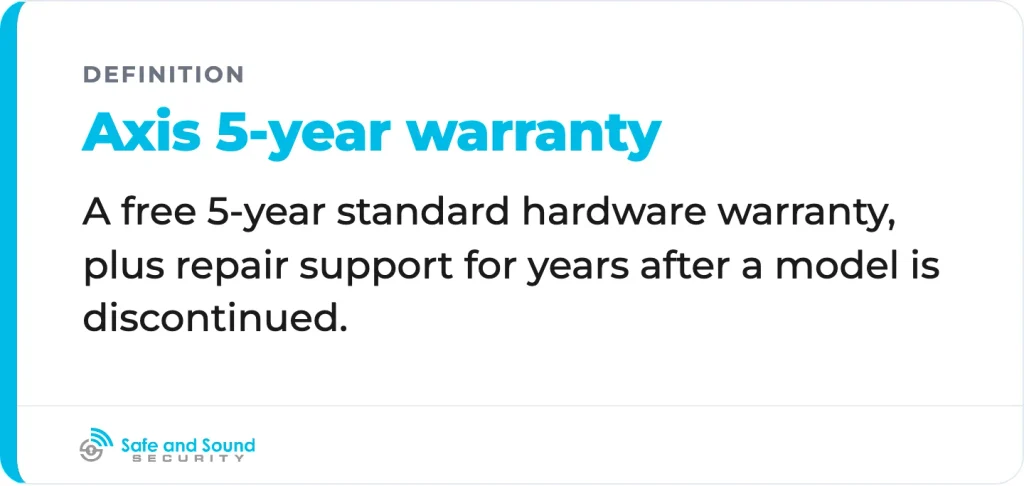
The warranty offsets long-term cost. Axis includes a free 5-year standard hardware warranty on its cameras, according to Axis Communications, and continues repair support for years after a model is discontinued. A long free warranty and service life is a real total-cost advantage over cheaper cameras that need replacing sooner.
Why Axis Costs More Than Budget Brands, and When It’s Worth It
Axis sits at the premium end of the camera market. Its price may be justified when the specified image quality, support and compliance meet the project’s needs. The decision is not “cheap versus expensive.” It is whether the project needs what the premium buys.
- Image quality and low light. Strong low-light imaging and wide dynamic range produce usable evidence where budget cameras produce noise, which is the entire point of a camera you may need in court.
- Cybersecurity and open platform. Axis cameras are ONVIF-compatible and run on an open platform, integrating with third-party video management software such as Genetec, Milestone, and Avigilon. That avoids locking you into one vendor’s recorder and software for the life of the system.
- Service life. The free 5-year warranty and long post-discontinuation support mean a longer dependable service life, which lowers the total cost of ownership.
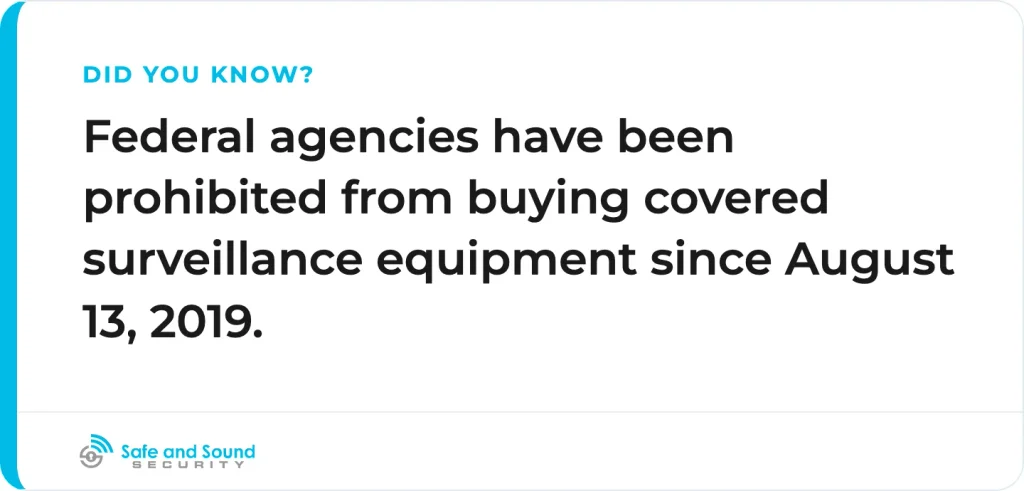
- NDAA compliance for government work. Axis affirms that its entire product portfolio is compliant with NDAA Section 889, according to Axis Communications. Federal agencies have been prohibited from buying covered surveillance equipment since August 13, 2019, under FAR 52.204-25, so compliant cameras are a requirement, not a preference, on federal and federally funded projects.
For commercial sites with good lighting and simple needs, a budget brand may be enough. For government, education, healthcare and other sites, evaluate whether the specified image quality, support and compliance justify the premium. Compare complete installed and ongoing costs over the same term rather than assuming a lower lifetime cost. We are an Axis camera dealer and installer and spec NDAA-compliant options where the project requires them, which you can read more about on our NDAA compliance page.
Is There an Axis Camera Price List?
Axis does not publish a complete public price list covering every model and SKU. Unlike consumer brands with a fixed online checkout price, Axis sells through authorized distributors and integrators, and firm pricing depends on your model mix, camera count, licensing, and installation scope. The market listings and ranges in this guide will get you to a working budget, but they are not a quote. A real number comes from pricing a specific design for a specific site, so the fastest path to one is a walkthrough and a scoped proposal rather than a line-item lookup.
Frequently Asked Questions
How much does an Axis dome camera cost?
One dated example is the P3265-LV indoor dome at $635 from Network Devices Inc., checked November 14, 2026. Other dome models differ in sensor, lens, environmental rating and analytics; this is not a catalog-wide range. Installed, expect the all-in per-camera figure to land in the $500 to $4,500 range once cabling, licensing, and labor are added.
How much does a commercial Axis camera system cost?
A commercial Axis camera system usually costs $500 to $4,500 per camera fully installed, so the system price scales with camera count and site complexity. A small office with a handful of M-series domes is a very different budget from a transit site with Q-series PTZ cameras and long cable runs. Cabling, network switches, software licensing, and labor drive the total more than the camera model itself.
Are Axis cameras NDAA compliant?
Yes. Axis affirms that its entire product portfolio is compliant with NDAA Section 889, which makes Axis an eligible choice for federal, state, and federally funded projects where covered equipment is prohibited. This is a key reason government and education buyers accept the Axis premium over cheaper, non-compliant brands.
Does Axis charge a monthly or recurring fee?
Axis cameras recording to a local recorder carry no mandatory monthly fee. The recurring costs are optional: cloud storage is a yearly per-camera fee, and multi-site management adds a per-device fee. Video management licensing through AXIS Camera Station Pro is a per-device cost that can be bought as a 1-year or 5-year term, or as a lifetime license with an Axis S-series recorder.
The Bottom Line
Budget two layers: exact camera hardware and a fully installed recording system. The current seller examples above run $532 to $2,863 for three different models; Tec-Tel’s broader installed benchmark is $500 to $4,500 per commercial camera, with specialty PTZ projects higher. The gap between those two numbers is the cabling, the network, the software, and the labor, and it is where the real budget lives. Axis earns its premium through image quality, an open platform, a long free warranty, and full NDAA compliance, which is why it stays a go-to choice for commercial and government video projects. Safe and Sound Security has installed Axis Communications equipment for more than 90 customers across 190-plus signed deals, covering 320-plus Axis equipment lines, more than 150 of them in the last three years, with our earliest Axis project signed in 2017. If you want a real number for your site instead of a range, contact our team for a scoped Axis camera proposal.


