
Brivo and Genea both offer cloud access control and supported Mercury retrofit paths. Genea centers its offering on non-proprietary Mercury controllers, while Brivo offers its own controllers and supported Mercury options alongside its access, video and visitor-management suite. Compare the exact installed controller, conversion requirements, identity integrations and full quote rather than treating hardware as an opposite choice.
Safe and Sound Security installs and supports Brivo, so we will say that up front. The comparison below still assesses both platforms on the same facts: hardware, integrations, mobile access, pricing, support, and fit. Where Genea is the stronger match for a specific need, we say so.
Key Takeaways
- Both offer Mercury retrofit paths. Genea centers on Mercury; Brivo supports its own panels and selected Mercury controllers. Reuse depends on exact model, firmware, software and conversion support.
- Brivo bundles video. After merging with Eagle Eye Networks in December 2025, Brivo sells access, mobile, video, visitor management, and intrusion as a single cloud suite.
- Both support directory-driven provisioning. Brivo Identity Connector supports SCIM user and group provisioning with directories including Microsoft Entra ID, Okta and Google Workspace. Genea also offers directory sync. Compare the required workflow, connector, edition, group mapping and deactivation behavior; Genea separately offers self-service tenant portals.
- Pricing transparency differs. Brivo has documented dealer pricing built on a software base plan plus a per-reader fee. Genea publishes no public price and sells on a custom, annually recurring quote.
- Review scores are close. G2 rates Brivo 4.6 out of 5 across 117 reviews and Genea 4.4 out of 5 across 101 reviews. The right pick depends on your existing hardware and integrations, not the rating gap.
Brivo vs. Genea: Side-by-Side Comparison
Brivo and Genea solve the same problem, cloud-managed door access, in different ways. This table lays out the core differences at a glance, then each dimension gets its own section.
| Dimension | Brivo | Genea |
|---|---|---|
| Deployment | Cloud and hybrid | Cloud-native |
| Controller hardware | Brivo controllers and supported Mercury options | Non-proprietary, open Mercury hardware only |
| Native video | Yes, through the Eagle Eye Networks merger | Separate add-on product |
| Mobile credentials | Brivo Mobile Pass, mature; 5 to 1,000 passes included by edition | Mobile access with reported reliability inconsistency |
| Identity and IT integrations | Identity Connector with SCIM provisioning; Entra ID, Okta and Google Workspace; API/SDK | Directory sync including Active Directory, Okta, OneLogin and Google Workspace |
| Visitor management | Yes, in the suite | Yes, plus self-service tenant portals |
| Pricing model | Software base plan plus per-reader monthly fee | Custom annual quote based on employees, doors and locations |
| Public pricing | Quote-only through a dealer | Quote-only, no public price |
| G2 rating | 4.6 out of 5 (117 reviews) | 4.4 out of 5 (101 reviews) |
| Design focus | Access, video and supported directory provisioning | Mercury hardware, directory provisioning and tenant workflows |
Ratings are from G2’s Brivo and Genea comparison. Platform capabilities are drawn from each vendor’s own product documentation.
Brivo Access Control: Overview
Brivo is a cloud and hybrid access-control platform offering its own panels and supported Mercury controllers. In December 2025, Brivo and Eagle Eye Networks merged into one company under the Brivo name. That brought native cloud video, access, mobile credentials, visitor management, and intrusion detection into a single suite.
Brivo’s strengths show up in setup and daily use. G2 reviewers find Brivo quick to set up and easy to use, and the Brivo Mobile Pass is a mature mobile credential. The platform’s broad API and SDK let integrators connect it to other systems, and the Eagle Eye tie-in gives buyers one vendor for both doors and cameras.
The trade-off is cost structure and support. Because Brivo charges a software base plan plus a fee for every reader, cost scales with door count. On Capterra, one reviewer wrote that “the monthly is 6-7 times more than the competition” and described slow support, “taking 3-4 days to resolve” an issue. G2’s comparison lists Brivo cons of internet dependency and slow performance. Brivo holds a G2 rating of 4.6 out of 5 across 117 reviews.
As a Brivo access control dealer, we design and install these systems for commercial and government buyers.
Genea Access Control: Overview
Genea is a cloud-native access control platform built entirely on non-proprietary Mercury hardware. Because it uses open Mercury controllers, a building with supported Mercury panels may move to Genea while retaining compatible controllers, subject to model, firmware and conversion checks, and the owner keeps the freedom to change software vendors later.
Genea’s design centers on enterprise identity. It synchronizes natively with directory services including Microsoft Active Directory, Okta, OneLogin, and Google Workspace, so employee access follows the directory automatically as people join or leave. It also offers self-service tenant portals for multi-tenant buildings, letting property teams hand badge and parking management to tenants, plus visitor management and interactive floor plans. Reviewers consistently praise Genea’s administration experience and its support team.
Genea’s reported weak spots sit on the enterprise axis of mobile reliability and feature depth. G2’s comparison lists Genea cons of performance issues, flagged by 6 reviewers, and limited features, flagged by 3, out of 101 reviews. A Capterra reviewer noted that “the quick shake to open feature. It works in some access points but not in others.” Genea holds a G2 rating of 4.4 out of 5 across 101 reviews.
Hardware and Architecture: Compare the Exact Controller
Both platforms can support a Mercury-based retrofit. Brivo’s panel range includes supported Mercury options as well as Brivo controllers. Genea centers on non-proprietary Mercury hardware. An existing Mercury label is a starting point: confirm the exact model, firmware, ownership, licenses and destination support before promising reuse.
For a new building, both require an agreed controller, reader and wiring design. On a retrofit, either platform may preserve supported Mercury hardware. Our general access-control cost guide uses $1,500 to $3,500 per installed door for a standard system; actual savings from reuse depend on the bill of materials. Include conversion, licensing and commissioning in both proposals.
Integrations and Identity Management
Both platforms offer directory-driven provisioning. Brivo Identity Connector uses SCIM to synchronize users and groups from supported directories, including Microsoft Entra ID, Okta and Google Workspace. Brivo documents lifecycle updates and deactivation of the associated physical permissions when a user is disabled or removed. Genea also provides directory synchronization, including the integrations listed below.
Brivo also offers an API and SDK for custom integrations, alongside its access-and-video ecosystem and VMS partnerships with Verkada and Avigilon. Genea offers self-service tenant portals for property teams that want tenants to manage badge and parking access. Compare the actual directory, connector, edition and required workflow on both platforms, including group mapping, lifecycle updates and deactivation. Do not assume that one requires custom development for a workflow the other provides through a supported connector.
Mobile Credentials and Access
Both platforms replace plastic badges with a phone-based credential. Brivo Mobile Pass is the more established of the two and includes a set number of passes by edition, from 5 on the entry plan up to 1,000 on the enterprise plan, with add-on passes available. Genea offers mobile access as well, and reviewers praise its ease of use, though some report that mobile unlock works inconsistently across different doors. For any site planning to standardize on phone credentials, test the unlock experience on your own doors before rollout.
Pricing and 5-Year Cost of Ownership
Both platforms need a quote for your deployment. Brivo’s public editions page describes packages and directs buyers to a reseller; it is not a public price offer. Genea states that custom annual pricing depends on employees, doors and locations.
Compare these lines on the same scope:
| Cost line | What to confirm |
|---|---|
| Controllers and conversion | Supported Mercury reuse, new panels, firmware and conversion work |
| Subscription | Base plan, door/reader counts, users, sites and term |
| Added functions | Mobile passes, identity sync, visitor management and video |
| Delivery and support | Cabling, commissioning, training, maintenance and renewal increases |
As an illustration,20 doors at our general $1,500 to $3,500 installed-door planning range gives $30,000 to $70,000 before software. That is arithmetic using a general GSS benchmark, not a Brivo or Genea project quote. Add each vendor’s actual subscription over 60 months and account for conversion or reuse on either side.
Ease of Use, Setup, and Support
The two platforms score closely on G2, with Brivo at 4.6 out of 5 and Genea at 4.4. Reviewers find Brivo quick to set up and easy to use day to day, while Genea draws praise for its administration and a responsive support team. The recurring knocks split the other way: Brivo’s is slow support response, and Genea’s is inconsistent mobile unlock. Both patterns come from documented review samples, so treat them as reported experience rather than a guarantee for your deployment.
Which Platform Fits Your Business?
The best fit follows your hardware and your integration priorities, not a universal winner.
Brivo is designed for organizations that want one cloud ecosystem covering both access and video, which fits multi-site commercial operators, multifamily and commercial real estate portfolios, and teams that want a mature mobile credential from a single vendor. Genea can suit organizations whose supported Mercury hardware, directory workflows and self-service tenant requirements match its offering. Brivo also supports directory provisioning, so test the required connector and lifecycle behavior on both.
If your needs point toward Brivo, or you are weighing the two and want an installer’s read on your specific doors, that is exactly the work we do. If your situation points squarely to Genea’s niche, that is a platform we do not install, so we would not be your installer for it. What we can tell you is how a Brivo deployment would look on your building, with real numbers.
How Safe and Sound Security Installs and Supports Brivo
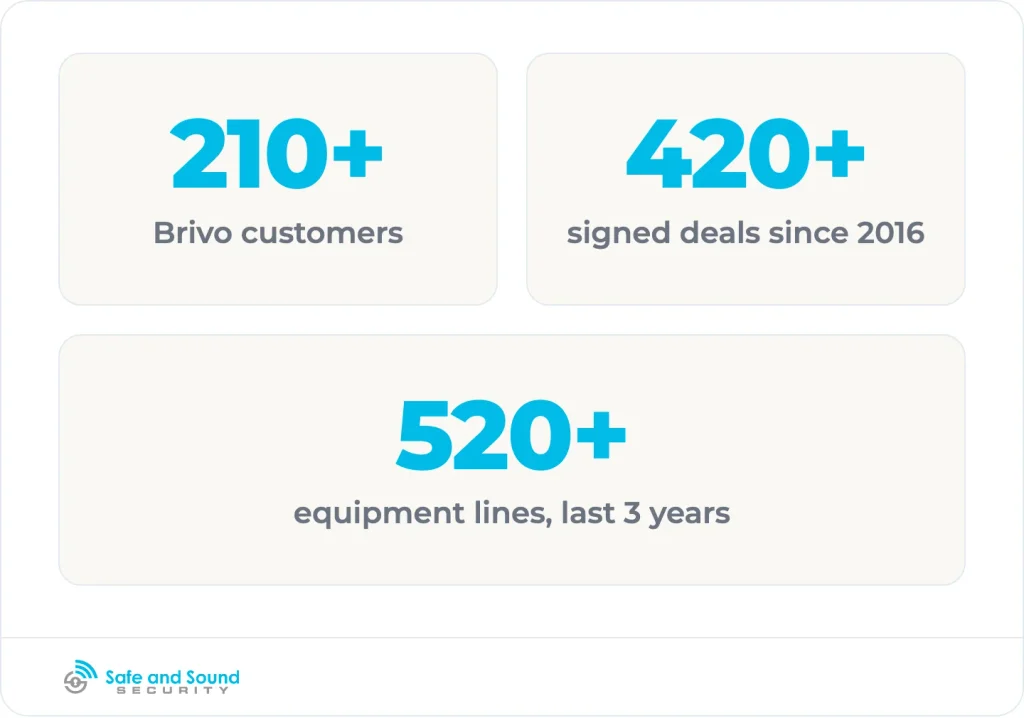
At Safe and Sound Security, we are a commercial Brivo access control installer, and we know the platform at depth. Our own project record shows Brivo installed for more than 210 customers across more than 420 signed deals since 2016, with more than 520 Brivo equipment lines added in the last three years. That is our first-party install history, not a vendor claim.
As an access control installer, we add what a comparison grid cannot: a single contractor for the whole system. We design, install, and support access control alongside video, intrusion, and structured cabling under one roof, so there is no vendor coordination between the door hardware and the network it runs on. For government and federally funded buyers, we also build with NDAA Section 889 compliance in mind and support multi-site rollouts nationwide from our California headquarters.
Frequently Asked Questions
How much do Brivo and Genea cost?
Both platforms require a quote for the actual deployment. Genea says its custom annual pricing depends on employees, doors and locations. Ask each quote to identify the base subscription, door or reader charges, users, sites, added services and supported hardware reuse; quote-only does not mean a fee is independent of system size.
What do reviewers say about Brivo vs. Genea?
Buyers searching for candor find close review scores with different complaint patterns. On G2, Brivo rates 4.6 out of 5 across 117 reviews and Genea 4.4 out of 5 across 101 reviews. Brivo reviewers tend to praise its interface and reliability but flag cost and slow support, with one Capterra reviewer citing support that took “3-4 days to resolve” an issue. Genea reviewers praise its identity integrations and support team but flag performance issues and inconsistent mobile unlock across doors. The scores are close enough that hardware and integration fit should decide it.
Does Genea use Mercury hardware?
Yes. Genea is built entirely on non-proprietary, open Mercury hardware. A building with supported Mercury panels may move to Genea without replacing those controllers, subject to conversion and licensing checks, and the owner keeps the option to change software vendors later without new hardware.
Did Brivo merge with Eagle Eye Networks?
Yes. Brivo and Eagle Eye Networks announced a merger on December 29, 2025, operating as one company under the Brivo name. The result is a single platform that combines cloud access control with native video, mobile credentials, visitor management, and intrusion detection.
Can Safe and Sound Security install Brivo access control?
Yes. We are a commercial Brivo access control dealer and installer, and we design, install, and support Brivo systems for businesses and government agencies nationwide. We handle access control alongside video, intrusion, and cabling as one project, and we can price a Brivo deployment against your actual door schedule.
Conclusion
Choosing between Brivo and Genea comes down to three questions: what hardware you already own, how much you need directory-driven identity sync, and whether you want access and video from one vendor. Both platforms offer supported Mercury paths and directory provisioning. Compare the exact controllers, identity connector, edition and required lifecycle workflow. Genea’s tenant portals and Brivo’s access-and-video suite are additional functions to evaluate against the site’s needs. Neither is universally better, and review scores for both sit within two-tenths of a point.
For buyers leaning toward Brivo, Safe and Sound Security is a commercial Brivo access control installer for businesses and government agencies nationwide, with Brivo deployed for more than 210 customers since 2016 and access, video, and cabling integrated under one contractor. If you want a straight read on which platform fits your building, and real numbers for a Brivo deployment, talk to our team.


