
2N and Aiphone are both commercial IP intercoms, but they come at the job from opposite directions. 2N is an Axis-owned, IP-native line built around the Axis camera and Genetec video ecosystem, fast mobile credentials, and design-forward hardware. Aiphone is a broad-range brand that spans IP and analog, scales to thousands of stations, runs with no mandatory subscription, and is widely specified in schools and government buildings. A 2N vs Aiphone decision comes down to the ecosystem you already run, your building type, the wiring you have, and whether a recurring fee fits your budget. Since we install and integrate both brands, the breakdown that follows measures each one against the same yardsticks and closes with a plain call on building fit.
Key Takeaways
- Both are IP intercoms, but the ecosystem is the real decision. 2N is built around Axis cameras and Genetec or Milestone video management, while Aiphone is built around native HID credentials and its own wide station range.
- Verify compliance for the exact configuration. Obtain the selected models’ Section 889 documentation and check the project’s procurement requirements.
- The cost models differ, not just the prices. 2N pairs hardware with an optional My 2N cloud subscription. Aiphone is hardware with no mandatory per-call or per-user fee.
- Scale and range split them. Aiphone spans IP (IX and IXG) and analog (GT, JO, JP) and scales to thousands of stations. 2N is IP-only and design-forward.
- Who installs and integrates it matters as much as the badge. Both wire into access control, cameras, and cabling, and we handle whichever one you choose end to end, one contractor for the whole job.
2N vs Aiphone: Feature Comparison
The grid below lines up 2N and Aiphone across the factors that actually swing an intercom purchase. Row order is for scanning, not a scorecard. Every price is a reseller or street figure current to November 2026, since neither manufacturer posts public list pricing and both sell through dealers.
| Criterion | 2N | Aiphone |
|---|---|---|
| Architecture | IP-native, open SIP only | IP (IX, IXG) and analog or 2-wire (GT, JO, JP) |
| Ecosystem and integration | Native Axis, Genetec, Milestone, Crestron; ONVIF Profile S and T | SIP and ONVIF; Genetec, LenelS2, Milestone, Software House |
| Access and credentials | WaveKey Bluetooth (0.3 s), NFC, RFID (format and security depend on reader module), PIN, QR | Native HID card readers, keypad, prox or RFID, IXG mobile app |
| Scale and station counts | Modular; large deployments via SIP and VMS | IXG up to 9,999 door, answering, mobile stations; GT up to 5,000 tenant stations |
| Pricing model | Hardware plus optional My 2N subscription | Hardware only, no mandatory per-call or per-user fee |
| Design and build | Design-forward: 10.1-inch touchscreen (IP Style), vandal-rated IP Force | Rugged institutional; stainless vandal-resistant door stations |
| NDAA and compliance | Obtain documentation for the selected 2N model | Aiphone-manufactured equipment is NDAA-compliant |
| Warranty | Five-year hardware warranty | Two to five years, varies by series |
| Ideal building types | Luxury multi-family, modern corporate lobbies, Axis or VMS sites | Schools, campuses, hospitals, government, legacy 2-wire retrofits |
| Install reality | Ethernet/PoE or compatible 2Wire conversion on suitable existing wiring; needs SIP and IT skill | 2-wire retrofit path or Cat5e or Cat6 for IP; IX config is complex |
Specifications as of November 2026. Both brands are dealer-quoted; confirm pricing with a project quote.
The Core Difference: Axis IP Ecosystem vs Broad-Range Workhorse
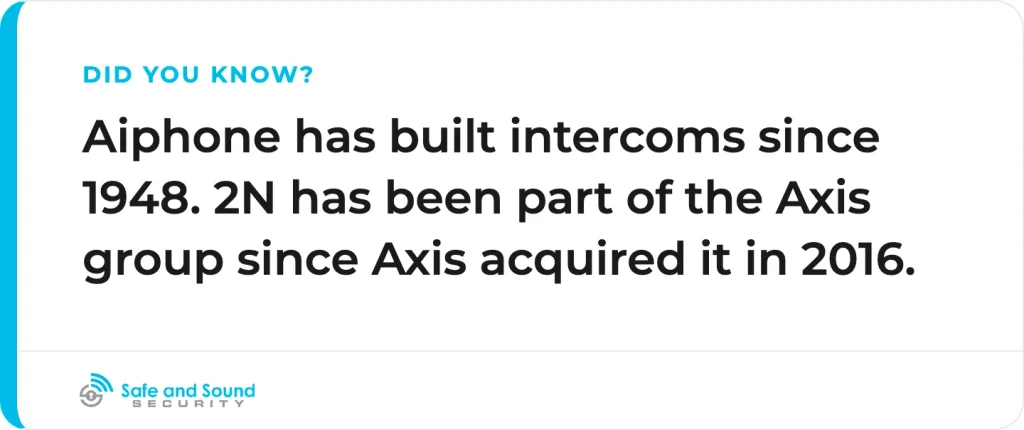
The split between the two brands is a split between a focused IP ecosystem and a wide institutional range. 2N is IP-native and open-SIP only, with no analog line, and it has been part of the Axis group since Axis acquired it in 2016. That ownership shapes the product: 2N shares Axis engineering, leans on design-forward hardware like the 10.1-inch IP Style touchscreen, and is built to slot into an Axis-and-Genetec building.
Aiphone comes from the other end of the market. The company has built intercoms since 1948 and carries more than 75 years in the category, and its range spans IP (the IX and IXG Series) and analog or 2-wire systems (the GT, JO, and JP Series). That breadth is why Aiphone shows up so often in school, hospital, and government specifications: one brand covers a new IP campus and a legacy 2-wire retrofit. The architecture choice drives everything downstream, from cost to scale to how hard the system is to install. Neither approach is better in the abstract. One fits a building standardizing on Axis and a modern app, and the other fits a facility that wants a proven range and no recurring fee.
Ecosystem and Integrations
2N is strongest when the building already runs Axis and a major video management platform. It integrates natively with Axis cameras, Genetec, Milestone, and Crestron through open SIP, and it supports ONVIF Profile S and T. One practical catch is worth planning for: integrators on IPVM report that older configurations required a paid license for ONVIF video. Current licensing varies with model and firmware, so identify the required license in the project quote rather than assuming every 2N integration carries that charge. If you run Genetec video management or Axis cameras already, that shared workflow is 2N’s biggest draw.
Aiphone also speaks SIP and ONVIF and integrates with Genetec, LenelS2, Milestone, and Software House, but its center of gravity is credentials rather than video. Aiphone is strongest where HID cards are already in use, because its GT door stations offer native HID readers. The two brands can both connect to the wider security stack, so the question is which stack you are building around: an Axis-and-Genetec video workflow points to 2N, while an HID credential environment points to Aiphone.
Access Control and Credentials
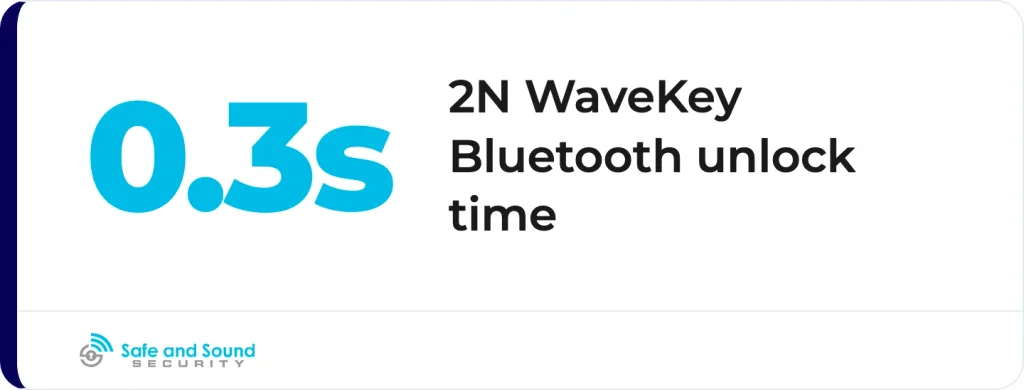
2N emphasizes fast mobile entry. Its WaveKey Bluetooth technology unlocks the door in 0.3 seconds and can pre-authenticate up to eight phones within range, alongside NFC, RFID, PIN, and QR entry. Credential support depends on the selected reader module. Current secured modules support HID Seos and other encrypted formats; confirm the exact reader, credential application and configuration rather than treating all 2N readers as CSN-only.
Aiphone takes the hardwired credential route. It offers native HID card readers through its GT-HID door stations, plus keypads, prox and RFID, and a mobile app on the IXG line. In practice, 2N is built around a fast phone-as-key experience, while Aiphone is built around the card readers and station hardware that institutions already standardize on. Both tie into a wider access control system, so the credential method your organization already issues usually decides this one.
Scale and Building Size
Aiphone publishes large station capacities for specific series. Its IXG multi-tenant system supports up to 9,999 door stations, answering stations, and mobile apps, and its GT Series supports up to 5,000 tenant stations, per Aiphone’s buyer guide, which fits large campuses, hospital networks, and big multi-tenant properties. Those published capacities are useful for planning a system with thousands of endpoints; they do not establish that 2N has a lower limit.

2N is modular and integrates through SIP and VMS. Validate the intended door, site and endpoint counts, plus the selected SIP and VMS platform limits, for the proposed design. Aiphone’s published capacities are planning references, not proof of a lower 2N limit.
Pricing and Cost of Ownership
The two brands cost differently because their fee structures point in opposite directions, and neither publishes public list pricing, so an accurate budget comes from a project quote rather than a web price. 2N splits into two lines: a one-time hardware purchase that climbs from a basic IP door station to a flagship touchscreen panel, plus an optional My 2N cloud subscription. Most My 2N management features are free, but cloud calling to a smartphone is a paid, per-device tier, so a 2N build that uses it carries a recurring software cost on top of the hardware.

Aiphone is hardware with no mandatory software fee. A hardwired multi-tenant Aiphone system usually puts more money into stations and entrances up front, but Aiphone states that its systems deliver full functionality without per-call or per-user charges, so year two onward is close to zero on the software line. Over the life of the system, the subscription-versus-no-subscription choice is the real swing: a 2N build with cloud calling carries a recurring line that an Aiphone build does not. Because both are dealer-quoted, the only firm number is the one on your quote. For help scoping either one against your building, our commercial intercom systems page covers how the pieces fit.
NDAA and Compliance
Compliance is a product and procurement check, rather than a conclusion to infer from a parent company’s name. Axis publishes a Section 889 portfolio statement, while Aiphone provides an NDAA compliance request route for its manufactured equipment and applicable exceptions. For a 2N purchase, obtain documentation covering the exact 2N models and accessories.
We help commercial and public-sector clients check the proposed NDAA-compliant configuration against a government security procurement. Section 889 status is one requirement; it does not establish eligibility for every funded project.
Installation and Reliability
What drives installation effort is the wiring and the configuration work, not the logo on the panel, and the gap between these two systems is at its widest right here. 2N uses IP at the device, with Ethernet/PoE or compatible 2N 2Wire converters over suitable existing two-wire or coax cabling, and it is not plug-and-play: it expects SIP, VoIP, and IT knowledge to configure, though integrators on IPVM say the software is straightforward once it is set up. Aiphone offers more wiring flexibility, with a 2-wire retrofit path on the GT, JO, and JP lines or Cat5e and Cat6 for the IP IX and IXG systems. The trade on Aiphone is at the high end: integrators on IPVM describe the IX Series as “very user friendly and very installer punishing” to configure, and changes to analog lines after install can get costly.
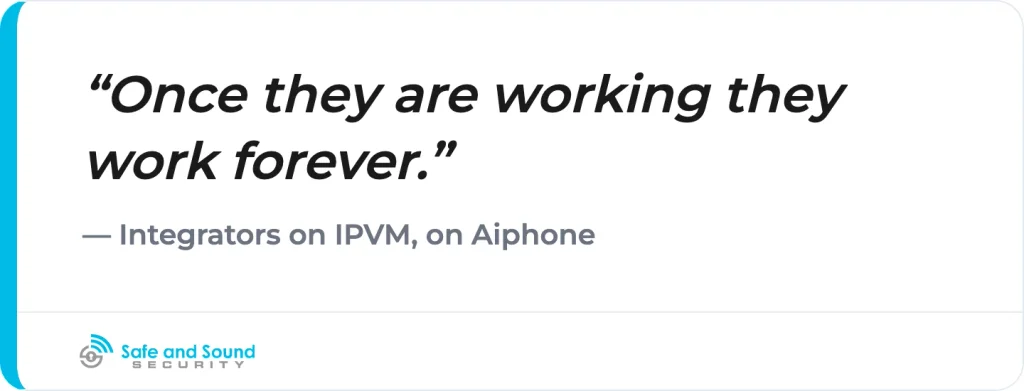
On reliability, Aiphone’s reputation is its strongest asset. Integrators on IPVM say its systems “once they are working they work forever,” to the point that some will install Aiphone exclusively. Opinion on image and audio quality splits honestly: one 2N-leaning integrator rates Aiphone’s video as sub-par, while an Aiphone-exclusive integrator praises its long-term reliability, so the quality read depends on who you ask and which models you compare. This is the judgment an integrator makes on every project. We keep structured cabling and security on one C7 license, so the intercom, its wiring, and the cameras it feeds get installed and integrated by one team instead of handed between trades. That read on fit is grounded in installed work: since 2018 we have specified Aiphone on more than 30 signed projects for over 20 organizations.
When to Choose 2N
2N is designed for buildings already standardized on Axis cameras or Genetec and Milestone video that want a unified workflow. It fits modern, architectural lobbies in luxury multi-family and corporate properties, buyers who want fast smartphone-as-key entry through WaveKey, and projects that value the five-year hardware warranty that 2N carries as standard. The trade you accept is the IT and SIP skill the system needs to deploy, any model- and firmware-dependent integration license, the need to match the reader module to the credential format, and the optional subscription if you want cloud calling. If that describes your stack, the Axis-ecosystem fit is the reason to shortlist it.
When to Choose Aiphone
Aiphone is designed for institutions that want a proven standard, a wide range, and no recurring fee. It fits K-12 schools, campuses, hospitals, and government buildings, sites reusing legacy 2-wire so a full rewire is off the table, deployments that need very high station counts through IX or IXG, and buyers who already issue HID credentials. The trade is at the top end: the IX Series is more work to configure, and changing analog lines after install costs more. For buildings that value durability and zero subscription over a design-led app experience, that is a fair trade, and it is why Aiphone is so often specified for school security.
Frequently Asked Questions
Is 2N or Aiphone better for a school?
Aiphone is worth shortlisting for schools that need a broad station range, large supported station counts and existing HID credentials. 2N can fit a school standardizing on Axis cameras and a supported video workflow. Compare the actual design, lockdown functions, credential modules and compliance documentation rather than choosing on brand reputation alone.
Does 2N or Aiphone require a subscription?
2N does not require a subscription for basic operation, but its My 2N cloud platform charges for the cloud-calling tier, with most management features free. Aiphone requires no mandatory subscription at all and states that its systems run with no per-call or per-user charges. If avoiding a recurring software line is a priority, Aiphone’s hardware-only model is the simpler path, while 2N’s subscription buys cloud calling for those who want it.
Are 2N and Aiphone NDAA-compliant?
Obtain current Section 889 documentation for the exact intercom models and accessories. Aiphone publishes a compliance request route and Axis publishes a portfolio statement, but parent-company ownership alone is not proof for a specific 2N configuration. Also check the buyer’s contract requirements.
Does 2N work with Axis cameras and Genetec?
Yes. 2N is an Axis brand and integrates natively with Axis cameras, Genetec, Milestone, and Crestron over open SIP, which is its core advantage for buildings on that stack. One detail to plan for: confirm ONVIF support and any paid license for the exact model and firmware. 2N has changed its licensing policy over time, so an older integrator report is not a universal current fee schedule.
Can either intercom reuse existing wiring?
Aiphone is the more flexible brand on wiring because its analog GT, JO, and JP lines can often reuse existing 2-wire runs on a retrofit, which lowers install cost. 2N is IP-native, but compatible 2N 2Wire converters can reuse suitable existing two-wire or coax runs. Compare converter hardware, cable condition, distance and power requirements with a new Ethernet run before budgeting a rewire. An installer confirms what your building’s cabling can support before quoting either system.
How do 2N and Aiphone scale?
Aiphone publishes these series-specific capacities: its IXG multi-tenant system supports up to 9,999 door stations, answering stations, and mobile apps, and its GT Series handles up to 5,000 tenant stations. Validate the intended door, site and endpoint counts, network design and SIP/VMS platform limits for the selected 2N design. Aiphone’s published capacities are planning references, not proof of a 2N limit.
The Bottom Line
Picking between 2N and Aiphone comes down to ecosystem against range. 2N draws the eye where a building is standardizing on Axis cameras and Genetec video, wants a design-forward panel and fast mobile entry, and has the IT depth to run an IP-and-SIP system. Aiphone earns the nod where an institution wants a proven name, very high station counts, HID credentials, legacy 2-wire flexibility, and no recurring fee. Because both can connect to a wider security stack, subject to model and integration checks, the real deciders are your ecosystem, your building type, your wiring, and whether a subscription fits the budget.
Safe and Sound Security installs commercial security and structured cabling for businesses and government agencies on one C7 license, with 19-plus years and 20,000-plus protected locations behind that work, so we scope, wire, and integrate either 2N or Aiphone alongside your access control and cameras without splitting the job across trades. That one-contractor coordination is usually what decides how cleanly an intercom works once it has to connect to everything else in the building. For a direct recommendation on the right system for your property, talk to our team.

