
Axis Communications and Hanwha Vision are two of the most specified enterprise IP camera brands in commercial and government security, and buyers comparing them usually want the same three answers: which is compliant, which has the better AI, and which costs less. Both brands are open, both design their own image-processing chips, and both meet US federal procurement rules, so the choice comes down to ecosystem, analytics approach, and budget rather than a simple winner. We install enterprise IP cameras, including Axis, across commercial and public-sector sites nationwide, and this guide lays out where the two brands actually differ so you can match the right one to your project.
Key Takeaways
- Both brands are NDAA compliant. Axis affirms its entire product portfolio meets Section 889, and Hanwha Vision builds its cameras in South Korea and Vietnam. Neither appears on the federal covered list, so the “banned camera” question is about Hikvision and Dahua, not these two.
- Axis leads on ecosystem and lifecycle. Canon-owned, with in-house ARTPEC silicon, an open ACAP analytics marketplace, and a reputation for 10-year-plus field life, at a premium hardware price.
- Both offer included edge analytics on compatible models. Axis Object Analytics is preinstalled at no extra cost; Hanwha also offers built-in deep-learning analytics. Compare required functions, model and VMS integration before deciding value.
- Warranty is now even. Both brands back current hardware with a five-year standard warranty, so warranty length no longer separates them.
- Both are open and ONVIF-based. Each works with third-party video management software like Milestone and Genetec, so neither locks you into one platform the way a closed cloud system does.
Axis vs Hanwha: Side-by-Side Comparison
Axis Communications and Hanwha Vision compete at the top of the professional IP camera market, but they are built for different buyers. This comparison sets the two side by side on the factors that drive a commercial or government purchase. The order of the columns is for navigation, not a ranking.
| Factor | Axis Communications | Hanwha Vision |
|---|---|---|
| Parent / origin | Canon, Sweden (founded 1984) | Hanwha Group, South Korea (formerly Samsung Techwin) |
| In-house chip | ARTPEC-9 (current; ARTPEC-8 still across most models) | Wisenet 9 (current generation) |
| AI analytics | Included Object Analytics on compatible cameras plus ACAP apps, some paid | Included deep-learning analytics on compatible models; confirm specific functions |
| VMS / ecosystem | AXIS Camera Station plus Milestone and Genetec (ONVIF) | Wisenet WAVE and BLAZE (ONVIF) |
| NDAA Section 889 | Manufacturer states compliant across its portfolio | Manufacturer states its cameras, components and systems are compliant |
| TAA eligibility | Model-specific; verify origin and compliance documents | Model-specific; verify origin and compliance documents |
| Price tier | Premium; quoted through resellers | Value; competitive pricing |
| Warranty | Five-year standard | Five-year standard |
| Designed for | Long-lifecycle, deep-integration enterprise and government fleets | Budget-conscious projects wanting strong built-in AI |
Axis Communications
Axis Communications is a Swedish manufacturer that invented the network camera in 1996 and has been a wholly owned subsidiary of Canon since 2015, with total sales of $2.1 billion in 2025 (axis.com). Axis designs its own ARTPEC image-processing chips, runs an open application platform called ACAP, and is widely regarded as the reliability benchmark in professional surveillance, with many cameras lasting well past ten years in the field. The trade-off is price: Axis sits firmly in the premium tier and sells only through resellers, so there is no public list price. For a deeper look at the lineup, see our Axis security cameras overview.
Hanwha Vision
Hanwha Vision is a South Korean manufacturer and part of the Hanwha Group, renamed from Hanwha Techwin in 2023 after a lineage that traces back to Samsung Techwin (hanwhavision.com). Its US arm, Hanwha Vision America, is based in New Jersey. Hanwha designs its own Wisenet chips, bakes deep-learning analytics directly into the camera, and competes hard on price-to-performance, which has made it a common choice for buyers who want capable AI without paying the full premium. It is not a Chinese company and not on any US federal ban list.
Image Processing and Chips: ARTPEC-9 vs Wisenet 9
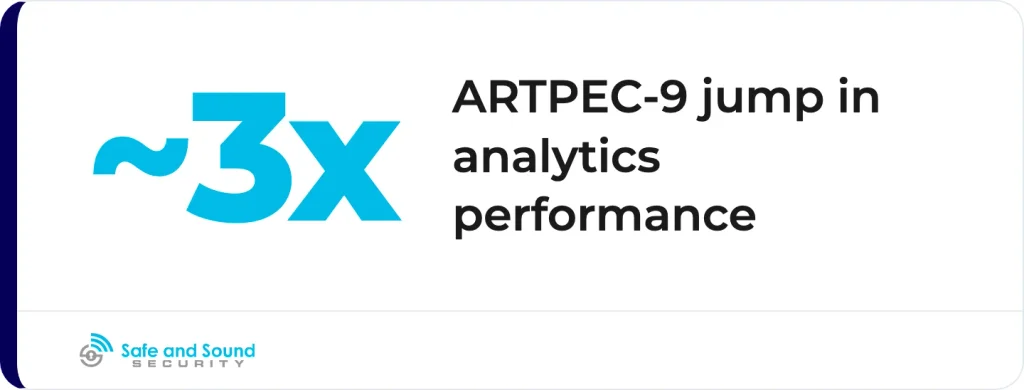
Both Axis and Hanwha design their own camera processors in-house, which is the main reason each controls its image quality and analytics so tightly. Axis announced ARTPEC-9, its ninth-generation system-on-chip, in late 2024, adding AV1 encoding, stronger on-chip AI, and a roughly threefold jump in analytics performance; the chip is rolling out gradually, so ARTPEC-8 still powers most of the current lineup (Axis newsroom). Hanwha’s current generation is Wisenet 9, released in 2025, which the company positions around faster built-in AI inference than its prior Wisenet 7 platform.
The practical takeaway is that both brands are a generation ahead of what most comparison articles describe, which still reference ARTPEC-8 and older Wisenet hardware. In-house silicon on both sides also means firmware, security features, and analytics are developed by the camera maker rather than bolted on from a third-party chipset.
AI and Analytics: Open ACAP vs Built-In Deep Learning
Both manufacturers offer analytics that run on compatible cameras. AXIS Object Analytics detects, classifies, tracks and counts people and vehicles, and comes preinstalled at no extra cost on supported Axis cameras. Axis also supports specialist ACAP applications, some of which require separate licenses.
Hanwha offers built-in deep-learning analytics on supported models, including object and attribute functions. The useful comparison is the exact scenario you need, its model and firmware support, and whether the selected VMS receives the required events and metadata. Brand name alone does not establish a universal included-AI advantage.
VMS and Ecosystem: AXIS Camera Station vs Wisenet WAVE and BLAZE
Both brands ship their own video management software and both stay open to third-party platforms, so neither locks your footage into a single system. Axis offers AXIS Camera Station, which is Axis-first but also supports ONVIF devices, and Axis cameras integrate cleanly with open platforms like Milestone XProtect and Genetec Security Center. Hanwha offers Wisenet WAVE and its newer BLAZE platform, a hybrid AI video management system that adds semantic and similarity search and automatically detects Hanwha hardware.
One cost detail is worth flagging for mixed fleets: video management platforms often license non-native cameras at a higher tier than their own hardware, so a mixed-brand estate can cost more to license than a single-brand one. Because both brands are ONVIF-based, a mixed Axis-and-Hanwha deployment is technically possible, which is not the case with closed cloud cameras that bar third-party software entirely. If you are also choosing recording hardware, our NVR vs DVR comparison covers how each fits a commercial system.
NDAA, TAA and Country of Origin: Are Hanwha Cameras Banned?
No, Hanwha cameras are not banned in the United States, and both Axis and Hanwha Vision meet NDAA Section 889. This is the single most misread point in the Axis-versus-Hanwha debate. The federal covered list that drives the camera “ban” names Hikvision, Dahua, Huawei, ZTE, and Hytera (FCC covered list); Hanwha is a South Korean company and appears on none of it. Hanwha’s current government guidance distinguishes its NDAA statement from TAA eligibility for certain products. TAA status is model-specific for both Hanwha and Axis. Obtain the selected model’s country-of-origin and compliance documentation rather than inferring eligibility from the brand or a general manufacturing-location statement.
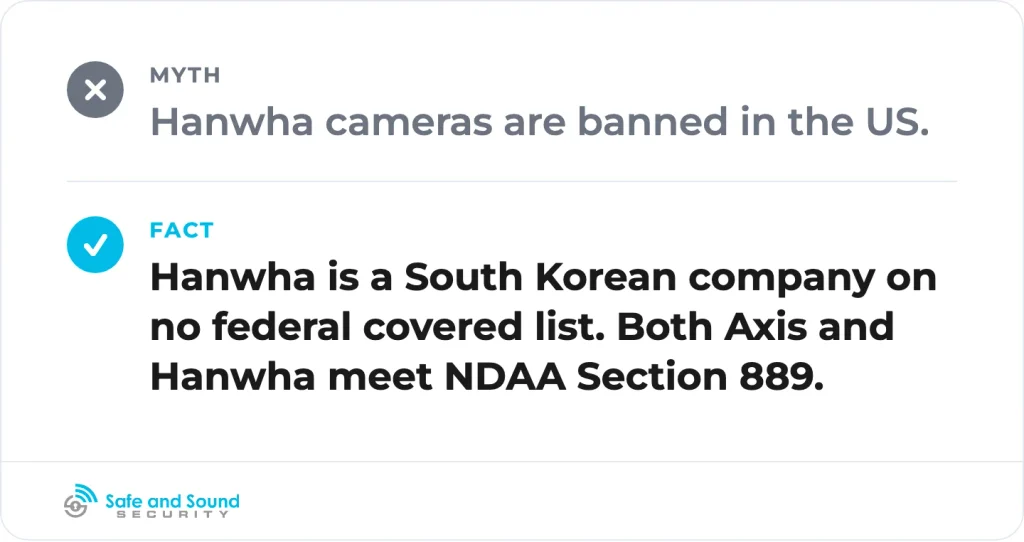
Axis clears the same bar. The manufacturer states that every product in its range meets Section 889, and that all its cameras run on NDAA-compliant chipsets (axis.com). For buyers on the strictest federal and defense projects, one nuance matters: Axis lists TAA compliance as product-specific rather than portfolio-wide, and it has not yet affirmed the tighter Section 5949 rule that takes effect in December 2027. Match the selected model and its documentation to the procurement rules that apply to the project; NDAA and TAA are separate checks. Our NDAA compliance page explains what the rule requires, and our guide on Hikvision and NDAA shows why the banned brands fail it.
Pricing and Total Cost of Ownership
Both lines span a wide range of hardware and features. Compare named models against the same scene requirements: resolution, lens, night performance, analytics, environmental rating, warranty and integration. Then compare the installed bill of materials, including licenses and infrastructure. A brand name alone does not establish the cheaper matched system.
Hardware is only part of the cost. Any separately licensed analytics, mixed-fleet VMS licenses, installation labor, and network cabling all feed the total. IP cameras now account for the large majority of the global surveillance camera market, at a 64.35 percent revenue share in 2025 (Mordor Intelligence), so most of these costs apply whichever brand you pick. Power over Ethernet cabling and installation labor are real line items worth planning early, not afterthoughts. For a full breakdown of what drives a system price, see our guide to security camera cost.
Reliability, Lifespan and Warranty
Both Axis and Hanwha now back current hardware with a five-year standard warranty, which removes a difference that older comparisons still cite. Axis offers its five-year warranty free of charge on products shipped on or after April 1, 2020 (axis.com), and Hanwha Vision America warrants network hardware shipped from July 1, 2023 for five years from the date of original purchase, honored on authorized-dealer purchases (Hanwha Vision America). Axis also carries a long-standing reputation for ten-year-plus service life, which is a pattern many large deployments report rather than a guarantee.

On reliability, no independent practitioner source we reviewed shows one brand as categorically more dependable than the other. Issues that do surface on either brand tend to tie to specific model-and-firmware combinations rather than the brand as a whole. The one documented security item worth noting is even-handed: researchers at Nozomi Networks disclosed and helped patch several medium-severity vulnerabilities in a Hanwha camera and its device manager (Nozomi Networks), while Axis hardens its own cameras with signed firmware and secure boot. Treat vulnerability disclosure as normal for any major vendor, not as a mark against one brand.
Which Brand Fits Which Project
There is no universal winner between Axis and Hanwha. The decision usually comes down to three questions: how deep your integration and ecosystem needs run, how tight the hardware budget is, and how long the system has to last. The two brands are built around different answers to those questions.
Axis is built around a premium, open ecosystem and a long service life, which is why it tends to suit large, standardized, or mission-critical fleets and projects that need a specific certified analytics partner from the ACAP marketplace. Hanwha offers built-in AI on compatible models, which can suit projects where the included functions match the actual detection task. Compare its quote with an Axis configuration that also includes Object Analytics. Because both are open and ONVIF-based, many sites run a mix. The deciding factor is rarely the badge on the camera; it is matching the camera to the site and specifying it correctly, which is where an experienced integrator earns its keep.
Specifying and Installing Either Brand
The camera brand is only a fraction of a working security system; specification, cabling, software configuration, and compliance documentation decide whether either brand actually performs. This is the part no spec sheet covers. A camera chosen correctly but mounted on undersized cabling, pointed at the wrong coverage angle, or paired with the wrong video management software will underperform a cheaper camera that was engineered into the site properly.
Safe and Sound Security is a nationwide commercial security installer that specifies, installs, integrates, and maintains enterprise IP camera systems, with 20,000 or more locations protected over 19-plus years and approval on 15-plus government procurement vehicles. We have installed Axis cameras for more than 90 customers across 190-plus signed projects, and because we are brand-agnostic, we specify and source whatever enterprise camera line fits each site rather than pushing a single brand. For government and federally funded work, we handle the NDAA documentation and compliance review that these projects require. Learn more on our security camera installation page, or our government security systems page for public-sector projects.
Frequently Asked Questions
Are Hanwha cameras banned in the US?
No. Hanwha Vision is a South Korean company and its cameras meet NDAA Section 889. The federal covered list that drives the camera ban names Hikvision, Dahua, Huawei, ZTE, and Hytera, and Hanwha is not on it.
Is Axis NDAA compliant?
Yes. Axis states that every product it sells meets Section 889 of the 2019 NDAA, and that all its cameras are built on NDAA-compliant chipsets.
Who owns Axis and Hanwha?
Axis Communications has been a wholly owned subsidiary of Canon since 2015. Hanwha Vision is part of South Korea’s Hanwha Group and was formerly known as Samsung Techwin, then Hanwha Techwin, before its 2023 rename.
Is Hanwha cheaper than Axis?
Brand alone does not establish the lower price at a comparable specification. Compare named models and configured quotes for the same scene, lens, included analytics, VMS licenses, mounting, cabling, power and support term.
Can Axis and Hanwha cameras run on the same system?
Yes. Both brands support ONVIF and work with open video management platforms such as Milestone and Genetec, so a mixed deployment of Axis and Hanwha cameras is possible.
The Bottom Line
Axis and Hanwha are both open, NDAA-compliant enterprise camera brands, and the gap between them is narrower than most comparisons suggest. Axis leans premium, with in-house ARTPEC silicon, an open analytics marketplace, and a long-lifecycle reputation. Hanwha offers built-in AI on compatible models. Compare the configured quotes, warranty terms and model-specific procurement requirements alongside ecosystem fit and installation quality; the brand alone does not establish a cheaper matched system.
That last factor is where the project is won or lost. Safe and Sound Security designs, installs, and integrates commercial and government IP camera systems nationwide, matching the right brand to each site and handling the cabling, software, and compliance that turn cameras into a working system. If you are weighing Axis against Hanwha for an upcoming project, contact our team to spec the right fit.
Sources
- Axis Communications: About Axis
- Axis Communications: Government and NDAA Compliance
- Axis Communications: ARTPEC SoC
- Axis Communications: Camera Application Platform
- Axis Communications: Warranty
- Hanwha Vision: About Hanwha Vision
- Hanwha Vision: NDAA Section 889 Statement
- Hanwha Vision America: Warranty and Repair
- Nozomi Networks Labs: Flaws in Hanwha Wisenet Cameras
- FCC: Covered List
- Mordor Intelligence: Surveillance Camera Market


