
For a commercial building, the choice between DSC and Honeywell comes down to scope. DSC is a focused intrusion-alarm brand owned by Johnson Controls. Honeywell is a broad commercial manufacturer that builds intrusion panels, access control, video, and fire alarm under one name. The two overlap mainly on alarm panels. Everywhere else, Honeywell has a product line and DSC does not.
There is one wrinkle that trips up most buyers: “Honeywell” on security hardware now means two different companies. Since 2018, the familiar VISTA alarm panels belong to Resideo, which licenses the Honeywell Home brand. The true commercial Honeywell portfolio, including MAXPRO and Pro-Watch, stayed with Honeywell Building Automation. Knowing which one you are looking at changes the whole comparison.
At Safe and Sound Security, we install commercial intrusion alarm systems for businesses and government agencies nationwide, and we have installed DSC and PowerG equipment for more than 230 customers across more than 430 signed projects. We install and service both brands, so this comparison is about which platform fits your building, not which badge we prefer.
Key Takeaways
- DSC is intrusion-focused; Honeywell is multi-system. The right pick depends on whether you want one manufacturer across alarm, access control, video, and fire, or a specialist intrusion platform.
- “Honeywell” means two companies now. Resideo owns the VISTA alarm line under a licensed Honeywell Home brand. Honeywell Building Automation owns the commercial MAXPRO, Pro-Watch, and Notifier lines.
- PowerG uses encrypted wireless. DSC PowerG runs two-way 128-bit AES encryption on the sensor-to-panel link. Honeywell runs two wireless generations, the older 5800 and the newer SiX, so confirm which one a site uses before relying on it.
- Capacity tiers differ. DSC PowerSeries Pro scales to 248 zones for mid-to-large commercial jobs. VISTA is light-commercial, and MAXPRO Intrusion is the enterprise Honeywell tier.
- For most commercial jobs, the integrator matters more than the brand. How the system is specified, integrated, and supported decides real-world reliability.
DSC vs Honeywell: Commercial Systems Compared
DSC and Honeywell solve the same core problem, commercial intrusion detection, from two different starting points. DSC builds a deep, focused alarm platform. Honeywell builds across the whole building. This side-by-side sets the two commercial platforms against each other before the full breakdown.
| Feature | DSC | Honeywell |
|---|---|---|
| Brand focus | Intrusion alarm panels and sensors | Intrusion, access control, video, and fire |
| Flagship commercial panel | PowerSeries Pro (up to 248 zones) | VISTA light-commercial and MAXPRO Intrusion (enterprise) |
| Wireless and encryption | PowerG, two-way 128-bit AES | 5800 (legacy) and SiX (newer) wireless lines |
| Native breadth | Intrusion focus; ancillary fire-zone support depends on model and listing | Intrusion, access, video, and fire under one manufacturer |
| Ownership | Johnson Controls / Tyco (sale to Truelink Capital announced, pending) | Resideo (VISTA, licensed Honeywell Home) and Honeywell Building Automation (MAXPRO, Pro-Watch, Notifier) |
| Buying channel | Professional dealer and distributor | Professional dealer and distributor |
Capacities and tiers are from each manufacturer’s own product pages, as of November 2026. Panel prices in this guide are bare-panel street prices and exclude sensors, keypads, labor, and monitoring.
DSC: Focused Intrusion-Alarm Platform
DSC is a specialist intrusion-alarm brand, built entirely around burglar alarm panels, sensors, and monitoring. Its commercial strength is depth in one job rather than breadth across many.
The lineup scales in two families. The PowerSeries Neo HS2128 expands to 128 wireless and hardwired zones across 8 partitions, which fits small to mid-sized sites. The PowerSeries Pro HS3248 expands to 248 total zones and is positioned by DSC for mid-to-large-sized commercial installations, Grade 3 compliant with anti-masking technology for wired and wireless zones. DSC’s dual-path LTE and IP communicators report to Sur-Gard receivers and Alarm.com interactive services, which covers common commercial central-station monitoring setups.
DSC is suitable for commercial sites that need scalable hardwired or hybrid intrusion, strong encrypted wireless, and multi-partition control for multi-tenant buildings. Security integrators on IPVM describe PowerG wireless range and module size favorably in commercial burglary threads, reported as installer experience rather than a lab result.
DSC’s focus in this comparison is intrusion. Some intrusion panels support ancillary fire zones, but that is different from a complete listed commercial fire-alarm portfolio. Access and video require supported integration with other product families. Those systems live under separate Johnson Controls brands, so a buyer who wants one manufacturer across every system does not get it from a DSC panel alone. DSC commercial gear is also sold through professional dealers and distributors rather than direct retail, which is the norm for commercial-grade equipment on both sides of this comparison.
As of November 2026, a PowerSeries Neo board runs around $310 and a PowerSeries Pro board runs roughly $440 to $510 at security distributors. Those are control-panel prices only. A working commercial system adds sensors, keypads, PowerG devices, labor, and monitoring, which carries the installed cost well above the panel figure.
Honeywell: Multi-System Commercial Manufacturer
Honeywell is a broad commercial security manufacturer that spans intrusion, access control, video, and fire alarm under one corporate name. That breadth is its defining difference from DSC.
On intrusion, Honeywell runs two tiers. The VISTA line, such as the VISTA-128BPT at 128 zones and 8 partitions, is labeled light-commercial. The enterprise tier is MAXPRO Intrusion MPI 2000, which connects up to 60 programmable zones, 500 users, and 46 peripherals for larger, critical-infrastructure sites. Beyond intrusion, Honeywell builds access control through Pro-Watch and WIN-PAK, video through MAXPRO VMS, and fire alarm through its Notifier, Silent Knight, and Fire-Lite brands.
Honeywell suits commercial and government buyers who want one manufacturer across several systems, sites expanding or keeping an existing VISTA or Notifier footprint, and enterprise projects that need Pro-Watch and MAXPRO. You can read more about the commercial lineup on our Honeywell commercial security page.
The material limitation is brand fragmentation. After the 2018 Resideo spin-off, two different companies sell security hardware under the Honeywell name, with different dealer networks, support channels, and licensing. A commercial buyer can land on the wrong one without realizing it. A second point to check is the wireless generation: Honeywell runs both the older 5800 line and the newer SiX line, and the two are not interchangeable on an older site, so confirm what is installed before extending it.
As of November 2026, a VISTA-128BPT panel lists around $460 and a VISTA-250BPT around $710 at security distributors, again bare-panel. The enterprise tier, MAXPRO Intrusion and Pro-Watch, is quote-only with no published list price, which is standard for enterprise commercial platforms.
What “Honeywell” Means Today: The Resideo Split
Since October 29, 2018, Honeywell’s residential and small-business security business has been a separate public company called Resideo. Honeywell confirmed the spin-off of Resideo Technologies that day, and Resideo’s own SEC filing states, “We separated from Honeywell International Inc. on October 29, 2018.” The familiar VISTA, 5800, SiX, and Lyric products are now Resideo products, sold under the Honeywell Home brand under license from Honeywell.
The commercial Honeywell portfolio did not move. MAXPRO, Pro-Watch, WIN-PAK, and the Notifier family of fire brands stayed with Honeywell Building Automation. So the word “Honeywell” on an alarm quote can point to either company depending on the product line.
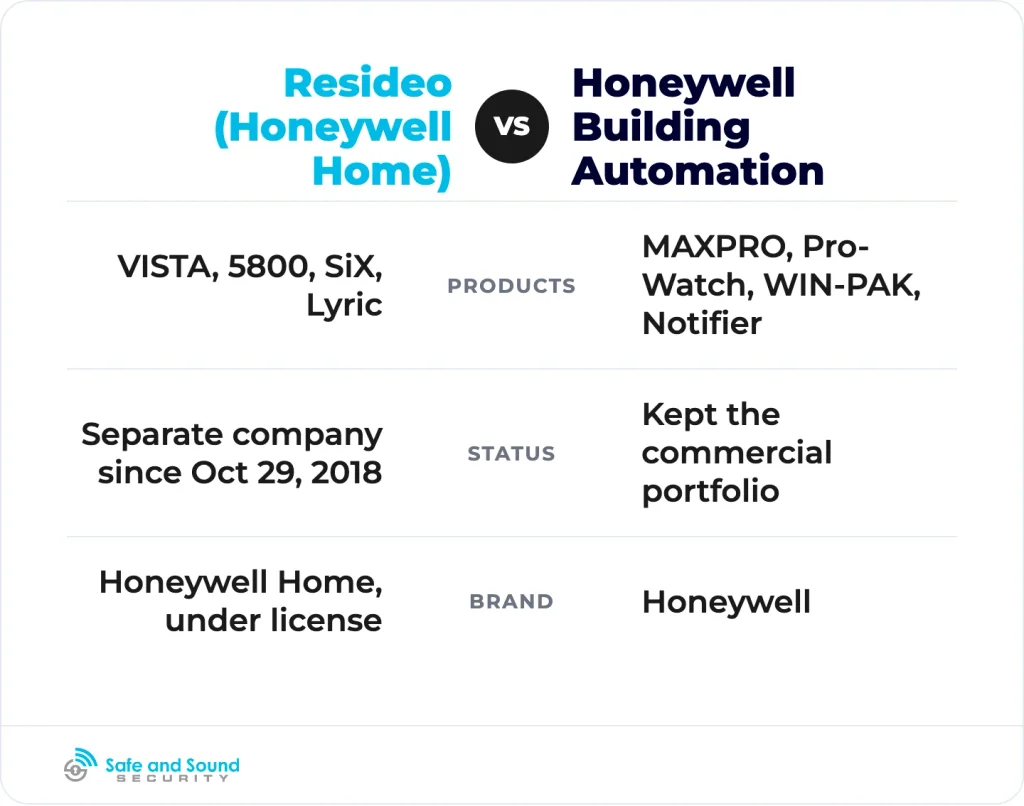
This matters for a commercial buyer because the two companies run different dealer networks, support channels, and warranty paths. A facilities director comparing a “Honeywell” VISTA panel against a “Honeywell” MAXPRO system is comparing a Resideo product against a Honeywell Building Automation product. Confirming which entity, and which support path, stands behind the quote prevents a surprise after the install.
Panel Lineups and Capacity for Commercial Buildings
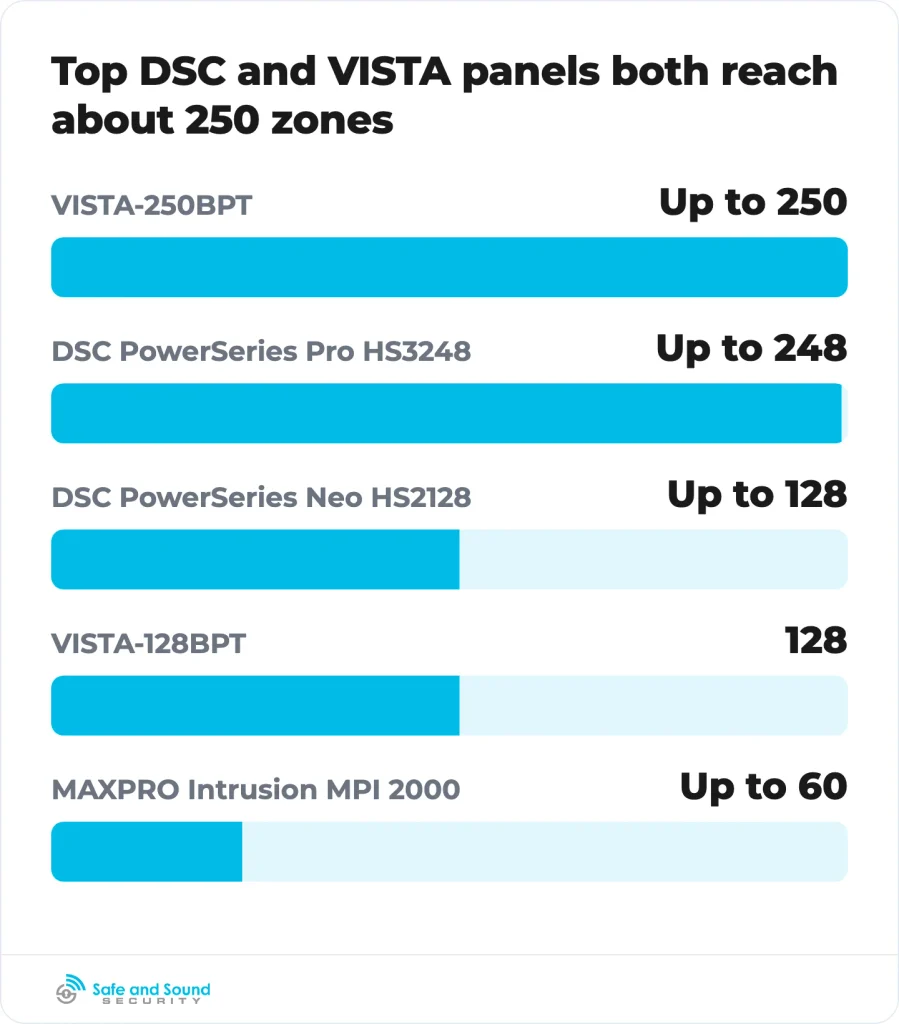
The honest tier match is VISTA against DSC Neo, and DSC PowerSeries Pro against Honeywell’s enterprise MAXPRO. Lining the panels up by their maker’s published capacity shows where each one fits.
| Panel | Maker | Zone capacity | Partitions | Positioned for |
|---|---|---|---|---|
| PowerSeries Neo HS2128 | DSC | Up to 128 zones | 8 | Small to mid-sized sites |
| PowerSeries Pro HS3248 | DSC | Up to 248 zones | Multi-partition | Mid-to-large commercial |
| VISTA-128BPT | Resideo (Honeywell Home) | 128 zones | 8 | Light-commercial |
| VISTA-250BPT | Resideo (Honeywell Home) | Up to 250 zones | 8 | Light-commercial |
| MAXPRO Intrusion MPI 2000 | Honeywell Building Automation | Up to 60 zones | Multi-area | Enterprise, critical infrastructure |
DSC’s PowerSeries Pro is the brand’s commercial workhorse, built for mid-to-large sites and listed by DSC as Grade 3 compliant. On the Honeywell side, VISTA covers light-commercial and small-business needs, while MAXPRO Intrusion is the enterprise platform for larger installations and critical-infrastructure sites. For the fundamentals behind these systems, see our guide to the commercial intrusion alarm. DSC lists the HS3248 at up to 248 total zones; the published partition counts and the VISTA-250BPT capacity come from each maker’s product and dealer documentation and should be confirmed against the current spec sheet before you design a system.
Wireless and Encryption: PowerG vs 5800 and SiX
On wireless, PowerG has the clearer encryption story. DSC’s PowerG sensors use two-way 128-bit AES encryption, which protects the radio link between the sensor and the panel. DSC also positions PowerG for long-range transmission, a benefit on larger commercial sites where sensors sit far from the panel.
Honeywell’s wireless splits across two generations, the older 5800 line and the newer SiX line. The two are not interchangeable, so a commercial site should confirm which sensors are installed and whether they meet its security requirements rather than assuming every “Honeywell” wireless device is equivalent. On an older building, planning the upgrade path to the current generation is safer than extending legacy wireless by default.
Breadth Beyond Intrusion: Access, Video, and Fire
Honeywell can carry intrusion, access control, video, and fire alarm under one manufacturer. DSC cannot, because it is an intrusion specialist and relies on sibling brands or third-party integration for everything else.
For a building standardizing on one platform, that breadth is Honeywell’s main commercial argument. Its Honeywell access control line and its Notifier and Silent Knight fire brands let a single manufacturer cover several systems. DSC keeps its focus on the alarm panel and integrates with access and video through Alarm.com, building management systems, or the separate Johnson Controls brands.
Breadth under one badge is not automatically the better choice. Many strong commercial deployments mix brands on purpose, pairing a specialist intrusion panel with a separate access or video platform. What matters is that the systems integrate cleanly and that one contractor owns the result. We install and integrate either path, whether that is a single-manufacturer stack or a best-of-breed mix across access control and security cameras.
Programming, Monitoring, and Installer Experience
Programming is where installers feel the difference day to day. DSC uses its DLS software and a menu-driven keypad workflow. Honeywell’s VISTA panels use a traditional address-and-item programming style that integrators on IPVM repeatedly describe as harder to learn, reported as working experience rather than a product defect.
On monitoring, both brands reach commercial central stations through dual-path cellular and IP communicators. DSC communicators report to Sur-Gard receivers and Alarm.com, a common commercial stack. Honeywell panels connect through their own communicator range to the same kind of central-station and interactive services. Either way, the monitoring path should be dual-path for a commercial site so a cut line or failed radio does not leave the building unprotected. Our commercial alarm monitoring service covers that central-station side.
Pricing Reality for Commercial Systems
Panel prices are the small part of a commercial system. The bare-board figures, around $310 for a DSC Neo, roughly $440 to $510 for a DSC Pro, about $460 for a VISTA-128BPT, and about $710 for a VISTA-250BPT as of November 2026, only cover the control panel. The real cost lands in sensors, keypads, wireless devices, cabling, labor, and ongoing monitoring.
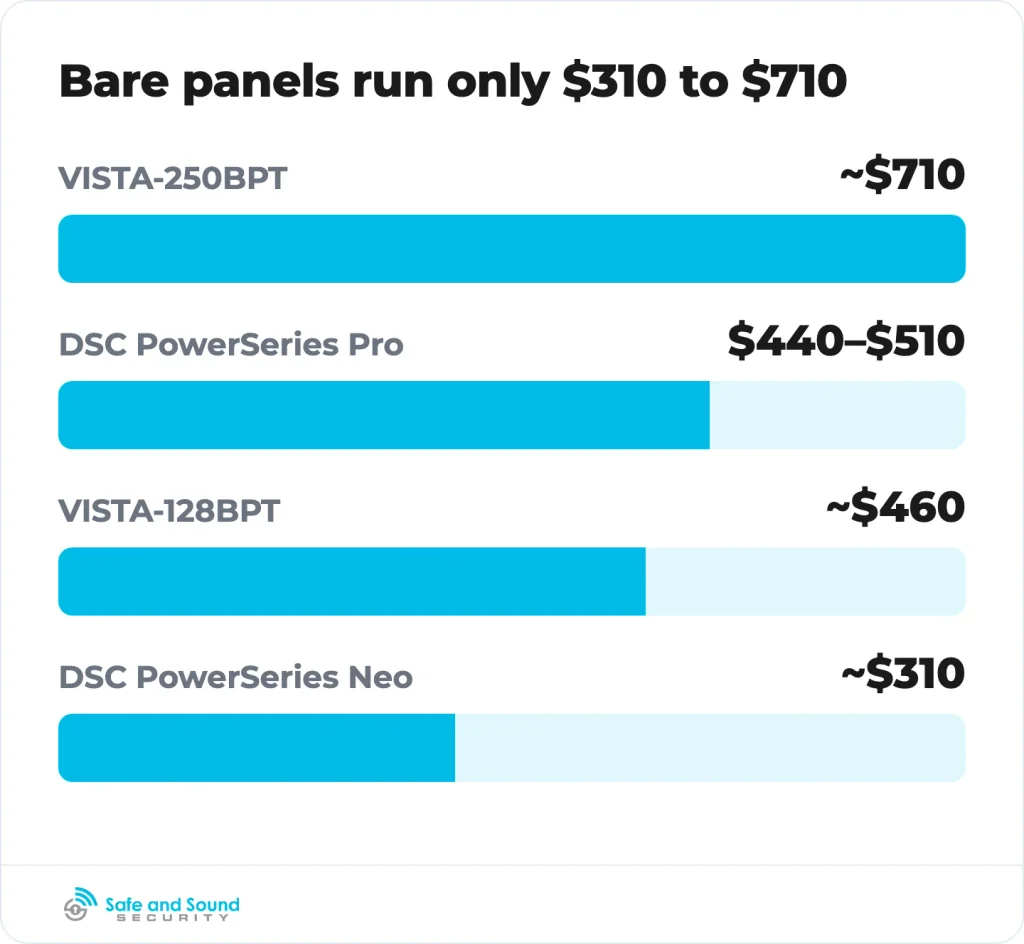
Enterprise tiers carry no public list pricing at all. DSC Pro-scale deployments and Honeywell MAXPRO or Pro-Watch systems are quoted per project, because zone counts, device types, integration, and labor vary too much for a list price. For realistic budgeting ranges across commercial alarm systems, see our business alarm systems pricing guide. The practical takeaway is to compare installed quotes on matching scope, not panel stickers.
Which System Fits Your Building
The fit follows the scope of the job, and neither brand wins in the abstract. An intrusion-only requirement that needs encrypted PowerG wireless and multi-partition control across a multi-tenant building fits DSC’s profile well. A requirement to standardize intrusion, access, video, and fire under one manufacturer, or to expand an existing Honeywell or Notifier footprint, fits Honeywell’s profile.
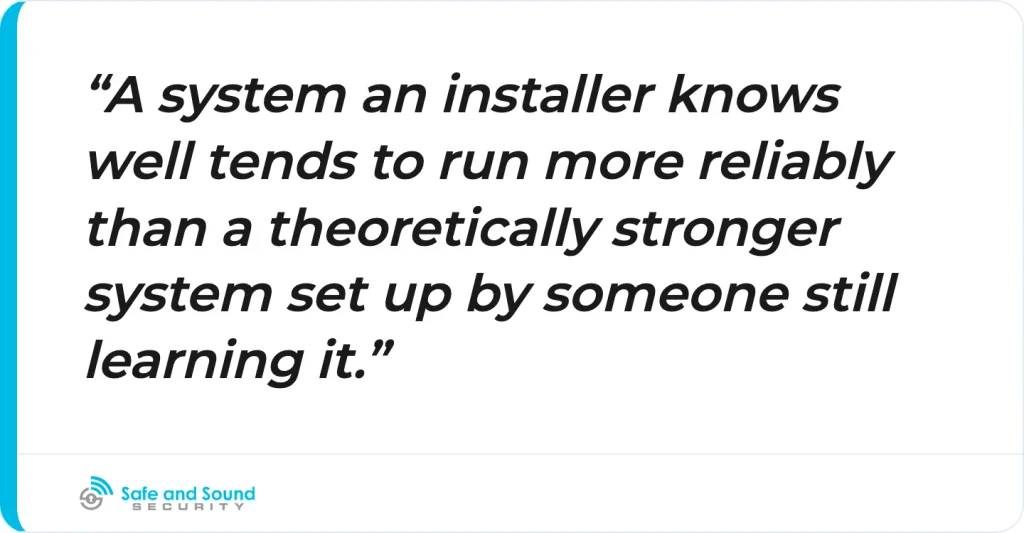
For most commercial buildings, though, the deciding factor is not the badge on the panel. It is whether the system is specified at the right tier, integrated cleanly with access and video, and supported by a contractor who knows the platform. A system an installer knows well tends to run more reliably than a theoretically stronger system set up by someone still learning it. That is the real decision for a facilities or security director. We install and service both DSC and Honeywell as a brand-agnostic commercial alarm installer, so the platform choice stays about your building rather than our catalog.
Frequently Asked Questions
Who owns DSC?
DSC (Digital Security Controls) is a brand of Johnson Controls, under its Tyco line. On October 26, 2026, Truelink Capital announced an agreement to acquire Johnson Controls’ global intrusion products business, including DSC. The buyer’s announcement expects closing in the first half of 2027, subject to approvals and closing conditions; this is an announced transaction rather than a completed change of ownership.
Who makes Honeywell VISTA alarm systems now?
Resideo makes and sells the Honeywell VISTA line. Honeywell spun off its residential and small-business security business as Resideo in 2018, and VISTA products are now sold under the Honeywell Home brand under a license from Honeywell. The commercial MAXPRO and Pro-Watch lines remain with Honeywell Building Automation.
Is DSC PowerG encrypted?
Yes. DSC PowerG uses two-way 128-bit AES encryption on the wireless link between each sensor and the panel. That encryption is a practical advantage on commercial sites, where a spoofed or intercepted sensor signal is a real risk.
Which is better for a commercial building, DSC or Honeywell?
It depends on scope. DSC fits an intrusion-focused project that wants encrypted PowerG wireless and multi-partition scaling. Honeywell fits a building that wants one manufacturer across intrusion, access, video, and fire, or that is extending an existing Honeywell footprint. For most buildings, a competent integrator who specifies and supports the system well matters more than the brand.
Conclusion
DSC and Honeywell answer the commercial intrusion question from opposite directions. DSC gives you a focused alarm platform with excellent encrypted wireless and a clean path to 248 zones. Honeywell gives you breadth, intrusion plus access, video, and fire under one manufacturer, as long as you confirm which Honeywell entity stands behind each product line after the Resideo split. VISTA competes with DSC’s Neo tier, and DSC’s PowerSeries Pro competes with Honeywell’s enterprise MAXPRO.
For a commercial building, the panel brand matters less than getting the system specified at the right tier, integrated with the rest of your security stack, and supported for the long run. At Safe and Sound Security, we install and service commercial security systems for businesses and government agencies nationwide, with security and structured cabling delivered under one C7 low-voltage license and more than 20,000 locations protected over 19 years in business. We install and service both DSC and Honeywell, so the decision stays about your building.
If you are weighing a new intrusion system or replacing an aging panel, our team can spec and install the right platform for your site. Talk to us about a commercial alarm system.
Sources
- DSC: PowerSeries Neo HS2128 Control Panel
- DSC: PowerSeries Pro Security Products
- DSC: PowerSeries Pro Grade 3
- DSC: Dual-Path Communicator
- Honeywell: Completes Spin-Off of Resideo Technologies
- Resideo Technologies: Form 10-K
- Resideo: VISTA Solutions
- Resideo: VISTA-128BPT Light Commercial Burglary Alarm
- Honeywell Building Automation: MAXPRO Intrusion MPI 2000
- Honeywell Building Automation: Pro-Watch Software
- Honeywell Building Automation: Products by Brand
- SDM Magazine: Truelink Capital to Acquire Johnson Controls Global Intrusion Business
- IPVM: Napco vs Honeywell vs Interlogix vs DSC for Commercial Burglary


