
Biometric attendance systems have changed how businesses track who’s actually showing up to work — and they do it with a level of accuracy that older methods simply can’t match. Time theft costs employers up to 7% of gross annual payroll, and most of it goes undetected. Biometric technology closes that gap by tying every clock-in to a unique physical trait — no workarounds, no buddy punching, no manual errors. In this guide, we’ll break down how these systems work, their costs, and what you need to know before deploying one.
Key Takeaways
- Time theft can cost up to 7% of gross annual payroll — biometric systems eliminate buddy punching entirely by tying attendance to each individual’s unique physical traits
- Biometric privacy laws now apply in 20+ U.S. states — compliance with BIPA, CCPA, and FERPA (for SLED buyers) is a required step before deployment, not an afterthought
- Commercial-grade systems cost 40–60% more than consumer devices — and hidden costs like enrollment, training, and compliance infrastructure typically add 20–40% on top of hardware quotes
- Environment determines the right modality — fingerprint works in clean office settings, while industrial and healthcare environments often require facial recognition or multi-modal systems
- Most organizations see a 3–5% reduction in labor costs in the first year after implementing biometric attendance tracking
What’s a Biometric Attendance System?
A biometric attendance system records employee attendance using biometric data, such as fingerprints, facial features (face recognition), or iris scans.
Unlike traditional attendance methods, biometric systems rely on unique physical characteristics that cannot be easily duplicated or faked. This makes them highly accurate and secure, ensuring that only authorized employees can gain access and be marked present.
The global biometric attendance system market reflects the widespread adoption of this technology by commercial and institutional operators. The market was valued at $3.82 billion in 2024 and is projected to reach $9.89 billion by 2032, growing at an 11.05% CAGR — driven primarily by demand from corporate office buildings, government agencies, healthcare campuses, and K–12 and higher education institutions.
How Does It Work?

A biometric attendance system works by capturing and storing employees’ biometric data. Here’s a step-by-step explanation of how these systems typically operate:
- Enrollment: Employees’ biometric data, such as fingerprints or facial images, are captured and stored in the system’s database. This data is associated with the employee’s identity and used for future verification.
- Verification: When an employee arrives at work, they use the biometric attendance machine to scan their biometric data. For example, they might place their finger on a fingerprint scanner or look into a facial recognition camera.
- Matching: The system compares the scanned biometric data against the data stored in the database. If there is a match, the employee’s attendance is recorded. This process is quick and accurate, reducing the chances of human error.
- Attendance Tracking: The system logs the attendance data, which management can access for attendance tracking and payroll processing. This data provides a reliable record of when employees clock in and out, helping ensure accurate payroll and monitor work hours.
- Access Control: In addition to tracking attendance, biometric systems can control access to restricted areas within the workplace, enhancing overall security.
Biometric Modality Comparison: Which Technology Is Right for Your Environment?
Not all biometric technologies perform equally across environments. Choosing the wrong modality for your workplace is one of the most common deployment mistakes.
| Modality | Best Environment | Key Limitation | Relative Cost |
|---|---|---|---|
| Fingerprint | Clean offices, controlled indoor spaces | Fails for manual laborers, dirty/wet hands | Low–Moderate |
| Facial Recognition | Warehouses, healthcare, contactless settings | Affected by poor lighting, face coverings | Moderate–High |
| Iris Scan | High-security areas, labs, data centers | Requires precise positioning; higher cost | High |
| Multi-Modal (Face + Fingerprint) | Industrial, multi-site enterprise | Higher hardware cost | Moderate–High |
| Mobile/App-Based | Remote, hybrid, or field workforces | Relies on employee device availability | Low–Moderate (SaaS) |
For industrial and warehouse settings specifically: Fingerprint scanners may struggle with accuracy for laborers with worn-out fingerprints or in dirty environments, while facial recognition systems can face challenges with poor lighting or face coverings. Multi-modal systems that combine fingerprint and facial recognition offer the most reliable performance in demanding environments.
What are the Benefits?
The business case for biometric attendance tracking is measurable. Organizations typically see a 3–5% reduction in labor costs within the first year of deployment. The core drivers:
- Accuracy: Biometric systems use unique physical characteristics, such as fingerprints and facial features, to ensure precise time and attendance tracking. Manual systems and punch cards allow manipulation — biometrics don’t.
- Security: They are more secure than traditional methods, preventing proxy attendance and unauthorized access.
- Buddy Punching Elimination: Buddy punching — where employees clock in for absent colleagues — affects an estimated 75% of businesses that use traditional time tracking. Biometric systems remove this entirely.
- Efficiency: Speeds up clock-in and clock-out, reducing time wasted on manual entries.
- Integration: Easily integrates with existing attendance software and payroll systems, streamlining administrative tasks.
- Reduced Fraud: Eliminates the possibility of buddy punching, where employees clock in or out for each other.
- Data Storage: Stores data electronically, enabling access and analysis for attendance trends and payroll processing.
- Remote Access: Some systems offer mobile applications that allow employers to track time and attendance from anywhere.
- Compliance: Helps businesses comply with labor laws and regulations by providing accurate attendance records.
For multi-site commercial operators and SLED organizations — managing office campuses, government facilities, or school districts — cloud-based biometric systems offer an additional layer of value: centralized management across all locations, real-time dashboards, and direct payroll sync, eliminating manual data reconciliation at every site.
Are There Limitations or Disadvantages?

While biometric systems offer significant benefits, there are limitations that every buyer should plan for:
- Privacy Concerns: Employees may be concerned about storing and using their biometric data, such as fingerprints or facial recognition. Unlike passwords, a compromised fingerprint cannot be changed. Clear policies, transparent communication, and strong data governance are critical before rollout.
- Legal Compliance Requirements: This is the most frequently overlooked cost. As of 2026, 20+ U.S. states have enacted or proposed biometric privacy legislation. Illinois’ BIPA and California’s CCPA/CPRA are the most consequential — requiring written consent, data retention policies, and deletion protocols before a single scan is taken. Violations under BIPA can reach $1,000–$5,000 per incident. Compliance infrastructure must be budgeted alongside hardware.
- Employee Resistance: Some employees may resist biometric enrollment on privacy grounds. Providing a compliant opt-out alternative (card or PIN fallback) is not just good practice — in some states, it’s legally required.
- Initial Cost: The setup cost for biometric systems can be higher than that of traditional time-and-attendance systems. See our full cost breakdown below.
- Technical Issues: Biometric systems rely on technology, which can malfunction and disrupt the attendance tracking process.
- Environmental Factors: Certain environmental conditions — like dirt, dust, or poor lighting — can affect the accuracy of fingerprint scanning and facial recognition. Industrial buyers should select modalities appropriate for their environment.
- Enrollment Time: Initial enrollment takes time. For organizations with 200+ employees across multiple access points, enrollment can represent multiple days of dedicated HR or IT effort — a hidden cost that rarely appears on vendor quotes.
- Maintenance: Regular maintenance and firmware updates are required to ensure biometric devices remain accurate and secure.
Are Biometric Systems Safe?
Biometric systems are significantly more secure than traditional card or PIN-based methods. They use advanced encryption and store mathematical representations of biometric traits — not the actual fingerprint images — making them extremely difficult to reverse-engineer.
However, it’s important to be accurate about what “secure” means in practice. Like all networked systems, biometric devices require proper configuration, access controls, and data governance to maintain security. A well-implemented biometric system is robust; a poorly configured one creates liability.
Key security considerations for commercial deployments:
- Biometric templates should be encrypted at rest and in transit
- Data access should be restricted to authorized personnel only
- Systems must be configured in compliance with applicable state laws before going live
- Ongoing firmware updates are necessary to close security vulnerabilities
The compliance layer is non-negotiable. Illinois’ BIPA has fueled hundreds of class-action lawsuits — settlements regularly reach tens of millions of dollars. California’s CCPA/CPRA treats biometric data as sensitive personal information with specific disclosure and deletion rights. For SLED buyers: biometric records maintained by educational institutions can fall under FERPA protection, adding a compliance layer on top of state biometric laws.
Working with an experienced installer who understands your state’s requirements ensures your system is configured for compliance from day one — something a software-only vendor typically can’t provide.
How Much Does It Usually Cost?
The cost of implementing a biometric system varies significantly based on technology type, deployment scale, and total cost of ownership — not just hardware.
Hardware baseline:
- Basic fingerprint reader: $200–$500 per device
- Advanced multi-modal or facial recognition reader: $500–$1,200+ per device
- Enterprise systems with cloud management: Variable; typically SaaS-priced per door/per month
The true commercial TCO includes costs most vendors don’t itemize:
| Cost Category | Typical Range | Notes |
|---|---|---|
| Hardware (per device) | $200–$1,200+ | Fingerprint vs. facial vs. multi-modal |
| Professional installation | Labor rate varies by region | Metro areas run 25–40% higher |
| Staff training | $500–$2,000 | System admins + end users |
| Enrollment time (200+ employees) | Multiple days of IT/HR effort | 15+ minutes per user, per access point |
| Compliance infrastructure | Legal review + consent workflows | Required before deployment in most states |
| Ongoing maintenance & updates | Variable | Annual calibration, firmware, SLA coverage |
Commercial-grade systems cost 40–60% more than consumer-grade devices due to the need for durability, audit trails, and integration with HR and payroll systems. Hidden costs — enrollment, training, and compliance infrastructure — typically add another 20–40% to the hardware quote.
Despite the higher upfront investment, most organizations see measurable ROI within 12–24 months through reduced payroll leakage and the elimination of time theft.
For a detailed breakdown of biometric system pricing by technology type and deployment scale, see our biometric access control system pricing guide.
Industry-Specific Considerations
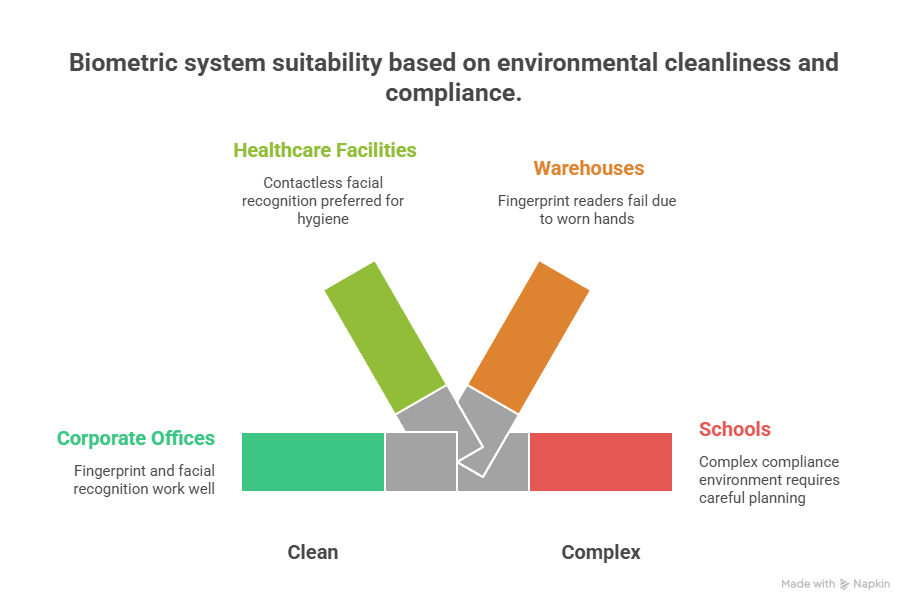
Corporate Offices and Commercial Buildings
Fingerprint and facial recognition are both well-suited to clean office environments. For facilities managers and IT directors overseeing multi-tenant commercial buildings, office campuses, or corporate headquarters, the primary focus is integration — ensuring biometric attendance data feeds directly into payroll and HRIS platforms. Cloud-based systems with API connectivity are the standard choice for organizations running modern HR software stacks. Multi-site operators benefit most from cloud-managed platforms that provide a unified view across all locations from a single dashboard.
Warehouses and Industrial Facilities
Industrial environments are where standard fingerprint readers most frequently fail. Workers with calloused, worn, or frequently wet hands often cannot be reliably scanned. Facial recognition or multi-modal systems are the recommended solution. Durability ratings (IP65 or higher) matter for readers installed near loading docks or in environments with variable temperatures.
Schools, Universities, and SLED Organizations
Government agencies, K–12 districts, and universities face the most complex compliance environment among buyer segments. Biometric attendance deployments must comply with state biometric privacy laws, FERPA data governance requirements (for student records), and the terms of cooperative procurement vehicles such as CMAS, PEPPM, NASPO ValuePoint, or BuyBoard. Procurement officers and security directors at these institutions need a contractor already approved for these vehicles — not just a software vendor selling a subscription. That distinction directly affects whether a deployment can be funded and contracted through standard institutional channels.
Healthcare Facilities
Contactless facial recognition is the preferred modality for hygiene-sensitive zones. Healthcare deployments also intersect with HIPAA when employee health information is involved. Selecting a system with strong data segregation and access controls is essential.
FAQs
What is the safest biometric security system?
The most secure systems combine multiple biometric technologies — fingerprint, facial recognition, and/or iris scanning — with strong encryption and strict data access controls. Multi-modal systems are significantly harder to defeat than single-modality systems. In high-security environments, pairing biometrics with a second factor (a card or PIN) adds another layer of security.
How much does a biometric attendance system cost?
Commercial deployments vary widely by technology and scale. Basic fingerprint readers start around $200–$500 per device. Enterprise multi-modal systems run $500–$1,200+ per reader. Don’t budget on hardware alone — enrollment, training, compliance infrastructure, and ongoing maintenance typically add 20–40% to the total project cost. See our full biometric pricing guide for a complete breakdown.
What is the most widely used biometric device today?
Fingerprint scanners remain the most widely deployed biometric modality globally due to their lower cost and reliability in controlled environments. However, facial recognition is growing rapidly — particularly in healthcare, warehousing, and any environment where contactless operation is preferred. For industrial settings, multi-modal systems combining both technologies are increasingly the recommended standard.
Is a biometric attendance system legal in my state?
It depends on your state. As of 2026, more than 20 U.S. states have enacted or proposed biometric privacy legislation. Illinois (BIPA), California (CCPA/CPRA), Texas (CUBI), Washington, and Colorado have active requirements. Most laws require written notice to employees, explicit consent before data collection, documented data retention and deletion policies, and secure storage. Consult legal counsel before deployment, particularly in Illinois and California, where exposure to violations is highest.
What happens if an employee refuses to enroll in a biometric system?
In states with biometric privacy laws, employers may be required to offer an alternative method of attendance tracking for employees who object. Even in states without explicit requirements, providing a card or PIN fallback is a practical best practice — it reduces legal exposure and morale friction. Employers in Illinois, for example, cannot force enrollment without meeting BIPA’s consent requirements.
How long does implementation take?
Most biometric attendance systems can be operational within a few days to a few weeks, depending on organization size and infrastructure. The enrollment phase is often the biggest time investment: expect 15+ minutes per employee per access point for initial biometric capture. For a 200-person organization with multiple controlled access points, plan for multiple days of dedicated IT or HR time before the system is fully operational.
Can biometric attendance systems work for remote or hybrid workforces?
Yes — mobile-based biometric attendance apps now support remote and hybrid teams. Employees clock in using facial recognition or fingerprint authentication on their smartphones, often combined with GPS geofencing to confirm location. This is increasingly common for field service teams, construction sites, and organizations with distributed workforces who need attendance accountability without fixed hardware.
Ready to Implement a Biometric Attendance System?
A biometric attendance system is one of the most effective ways to eliminate payroll fraud, improve workforce accountability, and simplify compliance recordkeeping. But the difference between a successful deployment and a costly one comes down to implementation: choosing the right modality for your environment, configuring the system to meet your state’s biometric privacy requirements, and integrating it properly with your existing access control and HR infrastructure.
We’ve protected more than 20,000 commercial and government locations across the country over 19+ years. Our team installs and integrates biometric access control and attendance systems for commercial office buildings, warehouses, manufacturing facilities, government agencies, and educational institutions — all configured for compliance from day one. For SLED buyers, we are an approved contractor on CMAS, PEPPM, and 15+ additional government procurement vehicles, simplifying the path from specification to contract.
Contact us today for a free consultation to discuss your biometric attendance project.
References
- https://www.marketresearchintellect.com/product/biometric-attendance-system-market/
- https://mihcm.com/resources/blog/biometric-attendance-systems-the-ultimate-guide/


