
When searching for the ideal educational environment for their children’s futures, many parents increasingly prioritize both academic achievement and comprehensive safety measures. The safest school districts in America demonstrate that exceptional security doesn’t come at the expense of educational excellence. Instead, these two priorities work hand-in-hand to create environments where students thrive. With school safety concerns at an all-time high, understanding which districts lead the nation in protecting students while delivering outstanding education has never been more crucial for families making informed decisions about their children’s futures.
School Safety Statistics in the U.S.

Key Statistic: School crime victimization rates dropped 77% between 2019 and 2021, from 30 to 7 victimizations per 1,000 students.
The current landscape of school safety in America reveals both encouraging trends and ongoing challenges that shape how districts approach security and student protection. According to federal data from the Bureau of Justice Statistics, nonfatal criminal victimization rates in schools decreased dramatically from 30 to 7 victimizations per 1,000 students between 2019 and 2021, representing a remarkable 77% reduction in student victimization. This improvement occurred alongside the implementation of comprehensive safety measures across the nation’s schools.
This dramatic improvement represents one of the most significant positive developments in American education over the past generation. The reduction encompasses both violent crimes, such as assault, and property crimes, including theft, indicating broad-based improvements in school safety environments. The data suggests that coordinated safety efforts, increased funding for security measures, and improved emergency response protocols are producing measurable results in protecting students from criminal activity.
Teacher Safety Shows Parallel Improvement
Teacher safety has also shown significant improvement, with threats against educators declining from 10% to 6% between 2011-12 and 2020-21. Physical attacks on teachers by students similarly decreased from 6% to 4% during the same period. These positive trends suggest that coordinated safety efforts are producing measurable results in protecting all members of the school community.
Professional Safety Trend: Teacher victimization rates have decreased across all categories, with verbal threats down 40% and physical attacks down 33% over the past decade.
The improvement in teacher safety directly correlates with enhanced educational environments, as teachers who feel secure can focus more effectively on instruction and student support. Research indicates that teacher safety concerns significantly impact job satisfaction, retention rates, and instructional quality, making these improvements particularly significant for overall educational outcomes and students’ test scores.
Grade-Level Safety Variations

However, challenges remain, and the data reveal clear patterns by school level that inform targeted safety interventions:
- Elementary schools: 8.7 incidents per thousand students (lowest rate)
- Middle schools: 13.6 incidents per thousand students (57% higher than elementary)
- High schools: 15.1 incidents per thousand students (74% higher than elementary)
Critical Insight: Middle schools show the steepest increase in safety incidents, with 90% reporting at least one violent incident and 28% experiencing weekly bullying.
This grade-level progression highlights the need for age-appropriate safety interventions that address the changing social dynamics as young students mature. The data suggest that early adolescence represents a particularly vulnerable period requiring specialized attention and resources. Middle schools face unique challenges related to social development, identity formation, and peer relationships that can contribute to increased safety concerns without proper intervention and support systems.
The elementary school advantage likely stems from smaller physical size, closer supervision ratios, and less complex social dynamics among younger students. However, even elementary schools must address safety concerns, with 83.2% of reported incidents involving either assaults or sexual offenses, highlighting the need for comprehensive safety planning across all grade levels.
Modern Threat Landscape
Emerging Concern: 82% of schools face cybersecurity challenges, while 3% of public schools reported hate crimes in 2022.
Modern safety concerns have expanded beyond traditional physical security to include cybersecurity threats, with 82% of schools facing digital security challenges that threaten both operational continuity and student data protection. This digital threat landscape includes ransomware attacks that can shut down school operations, data breaches that compromise student privacy, and cyber-harassment that extends traditional bullying into online environments.
Additionally, 3% of public schools reported hate crimes in 2022, representing a concerning trend that requires specialized attention and response strategies. This statistic, while seemingly small, represents thousands of incidents affecting tens of thousands of students across the nation, highlighting the need for comprehensive approaches to addressing bias-motivated incidents and creating inclusive school environments.
The Top Five Safest Districts
1. Adlai E. Stevenson High School District No. 125 (Lincolnshire, Illinois)
Achievement Highlight: 96% graduation rate with zero incidents of physical restraint and timeout procedures
Leading the nation with a 96% graduation rate and A+ ratings across multiple categories, this top district exemplifies how safety excellence supports academic achievement. The district reported zero incidents of physical restraint and timeout procedures during the 2022-2023 school year, demonstrating comprehensive approaches to student behaviour management that prioritize de-escalation and positive intervention strategies.
Located in affluent Lincolnshire, Illinois, the district serves approximately 4,000 students and has invested heavily in both academic programming and safety infrastructure. The district’s success stems from comprehensive planning that integrates safety considerations into all aspects of educational programming, from classroom management to emergency preparedness to community engagement initiatives.
2. Glenbrook High School District 225 (Glenview, Illinois)
Community Safety Factor: Located in an area with just two violent crimes per thousand inhabitants
Located in a community with exceptionally low crime rates, this district benefits from strong local safety foundations while implementing comprehensive school-based security measures. The surrounding community maintains violent crime rates of just 2 per thousand inhabitants, creating an environment where schools can focus on educational excellence rather than addressing external security threats.
The Glenbrook High School District serves two high schools with approximately 3,800 students and has developed sophisticated approaches to safety that leverage both community resources and internal capabilities. Their comprehensive safety planning includes advanced technology integration, professional development for all staff members, and extensive partnerships with local emergency responders.
3. New Canaan Public Schools (Connecticut)
Performance Metrics: 97% graduation rate, 86% reading proficiency, 81% mathematics proficiency
Ranking in the top 1% of all districts nationwide, New Canaan maintains a 97% graduation rate with 86% reading proficiency and 81% mathematics proficiency. The district’s consistent high performance reflects a sustained commitment to both safety and academic excellence, with comprehensive programming that addresses the full spectrum of student needs.
The district’s success shows that academic excellence and safety are interconnected—students who experience rigorous learning and supportive teacher relationships are less likely to engage in unsafe behaviors. New Canaan has invested in comprehensive counseling services, advanced security technology, and extensive professional development to maintain these exceptional outcomes.

4. East Williston Union Free School District (Old Westbury, New York)
In this Long Island district, supportive teaching and active parent involvement form safety networks where concerns are quickly recognized and addressed through strong connections among students, families, and staff. The district’s approach demonstrates how community engagement and relationship-building can create comprehensive safety networks that extend far beyond traditional security measures.
Relationship-Based Safety: Strong parent-teacher communication creates early warning systems for identifying and addressing potential safety concerns before they escalate.
The East Williston Union Free District serves approximately 1,800 students across four schools. It has developed sophisticated approaches to parent engagement that create multiple touchpoints for communication and collaboration around student safety and well-being. Their model demonstrates how smaller districts can achieve exceptional safety outcomes through intensive relationship-building and community engagement.
5. Syosset Central School District (New York)
Scale of Excellence: Serving 7,016 students across ten schools with comprehensive programming
Serving 7,016 students across ten schools, this district demonstrates how comprehensive programming in academics, music, sports, and clubs creates multiple touchpoints for student engagement and adult supervision. The Syosset Central School District’s approach shows how larger systems can maintain personalized attention and safety oversight through strategic programming and resource allocation.
The district has implemented comprehensive safety measures, including advanced visitor management systems, professional security staffing, and extensive emergency preparedness training, while maintaining focus on positive school climate development through robust extracurricular programming and student support services.
Additional Top Performers and Regional Distribution
Additional top-performing districts include Ladue School District (Missouri), Eanes Independent School District (Texas), and several other Illinois districts that have invested heavily in comprehensive safety infrastructure and programming. The geographic distribution reveals important patterns:
Geographic Pattern: Illinois claims 4 of the top 5 positions, while suburban districts nationwide dominate safety rankings.
Regional Characteristics of Top Districts:
- Illinois dominance: Four of the top five positions, reflecting state-level investment in education
- Suburban concentration: Most top districts are located in affluent suburban communities
- Geographic diversity: Representation from the Northeast, the Midwest, the South, and the West
- Community investment: High property values supporting robust school funding
- Professional staffing: Above-average teacher-student ratios and specialized personnel
These districts share common characteristics, including:
- Substantial community investment in education funding
- Professional security staffing with specialized training
- Integration of safety measures with positive school climate initiatives
- Comprehensive emergency preparedness programs
- Advanced technology implementation for safety and communication
How We Ranked the Safest School Districts
The evaluation of school district safety requires a comprehensive analysis of multiple factors that contribute to secure learning environments. Leading ranking organizations utilize sophisticated methodologies that examine both quantitative data and qualitative assessments from multiple stakeholder groups, creating holistic evaluations that consider the full spectrum of factors affecting student safety and well-being.

Methodology and Data Sources
Modern school district evaluation systems have evolved far beyond simple test score comparisons to incorporate comprehensive safety assessments that reflect the complex realities of contemporary education. These rankings systems utilize multiple data sources, including:
- Federal crime statistics from the School Survey on Crime and Safety (SSOCS)
- Student and parent surveys regarding safety perceptions and experiences
- Academic performance data showing a correlation between safety and achievement
- Community demographic information reflecting external safety factors
- Professional assessments of safety infrastructure and emergency preparedness
- Incident reporting data from state and local education agencies
Four Key Ranking Criteria
Academic Integration with Safety
Core Principle: Educational excellence and safety are interconnected priorities that reinforce each other in high-performing districts.
Top rankings systems recognize that educational excellence and safety are interconnected priorities rather than competing demands. Districts achieving the highest safety rankings typically demonstrate strong academic performance, as engagement in learning activities and positive relationships with teachers create natural protective factors against behavioral issues and safety concerns.
The correlation between academic achievement and safety outcomes reflects multiple factors, including student engagement levels, teacher-student relationships, resource availability, and community investment in education. Districts that maintain high academic standards often have better-trained teachers, more comprehensive programming, and stronger community support systems that contribute to overall safety.
Community Safety Context
The broader community environment significantly influences school safety outcomes in ways that extend far beyond school building boundaries. Districts located in areas with low crime rates, stable housing, strong family structures, and economic opportunity benefit from these external protective factors while implementing their own comprehensive safety measures.
Community Impact: Districts in communities with violent crime rates below 5 per thousand inhabitants show significantly better school safety outcomes.
Community safety factors that influence school district rankings include:
- Local crime rates and law enforcement effectiveness
- Economic stability and employment opportunities
- Housing stability and neighborhood cohesion
- Access to mental health and social services
- Community investment in youth programming and education
Infrastructure and Technology Assessment
Modern school safety evaluation includes a comprehensive assessment of technological infrastructure, from basic controlled access systems and surveillance capabilities to advanced emergency communication systems and threat detection technology. The most comprehensive districts have invested in multi-layered technological approaches while maintaining focus on human relationships and community building.
Technology assessment criteria include:
- Controlled access systems: Entry points, visitor management, perimeter security
- Surveillance capabilities: Coverage, quality, monitoring, and analysis systems
- Communication systems: Emergency alerts, intercom capabilities, external coordination
- Threat detection: Weapons screening, behavioral monitoring, environmental sensors
- Data protection: Cybersecurity measures, privacy safeguards, backup systems
Emergency Preparedness Capabilities
Ranking systems measure how effectively districts can prepare for and respond to emergencies, from natural disasters to medical incidents and security threats. This comprehensive assessment includes evaluation of training programs, coordination with emergency responders, and communication systems that function during crises.
Preparedness Standard: Top districts conduct a minimum of 12 emergency drills annually, covering multiple scenario types with external agency coordination.
Emergency preparedness evaluation encompasses:
- Training frequency and quality: Staff preparation, student instruction, scenario variety
- Response coordination: Law enforcement partnerships, emergency services integration
- Communication systems: Alert capabilities, family notification, media management
- Recovery planning: Continuity of operations, psychological support, facility restoration
- Continuous improvement: After-action reviews, plan updates, lesson integration
Emerging Trends in School Safety Across America
The evolution of school safety reflects changing threat landscapes and advancing technology solutions that create new opportunities for protecting students while maintaining positive educational environments. Understanding these trends helps districts plan for future challenges and investment priorities while adapting to rapidly changing security environments that require continuous learning and adaptation.
Technology Integration Revolution
Integrated Technology Solutions
Technology Trend: Artificial intelligence applications now provide real-time threat analysis and automated alerting capabilities that enhance response times while reducing false alarms.
Advanced sensor technology now enables the detection of multiple threats simultaneously, including weapons, vaping, aggressive behavior, and air quality issues that could impact student health and safety. Companies like HALO have developed multipurpose sensors that utilize artificial intelligence to provide real-time detection and alerting capabilities while serving multiple functions that make them cost-effective investments for school districts.
Modern technology integration includes:
- AI-powered surveillance: Behavioral analysis, crowd monitoring, threat identification
- Environmental monitoring: Air quality, sound analysis, unauthorized substance detection
- Communication platforms: Multi-channel alerts, location tracking, response coordination
- Access control systems: Biometric identification, visitor management, perimeter monitoring
- Data analytics: Pattern recognition, predictive modeling, resource optimization
The CENTEGIX Safety Platform exemplifies comprehensive technology integration, providing schools with reliable communication systems that operate independently of Wi-Fi or cellular connectivity, ensuring that emergency communications remain functional even when primary systems fail. The platform’s wearable panic button technology provides 100% campus-wide coverage with immediate digital mapping for first responders.
Also read: School Vaping Statistics
Mental Health Integration
Comprehensive Mental Health Programming
More schools are acknowledging that true safety depends on addressing the mental health challenges that may lead to harmful behaviors. Districts at the forefront of school safety expand resources for counseling and social-emotional learning while partnering with community providers to proactively address underlying concerns.
Investment Reality: Leading districts employ one counselor per 250 students compared to the national average of 1 per 408 students.
Mental health integration includes:
- Enhanced staffing ratios: More counselors, psychologists, and social workers
- Early intervention programs: Screening, assessment, and preventive services
- Social-emotional learning: Curriculum integration, skill development, relationship building
- Community partnerships: External mental health providers, specialized services, family support
- Crisis response capabilities: Immediate intervention, coordination with emergency services
The recognition that mental health significantly impacts school safety has led to substantial changes in how districts allocate resources and structure support services. Education research consistently demonstrates that schools with robust mental health programming experience fewer behavioral incidents, better academic outcomes, and improved overall school climate.
Community Partnership Expansion
Comprehensive Support Networks
The most effective safety programs extend beyond school buildings to include partnerships with law enforcement, emergency services, mental health providers, and community organizations. These partnerships create comprehensive support networks that address safety challenges through multiple approaches and resources while leveraging community assets to enhance school-based programming.
Modern community partnerships include:
- Law enforcement collaboration: School resource officers, threat assessment, emergency response
- Emergency services coordination: Fire, medical, hazmat response planning and training
- Mental health networks: Clinical services, crisis intervention, family support
- Community organizations: Youth programming, mentorship, resource provision
- Business partnerships: Technology support, funding, career connections
Partnership Impact: Districts with 5+ active community partnerships report 40% fewer serious safety incidents than those with minimal external connections.
Why School Safety Matters
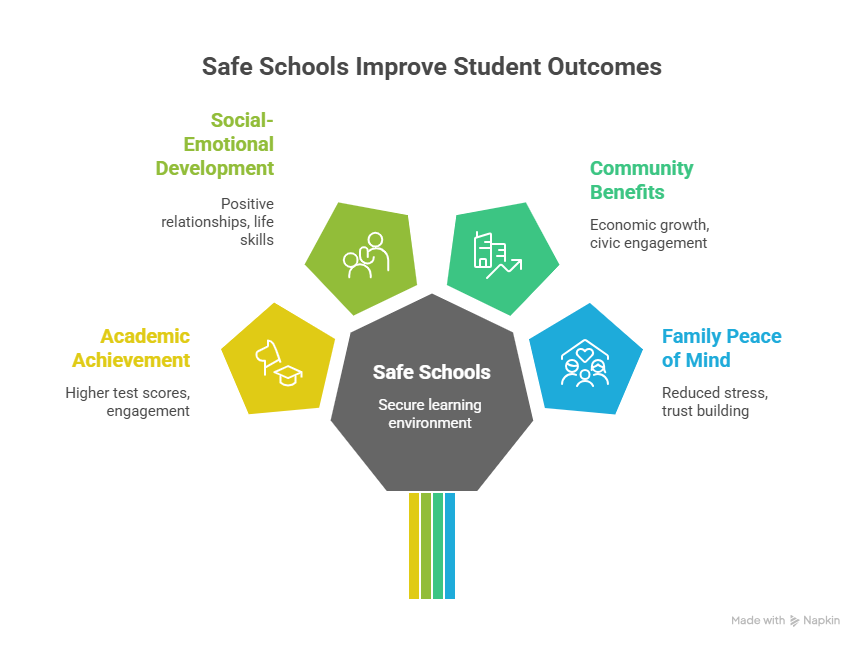
Core Finding: Safe schools create conditions where effective teaching and learning occur without disruption from safety concerns.
The importance of comprehensive school safety extends far beyond preventing dramatic incidents to encompass the daily learning environment that affects every student’s educational experience and long-term development. When students feel safe and secure, they can focus on learning, participate actively in classroom discussions, and engage with peers in positive ways that support social and emotional development – creating a strong foundation for their future career path.
Academic Achievement Connection
Direct Impact on Learning Outcomes
Education research consistently demonstrates strong correlations between school safety and academic performance across all grade levels and demographic groups. Students who feel secure in their learning environment demonstrate higher levels of engagement, better attendance, improved student test scores, and enhanced overall academic outcomes across all subject areas.
Academic Impact: Students in the safest schools show 15-20% higher achievement in reading and mathematics compared to peers in less secure environments.
The connection between safety and achievement operates through multiple mechanisms:
- Cognitive focus: Students can direct mental energy toward learning rather than safety concerns
- Stress reduction: Lower cortisol levels improve memory formation and recall
- Relationship quality: Positive student-teacher connections enhance instructional effectiveness
- Attendance patterns: Consistent school presence improves cumulative learning
- Risk-taking in learning: Students are more willing to engage in challenging academic activities
Safe schools create conditions where effective teaching and learning can occur without disruption from safety concerns or behavioral issues, enabling educators to focus on instruction. At the same time, students engage fully in educational activities.
Social-Emotional Development
Foundation for Healthy Development
Safe school environments provide crucial foundations for healthy social-emotional development, allowing students to form positive relationships with peers and adults while developing essential life skills, including communication, conflict resolution, emotional regulation, and empathy. These skills benefit students throughout their lives and contribute to positive community development.
Social-emotional benefits of safe schools include:
- Relationship building: Trust formation, communication skills, cooperation abilities
- Emotional regulation: Stress management, impulse control, resilience development
- Social skills: Conflict resolution, teamwork, cultural competence, leadership
- Self-efficacy: Confidence building, goal setting, problem-solving abilities
- Identity development: Self-awareness, value formation, future planning
Long-term Impact: Students from safe school environments show 25% higher rates of college completion and career success.
Long-Term Community Benefits
Generational Impact
Schools that maintain safe, positive environments contribute to stronger communities through graduates who are better prepared for higher education, career success, and civic participation. The investment in comprehensive school safety creates lasting benefits that extend far beyond individual students to affect entire communities and future generations – providing enhanced earning potential for children throughout their lives.
Community benefits include:
- Economic development: Better-educated workforce, higher property values, business attraction
- Crime reduction: Lower juvenile and adult crime rates, reduced incarceration costs
- Civic engagement: Higher voting rates, volunteer participation, community leadership
- Social cohesion: Stronger neighborhoods, reduced social problems, cultural vitality
- Generational improvement: Better parenting practices, family stability, child outcomes
Family Peace of Mind
Supporting the Home-School Partnership
Parents who trust their children are secure at school can shift their attention to encouraging academic success at home. This peace of mind strengthens the home-school partnership that is essential for student success while reducing family stress that can negatively impact family functioning and student well-being.
Family Impact: Parents of students in safe schools report 30% less stress related to children’s education and well-being.
Family benefits include:
- Reduced anxiety: Lower parental stress about children’s daily safety and well-being
- Educational support: Greater ability to focus on homework help and academic engagement
- Trust building: Stronger relationships with schools and educational professionals
- Community connection: Increased participation in school activities and volunteer opportunities
- Planning confidence: Greater willingness to make long-term educational investments
Safety Challenges Schools Still Face Today
Cybersecurity and Digital Safety
The Digital Threat Landscape
Challenge Scale: 82% of schools face cybersecurity challenges threatening operations and student data protection
Digital security has become a critical component of comprehensive school safety, with 82% of schools facing cybersecurity challenges that threaten both operational continuity and student data protection. The scope of digital threats includes ransomware attacks that can shut down entire school systems, data breaches that compromise sensitive student information, and online harassment that extends traditional bullying into digital environments where supervision is more difficult.
Modern cybersecurity challenges include:
- Ransomware attacks: System encryption, operational shutdowns, data hostage situations
- Data breaches: Student information theft, privacy violations, identity theft risks
- Phishing campaigns: Credential theft, malware installation, system infiltration
- Cyber-harassment: Online bullying, social media threats, digital stalking
- Infrastructure vulnerabilities: Outdated systems, inadequate protection, human error
Schools must develop expertise in protecting against these digital threats while teaching students about digital citizenship, online safety, and appropriate technology use. This requires substantial investment in both technology infrastructure and human expertise that many districts struggle to afford.
Resource and Expertise Gaps
Significant resource constraints compound the cybersecurity challenge, as schools typically lack the funding and expertise necessary to implement comprehensive digital security measures. Many districts rely on outdated technology systems that lack modern security features, while staff members often receive limited training in cybersecurity best practices.
Expertise Gap: Less than 30% of school districts employ dedicated cybersecurity professionals, leaving them most vulnerable to sophisticated attacks.
Mental Health Resource Gaps
Staffing and Service Limitations
Staffing Reality: National averages of 1 counselor per 408 students and one school psychologist per 1,127 students fall far short of recommended ratios
While recognition of mental health’s importance in school safety has increased dramatically, resource limitations prevent many districts from providing adequate services. The national average of one counselor per 408 students and one school psychologist per 1,127 students falls far short of recommended ratios of 1:250 for counselors and 1:500 for school psychologists, creating significant gaps in support for students experiencing emotional or behavioral challenges.
Mental health resource challenges include:
- Inadequate staffing ratios: Too few professionals to serve student populations effectively
- Limited clinical expertise: Shortage of professionals trained in trauma, crisis intervention
- Funding constraints: Insufficient resources for competitive salaries and comprehensive programming
- Training gaps: Need for ongoing professional development in emerging mental health issues
- Community coordination: Challenges connecting with external mental health providers
The consequences of inadequate mental health support extend beyond individual student needs to affect overall school climate and safety, as unaddressed mental health challenges can contribute to behavioral incidents, academic problems, and more serious safety concerns.
Emerging Mental Health Concerns
Modern students face mental health challenges that previous generations did not encounter, including social media-related anxiety, cyberbullying, academic pressure intensified by college competition, and social isolation exacerbated by technology use. Schools must adapt their mental health programming to address these contemporary issues while maintaining support for traditional concerns.
Emergency Response Coordination
Multi-Agency Collaboration Challenges
Coordinating effective emergency responses requires ongoing collaboration between school personnel, law enforcement, emergency medical services, fire departments, emergency management agencies, and community organizations. Maintaining these relationships and ensuring all parties understand their roles during various types of emergencies requires continuous training, communication, and coordination that can be challenging to sustain over time.
Coordination Reality: Effective emergency response requires coordination among 8-12 different agencies with varying protocols and priorities.
Emergency coordination challenges include:
- Communication protocols: Different radio systems, command structures, terminology
- Response procedures: Conflicting approaches, jurisdictional disputes, resource allocation
- Training coordination: Scheduling, funding, standardization across agencies
- Leadership clarity: Incident command, decision-making authority, resource control
- Community engagement: Public information, family communication, media management
Regular joint training exercises and clear communication protocols are essential for effective emergency response, but these require substantial coordination and resources that many communities struggle to maintain consistently.
Resource Allocation and Funding
Balancing Competing Priorities
Schools face the ongoing challenge of allocating limited resources among competing priorities, including academic programming, safety infrastructure, technology needs, facilities maintenance, and professional development. The cost of comprehensive safety measures can be substantial, requiring districts to make difficult decisions about resource allocation while ensuring that safety investments do not compromise educational quality.
Equity and Access Considerations
Funding Disparity: High-poverty districts spend an average of $2,400 less per student on safety and security measures compared to affluent districts.
Safety resource disparities create concerning equity issues, as districts serving high-need populations often lack the resources necessary to implement comprehensive safety measures despite facing greater safety challenges. This creates a situation where students who may be most vulnerable to safety risks receive the least protection, exacerbating existing educational inequalities.
What Parents Should Look For in a Safe School District

Five Essential Safety Indicators
Comprehensive Safety Planning
Planning Standard: Look for districts with detailed emergency management plans addressing 8+ different emergency scenarios with regular updates and community input.
Districts with well-developed emergency management plans stand out by preparing for everything from medical emergencies to natural and security-related threats.
Effective plans should include clear protocols, regular training programs, coordination with emergency responders, and communication systems that keep families informed during crises.
Comprehensive safety planning should include:
- Multi-hazard approach: Plans for natural disasters, medical emergencies, and security threats
- Clear protocols: Step-by-step procedures for various emergency scenarios
- Training programs: Regular drills, staff preparation, student instruction
- Communication systems: Family notification, media relations, community updates
- Recovery planning: Continuity of operations, psychological support, facility restoration
Parents should ask to review summary documents of emergency plans and inquire about training frequency, community involvement in planning processes, and coordination with local emergency responders.
Professional Staff and Training
Inquire into how districts prepare their safety teams, including resource officers, counselors, administrators, and classroom teachers, through training and ongoing development. Districts should be able to describe their professional development programs and demonstrate commitment to keeping staff current with evolving best practices.
Staff Investment: Top districts provide 40+ hours annually of safety-related professional development for all staff members.
Professional staffing considerations include:
- Specialized personnel: School resource officers, counselors, security coordinators
- Training frequency: Regular professional development, certification maintenance
- Qualification standards: Education requirements, experience expectations, and ongoing evaluation
- Emergency response roles: Clear responsibilities, coordination procedures, communication protocols
- Community connections: Relationships with external agencies, professional networks
Technology Integration
Examine the district’s investment in safety technology, including controlled access systems, surveillance capabilities, emergency communication systems, and visitor management procedures. However, remember that technology alone doesn’t create safe schools – it must be integrated with comprehensive programming and strong relationships between students and staff.
Technology assessment should consider:
- Access control: Entry systems, visitor management, perimeter security
- Surveillance systems: Camera coverage, monitoring capabilities, privacy protections
- Communication platforms: Emergency alerts, intercom systems, external coordination
- Threat detection: Screening procedures, environmental monitoring, behavioral analysis
- Data security: Cybersecurity measures, privacy safeguards, backup systems
Technology Balance: Effective districts use technology to enhance rather than replace human relationships and community-building efforts.
Transparent Communication
Look for districts that communicate openly with families about safety measures, emergency procedures, and incident reporting while maintaining appropriate confidentiality. Regular safety updates, clear emergency communication plans, and opportunities for parent input indicate districts that view families as partners in maintaining safe school environments.
Communication Standard: Effective districts provide monthly safety updates to families and quarterly opportunities for parent input on safety planning.
Also read:
- Dangerous Schools in America
- How Do School Safety Laws Vary by State?
- What Are Library Security Systems?
FAQs
What school has the lowest crime rate?
Individual school crime rates are typically not published publicly to protect student privacy and avoid stigmatizing particular institutions. However, schools in affluent suburban communities with strong community investment and comprehensive safety programming generally maintain the lowest incident rates.
Districts like Adlai E. Stevenson High School District No. 125, a unified school district, in Illinois report zero incidents of physical restraint and timeout procedures, indicating comprehensive approaches to maintaining safe environments. These results reflect stability for current students and reinforce confidence that the district’s commitment to safety remains unchanged year after year.
What city in the US has the best school system?
According to WalletHub’s rankings, Massachusetts leads the nation for overall school system quality, with cities like Boston, Cambridge, and Newton consistently ranking among the top performers. These cities benefit from high per-pupil spending, excellent teacher quality, and comprehensive safety programming.
Connecticut cities, including New Canaan and Darien, also rank exceptionally high for combined academic excellence and safety outcomes. WalletHub’s annual selection of top-performing school systems creates a real ripple effect across the country, prompting districts everywhere to prioritize both educational and safety improvements.
What is the least safe school?
Rankings of “least safe” schools are not typically published to avoid stigmatizing institutions and communities. However, schools facing the greatest safety challenges are often those with limited resources, high teacher turnover, inadequate mental health support, and location in communities experiencing high levels of violence or social instability. These schools require additional support rather than public criticism to improve outcomes for their students.
Are private schools safer than public schools?
Safety outcomes depend more on specific school policies, resources, and community context than on whether schools are public or private. Many public schools in well-resourced communities maintain excellent safety records that exceed those of some private institutions. The most important factors are comprehensive safety planning, adequate staffing, strong school climate, and community support, rather than school type.
How much do schools spend on safety per year?
School safety spending varies dramatically by district size, community needs, and available resources. Large urban districts may spend millions annually on safety personnel, technology, and programming, while smaller districts invest more modest amounts. The key is ensuring that safety investments are evidence-based and integrated with educational programming rather than focusing solely on spending levels.
Key Takeaways
Primary Insight: Exceptional security outcomes result from comprehensive, multi-layered approaches that integrate physical safety measures with positive school climate initiatives.
The safest school districts in America demonstrate that exceptional security outcomes result from comprehensive, multi-layered approaches that integrate physical safety measures with positive school climate initiatives and strong community partnerships. Leading districts recognize that safety and educational excellence are complementary rather than competing priorities that reinforce each other when properly implemented.
Illinois dominates national safety rankings through substantial investment in comprehensive safety programming, with districts like Adlai E. Stevenson achieving remarkable outcomes, including zero disciplinary incidents and 96% graduation rates. Notably, districts in the Cook County Chicago area, DuPage County Chicago area, and broader Chicago area illustrate how sustained investment pays off in measurable safety and academic success.
Similarly, districts in the Gwinnett County Atlanta area, San Diego County, San Francisco Bay Area, Los Angeles County, Santa Clara County, and the New York City area demonstrate that excellence is not region-specific but can emerge wherever communities commit resources and planning.
For parents searching for the right school, examining the best school districts means looking beyond test scores to evaluate how safety and climate interact. When families choose schools, the decision often balances both academic reputation and demonstrated safety practices, showing how these priorities are deeply interconnected.
Next, parents seeking safe schools should look beyond visible security measures to examine comprehensive safety planning, professional staff development, community partnerships, and transparent communication that indicates districts view safety as an integral component of educational excellence rather than a separate concern requiring independent attention.
Citations:
[1] https://www.niche.com/about/niche-releases-its-10th-annual-best-schools-and-districts-rankings-for-2024/
[2] https://bjs.ojp.gov/document/iscs22.pdf
[3] https://bjs.ojp.gov/library/publications/report-indicators-school-crime-and-safety-2023-and-indicator-2-incidence
[4] https://nces.ed.gov/programs/coe/pdf/2024/A02_508c.pdf
[5] https://nces.ed.gov/pubs2024/2024043.pdf
[6] https://www.edweek.org/leadership/school-shootings-in-2024-more-than-last-year-but-fewer-deaths/2024/12
[7] https://nces.ed.gov/programs/coe/pdf/2024/a10_508c.pdf
[8] https://nces.ed.gov/whatsnew/press_releases/5_9_2024.asp
[9] https://www.k12dive.com/news/fbi-hate-crimes-steadily-rising-in-elementary-secondary-schools-doubled/705995/
[10] https://worldpopulationreview.com/state-rankings/public-school-rankings-by-state


