
A mobile credential costs between $0 and about $10 per user per year, but the sticker price on the credential is the smallest part of the bill. The real money goes to the Bluetooth or NFC readers that let a phone open a door ($150 to $600 per door) and the access platform’s software, hosting and support. Some platforms are cloud-managed; others are on-premise with mobile-key delivery services. Whether you pay anything at all for the credential itself depends entirely on the pricing model your platform uses. A mobile credential is a digital key stored on a smartphone or smartwatch that opens a door over Bluetooth, NFC, or a wallet pass instead of a plastic card.
At Safe and Sound Security, we install mobile access control for commercial and government facilities nationwide, and we have delivered card readers and credentials for more than 430 customers. The first question buyers ask us is almost always the wrong one. They ask what a mobile credential costs. The better question is what the whole switch costs, because two platforms with identical phone credentials can land thousands of dollars apart once readers, software, and headcount are counted. This guide lays out current pricing across the major platforms, the three ways credentials are billed, what actually drives the cost, and how mobile compares to key cards over time.
Key Takeaways
- The pricing model matters more than the brand. Platforms that license each credential charge roughly $4 per user per year, while platforms that bundle credentials into the software charge nothing per credential. Same phone, very different recurring bill.
- The credential is cheap; the reader is the budget. Legacy 125 kHz proximity readers cannot read a phone, so a Bluetooth/NFC reader swap at $150 to $600 per door is the real upfront cost of going mobile.
- Mobile beats cards on total cost over time, not sticker price. A lost plastic card costs $2 to $10 plus staff time every time, while a phone credential is revoked and reissued in software at near-zero marginal cost. High-turnover buildings cross over fastest.
- Budget the actual access platform. Mobile keys work with cloud-managed and on-premise systems. Include the applicable license, hosting, support and credential-delivery costs.
- Wallet/NFC and app credentials can have different prices. Compare the exact platform product, supported readers, user allowance and renewal term.
How Much Does a Mobile Credential Cost?
A mobile credential costs between $0 and about $10 per user per year, and the price depends on the billing model, not the technology. Platforms that license each credential, such as HID Mobile Access, charge roughly $4 per user per year with a 20-credential minimum order; Verkada Mobile NFC works out to $9.95 per user per year when all 20 places are used. Platforms that bundle credentials into the software subscription, such as ProdataKey, Kisi, and the ButterflyMX app, charge nothing per credential. On top of the credential, every mobile system needs a Bluetooth or NFC reader at $150 to $600 per door plus the chosen platform’s software, hosting and support costs. A per-door cloud fee applies only where that platform uses one.
Published mobile credential pricing across the platforms a commercial or government buyer is most likely to shortlist is compared here. All figures are current as of November 2026. We install across this field and stay brand-agnostic, so this is a cost comparison, not a recommendation of one platform over another.
| Platform | Mobile credential price | Billing model | Compatible reader (one-time) |
|---|---|---|---|
| HID Mobile Access (Origo) | $3.95 to $4.73 per credential per year (20-credential minimum) | Annual per-credential license | HID Signo 40 around $302 |
| Brivo | Bundled passes by edition (500 on Professional, 1,000 on Enterprise); add-on packs from about $12.40 per 100 per month | Bundled into the plan, plus monthly add-on packs | Third-party readers, quoted per project |
| Avigilon Alta (formerly Openpath) | 10 credentials free, then roughly $2 per credential per year | Per-credential license | Smart reader around $200 to $275 |
| Kisi | Included and unlimited with the door license | Bundled into the door license (platform from $99 per month) | Reader Pro 2 around $475 |
| Verkada Mobile NFC | $199 USD MSRP per license (20 users for one year) | Mobile NFC license, 20 users each | Door reader AD34 around $349 |
| ProdataKey (PDK) | Free, unlimited | Bundled free into the subscription | PDK reader from about $278 |
| Swiftlane | Bundled into the subscription | Per-door monthly software | Reader around $150 to $500 per door |
| Salto (JustIN Mobile) | Mobile add-on about $6 per user, layered on a Salto KS cloud plan | Add-on on the cloud or Space license | Smart lock or reader around $250 to $600 per door |
| ButterflyMX | App credential free | Per-door monthly software ($20 per door, gate, or elevator) | Hardware quoted per project |
| ZKTeco (ZKey app) | $12 to $13 one-time per credential | One-time per-credential license | Bluetooth reader |
Pricing for several platforms, including Salto, Genea, and the base PDK and Swiftlane subscriptions, is quote-only, so the credential and reader figures above reflect published list prices and reseller pricing where the vendor itself does not post a number. Those figures come from current manufacturer and reseller pricing: Brivo, GetSCW for Avigilon Alta, Swiftlane, Saltopro for Salto, and ButterflyMX, plus Kisi, Verkada, ProdataKey, and HID reader listings at ID Wholesaler (each linked in the sections below and in the full list at the end). For brand-specific depth, we keep separate pricing breakdowns for Brivo and Avigilon Alta and Openpath.
The Three Ways Mobile Credentials Are Priced
Mobile credentials are billed one of three ways, and the model you land on decides your recurring cost far more than the brand name does. Credentials are commonly priced per user or per credential, as a one-time license or a yearly subscription, on top of compatible readers (ITBroker). Knowing which model a platform uses tells you whether credentials are a line item that grows with your headcount or a cost that disappears into the software fee.
Per-Credential Annual License
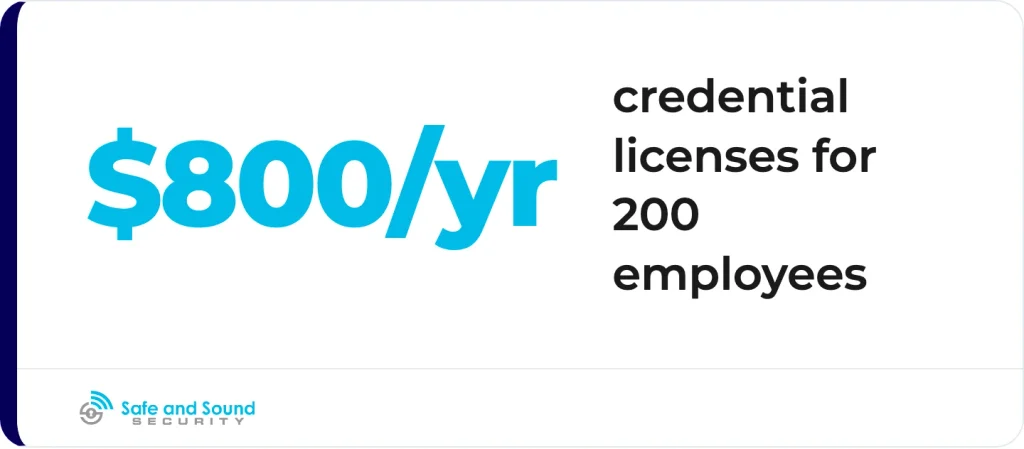
A per-credential license charges a fee for every active phone credential, every year. HID Mobile Access is the common example, with published prices from $3.95 to $4.73 per credential per year and a minimum order of 20 credentials (ID Wholesaler and TapeAndMedia list pricing, as of November 2026). The math is simple and it recurs: 200 employees on a per-credential platform is about $800 a year in credential licenses alone, before readers or software. This model is predictable, but it scales directly with the number of people you let through the door.
Bundled and Unlimited
A bundled model folds credentials into the software subscription, so the per-credential cost is zero and you pay instead for each door or reader. ProdataKey offers free, unlimited mobile credentials (PDK, as of November 2026), Kisi includes unlimited mobile access with its door license (Kisi, as of November 2026), and the ButterflyMX app credential is free with its per-door software fee. This model favors buildings with a high ratio of people to doors, like offices and apartment communities, where handing out thousands of credentials costs nothing extra.
One-Time Credential License
A one-time license buys a credential outright with no annual renewal. ZKTeco’s ZKey credential is $12 to $13 per unit with no recurring fee (Nelly’s Security, as of November 2026). Term-based licenses sit between the annual and one-time models: Verkada sells Mobile NFC at $199 USD MSRP for 20 users for one year, which is $9.95 per user per year when all 20 places are used. Other terms require their own price comparison (Verkada, as of November 2026). Match the model to your headcount-to-door ratio and the right choice usually becomes obvious.
What Drives the Cost of Going Mobile
The biggest costs of switching to mobile credentials are the readers and the software, not the credentials themselves. A building with cheap credentials and old readers will spend far more than a building with pricier credentials and reader-ready doors. Here is where the budget actually goes.
Reader Retrofit
The reader swap is often the largest single line in a mobile credential project. Older 125 kHz proximity readers cannot read a smartphone, so every door that needs mobile access needs a multi-technology Bluetooth/NFC reader, which runs from about $150 to $600 per door across the major platforms. A current reader like the HID Signo 40 lists around $302 (ID Wholesaler, as of November 2026). A 20-door site replacing every reader is looking at $3,000 to $12,000 in hardware before labor. The number of doors you actually need to convert, not the credential price, sets the scale of the project. Our teams size this against the existing reader fleet first, because doors that already run a compatible smart reader may need no hardware change at all. See our guide to access control reader types and cost for how the reader generations differ.
Per-User License Math
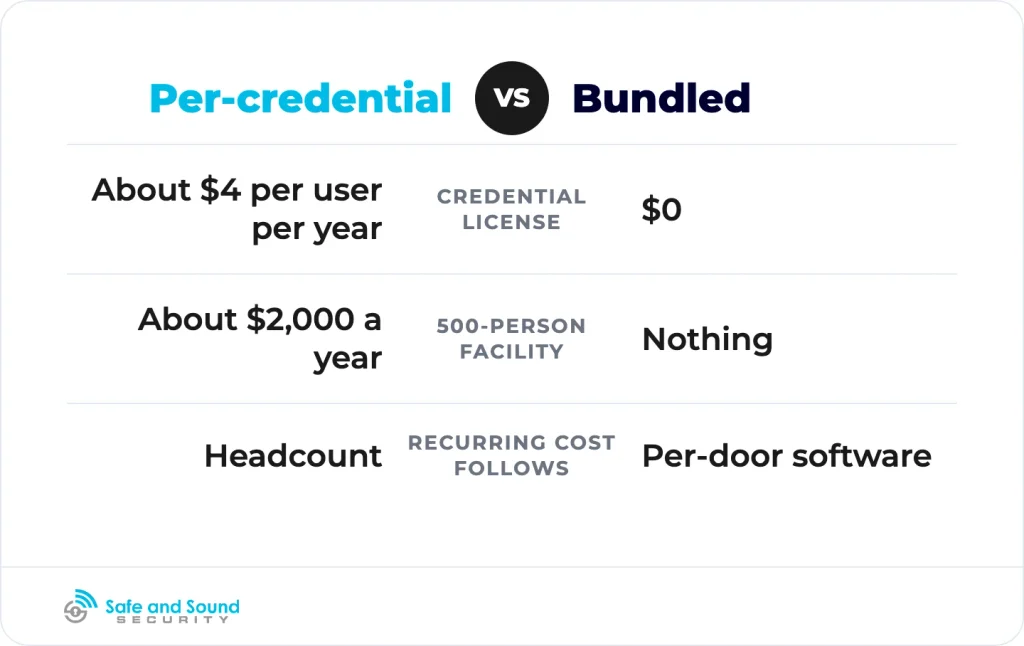
On a per-credential platform, your recurring license cost is headcount multiplied by the annual fee, and on a bundled platform it is zero. That single difference can swing the five-year cost of a large site by thousands of dollars. A 500-person facility pays about $2,000 a year in credential licenses on a per-credential model and nothing on a bundled model. Minimum order quantities matter too: some platforms require a starting block of 20 credentials, which sets a small floor even for a tiny site.
Access Platform Licensing and Hosting
Mobile credentials do not require every access system to be hosted in the cloud. Cloud-managed platforms may charge by door and bundle some credentials into that fee. An on-premise platform can also issue mobile keys: Salto Space’s system requirements describe its local database and connections to Salto cloud services when JustIN Mobile keys are used. Credential delivery over a cloud service is different from a cloud-hosted access-control system. Budget the selected platform’s actual license, hosting and support model rather than adding a universal per-door cloud charge.
Installation and Cabling
A fully installed access control system runs $1,500 to $3,500 per door, or $3,000 to $5,000 per door once first-year licensing is included, per our access control cost guide (as of November 2026). Mobile credentials do not change this baseline much, since the controllers, wiring, and door hardware are the same. We handle the readers and the structured cabling in-house under one license, so a mobile upgrade does not require a separate cabling contractor.
Administration and Lifecycle
Mobile credentials cost almost nothing to issue, revoke, or reissue once the system is live. An administrator provisions a new hire’s phone in the software console in seconds and revokes a departed employee just as fast, with no card to print, mail, or collect. This is the cost that card-based systems carry quietly and mobile systems mostly erase, and it compounds at any site with regular turnover.
Mobile Credentials vs. Key Cards: Total Cost of Ownership
Over several years, mobile credentials usually cost less than key cards for buildings with turnover, even though the upfront reader cost is higher. The comparison buyers should run is total cost of ownership, not the price of a single credential against the price of a single card. A plastic card looks cheaper on day one and often costs more by year three.
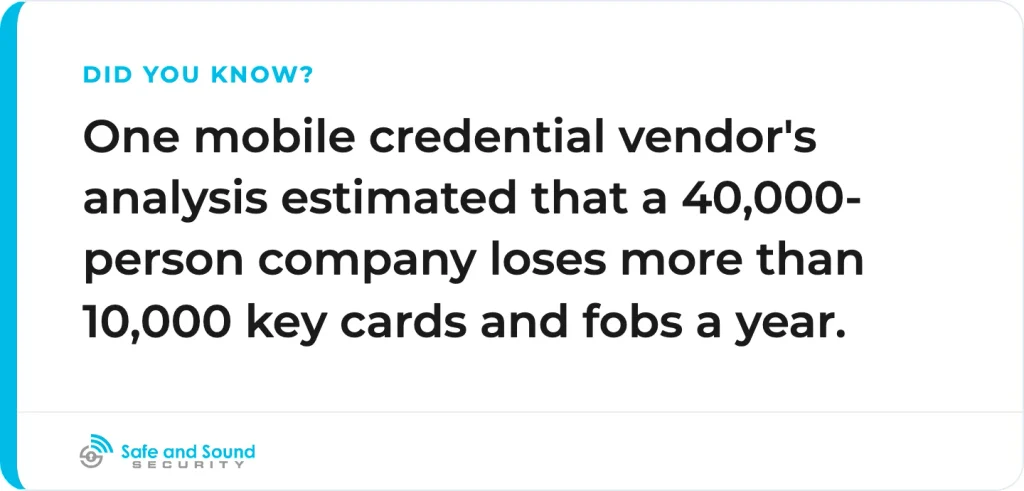
Physical cards and fobs typically run $2 to $10 each, with proximity readers around $150 to $400 per door. The visible cost is low, but the recurring cost is not. Cards are lost, damaged, and left in departed employees’ pockets, so they are repurchased constantly. One mobile credential vendor’s analysis estimated that a 40,000-person company loses more than 10,000 key cards and fobs a year (Sharry). Each replacement carries card stock, printing, and staff time. Legacy 125 kHz proximity cards also carry a security cost, since they can be copied with inexpensive, widely sold cloning devices, while mobile credentials are encrypted.
Mobile credentials invert that pattern. The reader upgrade costs more upfront, but reissuing a credential is free and instant, and there is no physical card to clone or replace. Buildings with high turnover, such as multifamily communities, warehouses, and schools, tend to recover the reader cost fastest because they reissue credentials constantly. The exact crossover point depends on your turnover rate and door count, which is why we model it per building rather than quoting a rule of thumb. For the card side of that math, see our breakdown of key card and fob system pricing.
How to Budget a Mobile Credential Rollout
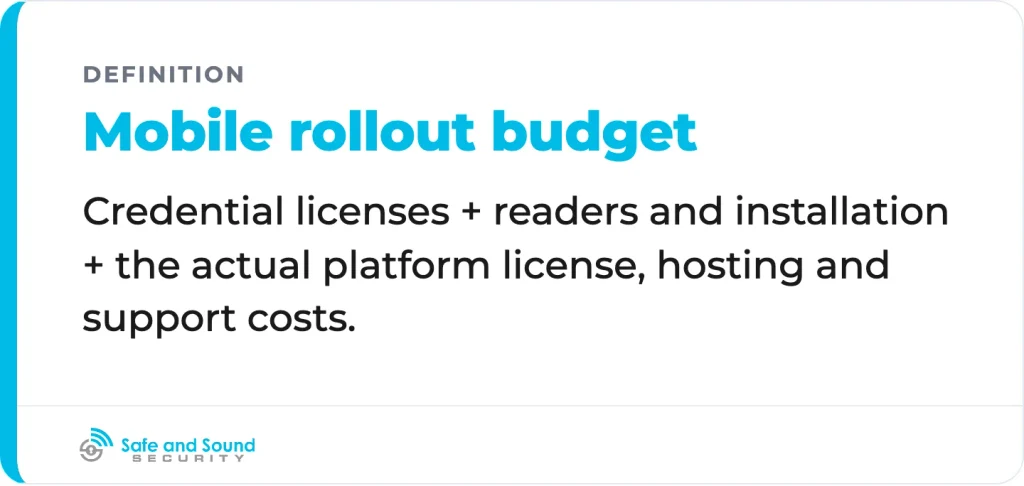
Budget a mobile credential rollout from the actual credential allowance and term, the readers and installation needed for the doors you are converting, and the selected platform’s license, hosting and support costs. A cloud per-door fee is one possible platform model, not a universal charge. Separate one-time work from annual renewals. Running it on a per-credential model and a bundled model side by side shows exactly where the two diverge.
Take a 150-person company converting 12 doors, 10 of which need new readers:
- On a per-credential platform: 150 credentials at about $4 per year is $600 in licenses, 10 readers at $350 is $3,500 in hardware, and 12 doors of cloud software at $10 per month is $1,440 a year. First-year software and licenses land near $2,040, plus the $3,500 one-time reader cost.
- On a bundled platform: credentials are $0, the same 10 readers are $3,500, and software may run higher per door to absorb the free credentials. The recurring cost shifts almost entirely to the per-door software fee.
The upfront reader cost is similar either way. The recurring cost is where the model choice shows up, and it widens as headcount grows. Platforms with quote-only pricing, including several enterprise systems, need a scoped quote to fill in the software number, but the structure of the budget stays the same.
Apple Wallet and Google Wallet: Does It Cost Extra?
Apple Wallet, Google Wallet and an access-control app can have different licensing and reader requirements. Compare the specific credential product and term, not just whether it appears on a phone. Ask the platform to identify any per-user, pack, activation or renewal charge in its quote; no universal phone-operating-system fee is established here. For example, Verkada lists its Mobile NFC product separately, at $199 USD MSRP for a one-year license covering 20 users.
How Safe and Sound Security Scopes a Mobile Credential Rollout
We scope a mobile credential project by auditing your existing readers first, then matching the pricing model to your headcount and door count. The reader fleet decides most of the budget, so we start there: doors already running a compatible Bluetooth or NFC reader may need no hardware change, while doors on legacy 125 kHz readers need a swap. We install the major mobile platforms, including Brivo, Avigilon Alta, HID, Kisi, Salto, and ProdataKey, and stay brand-agnostic so the system fits the building rather than a sales quota. You can see the platforms and credential types on our access control installation and credentials and readers pages.
Commercial buyers usually care most about the multi-site license math and the turnover savings, since a national footprint multiplies both the credential count and the administrative load. Government and education buyers add a compliance layer: federal and federally funded projects often require NDAA-compliant hardware and credentials that meet PIV or CAC standards, and we carry compliant options and are approved on more than 15 government procurement vehicles. We have delivered card readers and credentials for more than 430 customers across 1,000-plus signed projects, so the reader-and-credential sizing that sets your budget is work we do routinely rather than estimate.
Frequently Asked Questions
How much does a mobile credential cost per user?
A mobile credential costs between $0 and about $10 per user per year. Per-credential platforms such as HID Mobile Access charge roughly $4 per user per year with a 20-credential minimum, Verkada Mobile NFC works out to $9.95 per user per year at the full 20-user allowance, and bundled platforms such as ProdataKey, Kisi, and the ButterflyMX app include credentials at no per-user cost.
Are mobile credentials cheaper than key cards?
Over time, mobile credentials are usually cheaper than key cards for buildings with turnover, even though the reader upgrade costs more upfront. Cards are repurchased constantly as they are lost or left behind, while mobile credentials are revoked and reissued in software for free, so the savings grow at sites that reissue often.
Do I need new readers for mobile credentials?
Usually yes, unless your readers already support Bluetooth or NFC. Legacy 125 kHz proximity readers cannot read a smartphone, so each door that needs mobile access needs a multi-technology reader at $150 to $600. Doors already running a compatible smart reader may need no change.
Is there a monthly or annual fee for mobile credentials?
It depends on the product. Some credentials renew annually, some use one-time licenses and some are bundled into the access platform. The system itself may be cloud-managed or on-premise. Confirm both the credential term and the underlying platform’s license, hosting and support costs.
Which access control platforms include mobile credentials for free?
ProdataKey offers free, unlimited mobile credentials, Kisi includes unlimited mobile access with its door license, and the ButterflyMX app credential is free with its per-door software fee. On these platforms the cost shifts from the credential to the per-door or per-reader software.
Can I use Apple Wallet or Google Wallet for door access, and does it cost extra?
Many platforms support wallet/NFC credentials, app-based credentials or both, with different reader and phone requirements. Pricing is product-specific. Request the exact credential SKU, user allowance, term, activation and renewal fees; do not assume that a wallet option is priced the same as an app credential or that a universal phone-OS charge applies.
The Bottom Line
The cost of a mobile credential is the wrong number to anchor on. The credential itself runs from free to about $10 per user per year, but the switch is really a reader project plus the selected platform’s software and support costs, and the pricing model your platform uses decides how much you pay every year after that. Compare total cost of ownership against your current cards, weight it by your turnover and door count, and the right model usually declares itself.
Safe and Sound Security installs mobile access control for commercial and government facilities nationwide, backed by 19-plus years in business and approval on 15-plus government procurement vehicles. We size the reader retrofit and the license model to the building before a dollar is spent. If you want a scoped number for your own site rather than a range, tell us about your facility and we will put the math together.
Sources
- ID Wholesaler: HID Mobile Access License
- ID Wholesaler: HID Signo Reader
- TapeAndMedia: HID Mobile Access Enterprise Subscription
- Brivo: Security Suite Editions
- GetSCW: Avigilon Alta Mobile Credentials
- Kisi: Pricing
- Verkada: Pricing
- ProdataKey: Mobile Credentials
- Swiftlane: Key Fob Entry System Cost
- Saltopro: Salto Software Cost
- ButterflyMX: Access Control System
- Nelly’s Security: ZKTeco ZKey Mobile Credential
- ITBroker: What Are Mobile Credentials?
- Sharry: What Are Mobile Credentials?
- Salto Space: System requirements and connectivity


