
OpenEye does not publish a public price list. What you pay is assembled from two parts, a one-time hardware purchase and a recurring OpenEye Web Services (OWS) subscription, then quoted through a certified integrator based on your camera count, storage needs, and the licensing tier you choose. That is the honest answer, and it is why most pricing pages stop there.
Real cost anchors do exist. Public reseller listings put an 8-channel OpenEye recorder license near $1,050, and the OWS subscription adds a recurring per-channel cost on top of the hardware. Below is how the pricing model works, the real numbers available today, how OWS licensing and channel counting change your total, and what a complete OpenEye quote should include. Safe and Sound Security has installed OpenEye for more than 80 customers since 2021, and we scope and quote these systems as a brand-agnostic integrator.
Key Takeaways
- OpenEye has no public flat price. Cost is quoted by a certified integrator from your exact system, because OpenEye sells and prices through its partner network rather than direct to buyers.
- Your bill has two parts. A one-time hardware purchase (recorder or all-in-one Cloud Cameras) plus a recurring OWS subscription licensed per recording channel, billed monthly or annually.
- Licensing counts recording channels, not camera bodies. OWS licenses per recording channel. A third-party multisensor camera uses one license per channel, while an OpenEye multisensor camera can use as little as one license for every four channels, depending on the tier. Count channels and ask which cameras are multisensor.
- The license is not trivial. Public reseller listings put an 8-channel OpenEye recorder license near $1,050 as of November 2026, and the OWS subscription is a separate recurring line on top of the hardware.
- Ignore old camera prices. A widely repeated 2021 figure of roughly $200 to $600 per camera came from models no longer in OpenEye’s catalog. Scope from a current integrator quote, not a stale number.
How OpenEye Pricing Works
OpenEye prices every system through certified integrators, not at a fixed public rate. OpenEye is a cloud-managed video surveillance platform, built around OpenEye Web Services (OWS), and owned by Alarm.com, which acquired a majority stake in October 2019. For what the platform does and how it fits a camera system, see our OpenEye overview. This guide stays on cost.
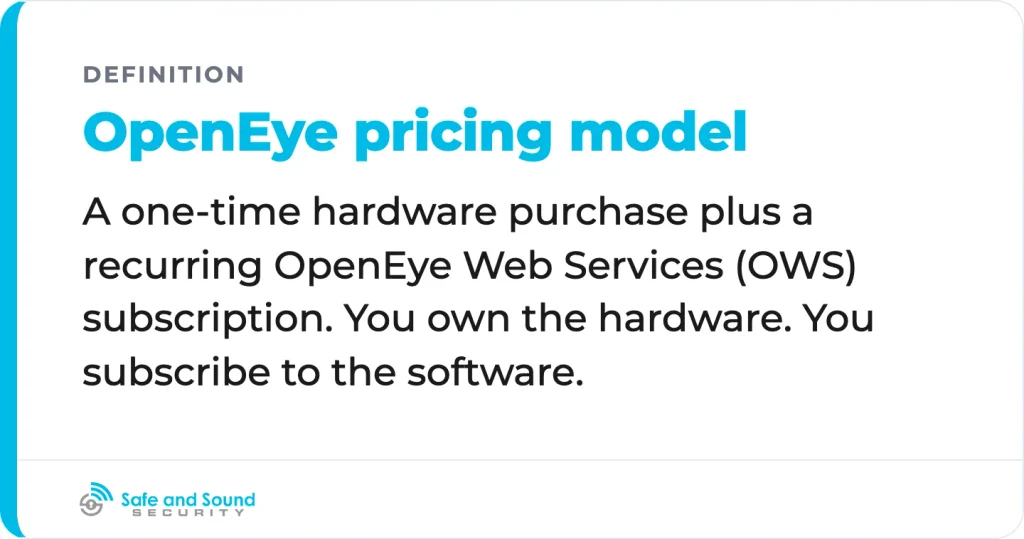
Two separate costs make up the price. First is the hardware you buy once: an OpenEye recorder (its M-Series lines) with your cameras, or all-in-one Cloud Cameras that record to onboard storage with no recorder. Second is the OWS subscription, the recurring software licensing that manages the system in the cloud, delivers updates, and unlocks features. You own the hardware. You subscribe to the software. That split is the core of every OpenEye quote, and it is the main way OpenEye pricing differs from a traditional recorder-and-software purchase.
Because OpenEye lists no prices on its own site, the figure you pay is built for your project, not looked up. The inputs are your camera count, the resolution and retention you need, the OWS tier, any AI analytics, and the install itself. The rest of this guide breaks each of those down.
What an OpenEye System Actually Costs in 2026
OpenEye publishes no list prices, but real reseller anchors exist for the hardware licensing, and they show the cost is not trivial. The clearest public number: public reseller listings put the 8-channel recorder license (model OE-ZUPNVR08) at about $1,050 as of November 2026, a figure you can check by searching that model number. Channel licenses scale up from there with the number of recording channels. These are channel-license SKUs for recorders, not the price of a finished system, and resellers set their own numbers, so treat them as a floor and confirm live figures in a quote.
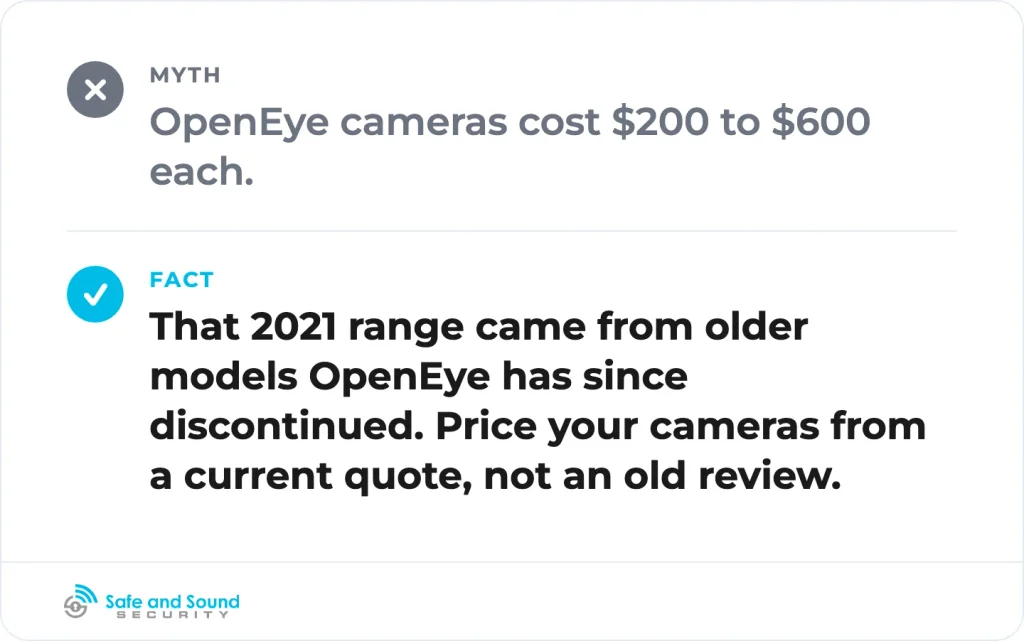
Camera hardware is where buyers most often work from stale data. A 2021 third-party review priced OpenEye cameras at roughly $200 to $600 each, and that range still circulates online. Those were older models OpenEye has since discontinued, and OpenEye does not publish current list prices for its active camera lineup. Any specific per-camera figure from a few years ago is likely a model no longer sold, so price your cameras from a current quote, not an old review.
For the wider hardware picture, retention and resolution drive more of the total than the camera sticker price. Higher resolution and longer recording both raise storage, and storage is often the largest single line after the cameras themselves. Our guide to security camera costs covers the hardware and installation side that sits underneath any cloud-video platform.
OpenEye Web Services (OWS) Subscription Tiers and Billing
OpenEye Web Services is a subscription, billed monthly or annually, and it is the recurring cost on top of the hardware. OpenEye’s own knowledge base describes OWS as an all-inclusive subscription that includes software updates and new features for the length of the term, so the platform stays current without a separate upgrade purchase. Annual and multi-year terms are typically discounted against monthly billing.
OpenEye’s licensing page sets three feature tiers, Standard, Plus, and AI Pro, and a single server supports up to 128 recording channels on every tier. The tier sets what the subscription does, not what it costs, since OpenEye quotes price per project. Higher tiers unlock more cloud features and analytics, which is where the recurring cost climbs.
| Tier | Designed for | What it adds |
|---|---|---|
| Standard | Core cloud management | Cloud management, automated software updates, up to 128 channels per server |
| Plus | Sites needing more search and events | Adds cloud event recording and License Plate recognition |
| AI Pro | Sites needing advanced analytics | Adds AI Visual Search on top of the Plus features |
Some analytics cost extra on top of the tier. OpenEye notes an additional fee for POS Connect, which ties point-of-sale data to video, and for Operational Analytics processing. License Plate recognition is included on the Plus and AI Pro tiers, and AI Visual Search is limited to AI Pro, so the analytics you need can decide both your tier and your recurring cost. Cloud retention is the other recurring driver: the longer you keep footage and the more you record to the cloud rather than the local recorder, the higher the subscription line. Our security camera cloud storage guide covers how retention length translates into cost.
How OWS Channel Licensing Counts Your Cameras
OWS licenses per recording channel, not per physical camera, and the difference shows up with multisensor cameras. A standard single-sensor camera is one channel and one license. A multisensor camera, which packs several lenses in one housing to cover a wide area, carries several recording channels, so it can need more than one license.
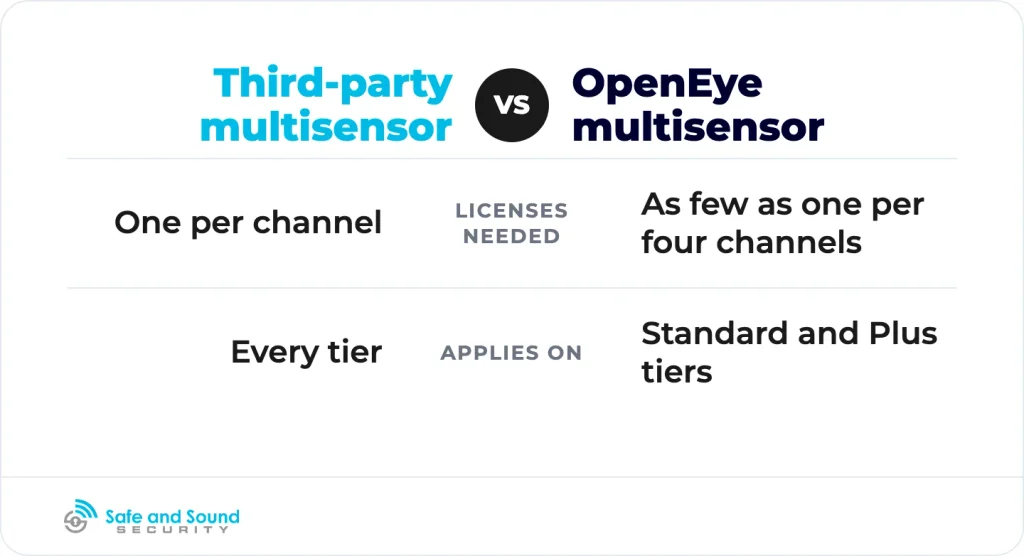
How many licenses a multisensor camera needs depends on the camera and the tier. OpenEye’s licensing page sets the ratio of licenses to recording channels: a third-party multisensor device is licensed one license per channel on every tier, while an OpenEye multisensor camera can be as favorable as one license for every four channels on the Standard and Plus tiers. The practical result: a job with 40 physical cameras is not automatically 40 licenses, and whether your multisensor cameras are OpenEye or third-party changes the math. Count recording channels, not camera bodies, and ask your integrator to show the channel and license count on the quote.
Recorder vs Cloud Camera: Two Architectures, Two Cost Shapes
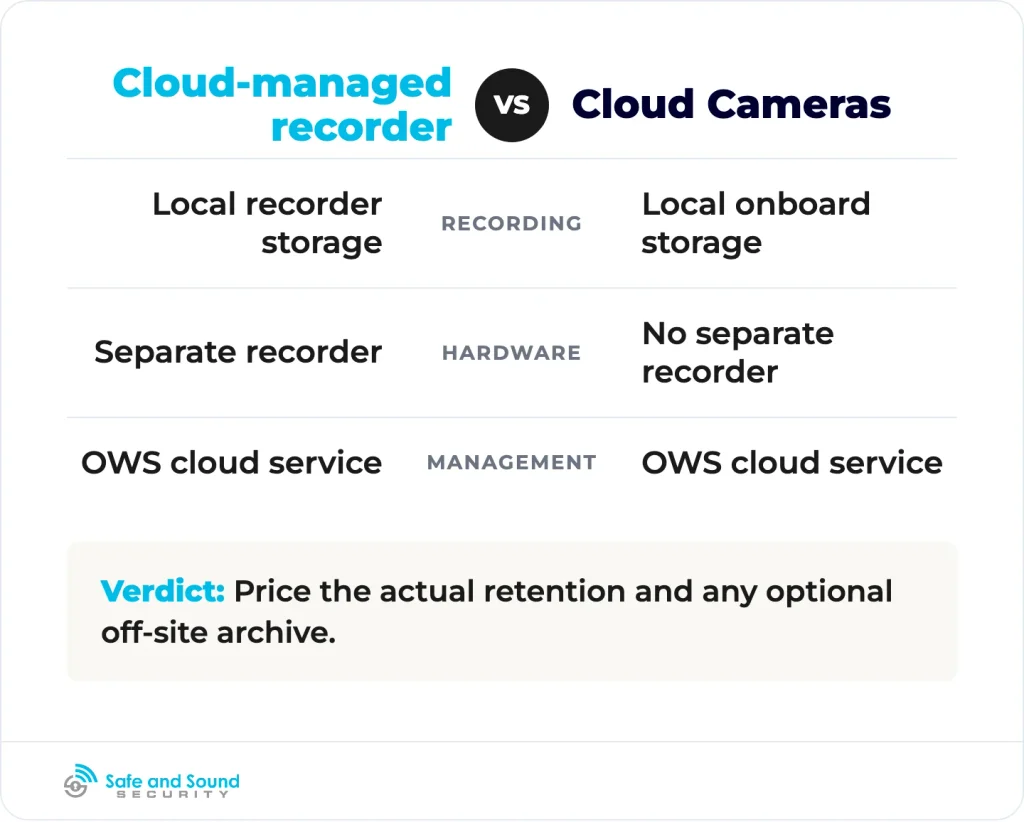
OpenEye supports two local recording designs. A recorder-based system stores video on a local OpenEye recorder and uses OWS for cloud management. Cloud Cameras combine a camera, onboard recording storage and analytics in one device, so no separate recorder is needed. The name “Cloud Camera” does not mean that continuous recording automatically moves to cloud storage.
The tradeoff is centralized recorder capacity versus storage distributed across the cameras. A recorder can suit high camera counts, longer retention or RAID requirements. Cloud Cameras reduce separate recorder hardware and management, but compare the camera’s onboard storage, supported retention and replacement cost. Both designs still use OWS subscriptions. Any optional off-site archive or clip-retention service should be itemized separately rather than assumed to be included. Our NVR vs DVR guide explains the recorder side.
What an OpenEye Quote Should Itemize
A complete OpenEye quote separates one-time hardware from recurring subscription, line by line, so you can see the real five-year cost rather than just the first invoice. A quote that bundles everything into one number hides the recurring OWS line, which is where total cost of ownership actually grows.
The lines an itemized OpenEye quote should show:
- Cameras, by model and recording-channel count, since channels drive the license count.
- Recorder or Cloud Cameras, with storage capacity sized to your retention target.
- OWS subscription, by tier and channel count, billed monthly or annually.
- AI analytics, since POS Connect and Operational Analytics carry an added fee and features like AI Visual Search require a higher tier.
- PoE network and cabling, the switches and structured cabling the cameras run on.
- Mounts and accessories, housings, brackets, and power supplies.
- Installation labor, to design, cable, configure, and commission the system.
- Support terms, including the hardware warranty period your integrator passes through.
Seeing those lines split out is also what lets you compare two OpenEye quotes fairly. The same camera count can produce very different prices depending on retention length, OWS tier, and how many recording channels the cameras carry, so a like-for-like comparison has to hold those inputs constant.
NDAA, TAA, and Where OpenEye Hardware Is Made
OpenEye’s current hardware is NDAA compliant, but NDAA compliance and TAA compliance are different standards, and the gap matters for federal and grant-funded buyers. According to OpenEye’s own country-of-origin disclosure, all OWS platform software is Made in the USA, while its recorders are assembled in the USA or made in Taiwan or Korea, and many of its current cameras are made in China yet listed as NDAA compliant. OpenEye also discloses that some of its hardware, mostly discontinued models, contains components from a company prohibited under the 2019 NDAA and should not be installed in federal applications.
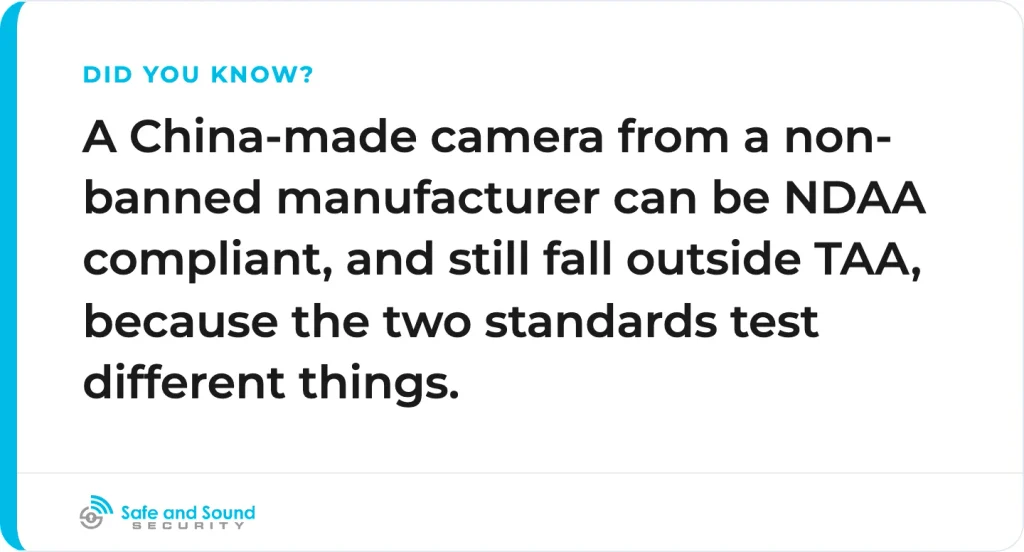
That mix is not a contradiction. NDAA Section 889 bans equipment from specific named manufacturers, Hikvision, Dahua, Huawei, ZTE, and Hytera on the FCC Covered List, not from specific countries, so a China-made camera from a non-banned manufacturer can be NDAA compliant. TAA, the Trade Agreements Act, is a separate federal standard that generally requires manufacture in the United States or a designated country. China is not a designated country, so hardware that passes NDAA can still fall outside TAA.
For a commercial project, OpenEye’s NDAA-compliant status is usually enough. For a federal contract or a grant with a TAA requirement, confirm the specific model’s country of origin before you buy, because the answer varies by product line. We help government and enterprise buyers match the right model to their compliance requirement, and our NDAA compliance guide covers the rules in full.
Why Some Buyers Call OpenEye Expensive
OpenEye earns an “expensive” label in some reviews, and the reasons trace to specific cost mechanics rather than a single high price. Some buyer reviews describe OpenEye as expensive and point to limited storage durations. The drivers behind that perception are concrete: channel licensing can push the license count above the camera count when multisensor cameras are involved, the OWS subscription is a recurring cost that never ends, and some analytics are separate add-ons that raise the monthly or annual line.
The counter-signal is worth stating too. OpenEye includes software updates and new features for the length of the subscription, so the platform stays current without a separate upgrade purchase, and the included cloud management is work a buyer would otherwise pay to run in house. Whether OpenEye is expensive for your site depends on how long you retain footage, how many recording channels you deploy, and which analytics you actually need, which is exactly why the system is quoted rather than listed.
How to Get and Compare an OpenEye Quote
An accurate OpenEye number comes from scoping the system, not from a list. That means camera and recording-channel count, the retention you need, the OWS tier and any analytics, recorder or Cloud Camera hardware, and the install itself. Those inputs are what turn the pricing model into a real quote, and they are the same inputs that let you compare two quotes fairly: hold retention, channel count, OWS tier, analytics, and warranty constant, and the prices become directly comparable.
Safe and Sound Security has installed OpenEye for more than 80 customers across 180-plus signed projects since 2021, and we quote these systems as a brand-agnostic integrator. Because we also deploy Verkada, Axis, Avigilon, and other platforms, we can scope OpenEye against your actual requirements and tell you when a different platform fits better, which you can see in our Verkada vs OpenEye comparison. For government, education, and enterprise buyers, we match NDAA and TAA requirements to the right model and handle the procurement process. When you want a real number, contact our team or see how we handle commercial camera installation.
OpenEye Pricing FAQs
Does OpenEye publish a price list?
No. OpenEye does not publish list prices on its website and sells through certified integrators, who build a custom quote from your camera count, storage, OWS tier, and analytics. Third-party resellers list some recorder license SKUs publicly, but the full system price comes from an integrator quote.
Is OpenEye a subscription or a one-time purchase?
Both. You buy the hardware once (recorder and cameras, or all-in-one Cloud Cameras), then pay a recurring OpenEye Web Services (OWS) subscription licensed per recording channel and billed monthly or annually. The subscription includes software updates for the length of the term.
Is OpenEye NDAA compliant?
Yes, OpenEye’s current hardware is NDAA compliant, including cameras made in China, because NDAA Section 889 bans specific manufacturers rather than countries. NDAA compliance is not the same as TAA compliance, so federal or grant-funded buyers with a TAA requirement should confirm a model’s country of origin before purchase.
How much does a full OpenEye system cost?
OpenEye does not publish a total system price, because it depends on camera and recording-channel count, recorder or Cloud Camera hardware, retention length, OWS tier, AI analytics, and installation. The recurring OWS subscription is a separate line on top of the hardware, so budget for both the one-time and ongoing cost in any estimate.
The Bottom Line
OpenEye has no public sticker price, but its cost is far from unknowable. The model is a one-time hardware purchase plus a recurring OWS subscription, licensed per recording channel and billed monthly or annually, with AI analytics and retention as the lines that drive the recurring total. Reseller listings put a recorder license near $1,050 for eight channels, and old per-camera figures from 2021 no longer reflect the current catalog. Treat any single number as a starting point and let an integrator confirm the real figure for your system.
Safe and Sound Security has scoped and installed commercial and government video systems nationwide for 19 years, and we have installed OpenEye for more than 80 customers since 2021 with brand-agnostic, NDAA-aware guidance. If you are pricing an OpenEye project, talk to our team for an itemized quote built around your camera count, retention, and compliance needs.


